BOOK: Bokuden Ryu Jujutsu by Otsuka Nobuyoshi; Trans. by Eric Shahan

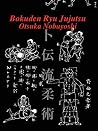
Bokuden Ryu Jujutsu: A Record of Intensive Lessons in Jujutsu with Additional Secret Teachings on ResuscitationBokuden Ryu Jujutsu: A Record of Intensive Lessons in Jujutsu with Additional Secret Teachings on Resuscitation by Otsuka Nobuyoshi
My rating: 4 of 5 stars

Translator Amazon Page

This is a manual, written in 1916, of the Bokuden Ryu school of Jujutsu. Tsukahara Bokuden was a sixteenth century samurai and is one of the most famous of Japan’s swordsmen, having been instructor to a Shogun and a Provincial Governor, and the school of Jujutsu described in this book was said to have been founded by him.

The manual mostly consists of textual and line drawn descriptions of thirty techniques of the system, mostly throws and takedowns. Each page has an English translation appended to the original manual’s text and drawings. Most techniques are explained over two or three pages (i.e. two or three drawings.) The book also includes three resuscitation techniques and a few odds and ends. There is also a nice set of atemi maps – i.e. drawings showing various vulnerable spots on the body, and a brief biography (a few pages) of Tsukahara Bokuden.

The translator points out errors in the original and corrects them in the translation (e.g. there are a couple of techniques in which attacker and defender labels are swapped.)

If you’re interested in Japanese martial arts and the evolution of Jujutsu, I’d recommend this manual. There is not a great deal of fine detail to be gleaned, but the concise descriptions do offer insights into what is unique and what is common to the system.

View all my reviews

PROMPT: Changed

Daily writing prompt
What’s a piece of media (book, movie, song) that changed how you see the world?

Leaves of Grass by Walt Whitman.

Also: Quiet by Susan Cain; Water Margin by Shī Nài’ān; and Self-Reliance and Other Essays by Ralph Waldo Emerson

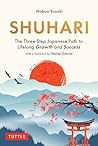
BOOK: “Shuhari” by Nobuo Suzuki

Shuhari: The Three-Step Japanese Path to Lifelong Growth and SuccessShuhari: The Three-Step Japanese Path to Lifelong Growth and Success by Nobuo Suzuki
My rating: 5 of 5 stars

Release date: August 11, 2026

I was introduced to the concept of “shuhari” as a student of Japanese martial arts, and over time I discovered it to be one of the most useful concepts for personal growth and development. Shuhari is by no means exclusive to martial arts and is applied to arts in the broadest sense — really to endeavors of any type (as is true in this book which references not only martial arts, but literary arts, graphic arts, cinematic art, and even sciences.) The idea is this: one begins by repetitively practicing what one is taught in as close to an exemplary fashion as possible (shu,) then one starts adapting the principles one has cultivated to changing and unpredictable circumstances (ha,) and finally one abandons the forms and embraces the spontaneous (ri.) In short, we follow the rules (shu,) break the rules (ha,) and abandon the rules (ri.)

Recent years have seen a flood of books on cultural life philosophies, starting and continuing with those of the Japanese culture, but venturing out into Scandinavian (Sisu and Lagom,) Goan (Susegad,) and many others. One could easily fill a shelf each with the popular books on “ikigai” or “ganbatte.” It’s kind of a surprise to see that it’s taken this long to venture into the invaluable concept of “Shuhari.” It is an idea whose time has come to go global.

In a broad sense, this is a book on learning and creativity, and I’d highly recommend it for anyone looking to reevaluate their approach to learning and / or creating.

View all my reviews

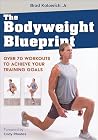
BOOKS: “The Bodyweight Blueprint” by Brad Kolowich Jr.

The Bodyweight Blueprint: Over 70 Workouts to Achieve Your Training GoalsThe Bodyweight Blueprint: Over 70 Workouts to Achieve Your Training Goals by Brad Kolowich Jr.
My rating: 4 of 5 stars

Publisher Site – Human Kinetics

This book offers a collection of exercises (and workouts built on said exercises) that require no equipment (excepting the inescapable calisthenic necessity of a bar, bars, or a safe facsimile thereof upon which one can lift one’s bodyweight.) The book does a fine job, though in a saturated market of similar books.

I’ll, therefore, talk about just a couple of ideas in this book that stood out to me as unique among the calisthenics books I’ve read. First, in the first section of the book, which lays a conceptual background for the exercises and workouts presented in subsequent sections, Kolowich explores the importance of Time Under Tension (TUT) and how it is achieved. I found this explanation valuable. Second, this book presents a much greater number of “self-resisted” exercises than I’ve seen in other books. I will need to give them a try before I comment on whether I think that is a good thing, but it was novel.

If this is your first book on calisthenics or bodyweight workouts, it’s as good as any. If you’ve read others, I can’t claim that you’re likely to find any profound revelations.

View all my reviews

BOOK: “The AI-Driven Leader” by Geoff Woods

The AI-Driven Leader: Harnessing AI to Make Faster, Smarter DecisionsThe AI-Driven Leader: Harnessing AI to Make Faster, Smarter Decisions by Geoff Woods
My rating: 4 of 5 stars

Publisher site – Simon & Schuster

As the title suggests, this is a book about how leaders can use artificial intelligence (AI) to better perform their jobs, jobs which include many aspects – not the least of which is to facilitate greater adoption of AI by their company or organization. The author’s central premise is that AI offers tremendous potential but is often underutilized because leaders have too many near term items on their plate to muck about with it. This creates a paradox in which most leaders see the benefits and would like to see greater AI adoption, but few take the time to advance that goal.

Not being a leader, I got the most out of the book’s discussion of what kinds of prompts can be used to meet various objectives in order to move AI beyond just a personable search engine that (to some degree) shows its work. However, it is intriguing to see how AI may shape various organizations as leadership changes its approach to it.

The author uses a great deal of strategic repetition to pound a few key ideas into the reader’s mind. I found this to be beneficial, but I can imagine some may find the repetition tedious.

Like it or lump it, there’s no getting around the impact of AI on our world. This is a worthwhile read to gain some insight into how that impact may play out.

View all my reviews

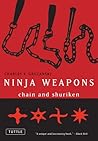
BOOK: “Ninja Weapons” by Charles V. Gruzanski

Ninja Weapons: Chain and ShurikenNinja Weapons: Chain and Shuriken by Charles V. Gruzanski
My rating: 4 of 5 stars

Online – Internet Archives

The first item to get out of the way is that this book doesn’t have a particularly apt title. The book was originally released with the more accurate (but less sexy) title, “Spike and Chain,” and then this edition came out in early 90’s when fascination with all things ninja was high. An accurate title would be “Masaki-ryu Chain Fighting Basics with Information on Throwing Blades on the Side.” But, of course, that would be a horrible, wordy, and tremendously unsexy title. Still, the bulk of the book is a description of the postures and fundamental techniques of fighting with a short weighted chain (called manriki-gusari [10-power chain] in Masaki-ryu or by the more literal kusari-fundo [chain (w/) weight,] elsewhere) and then there is a section on shuriken (throwing spikes and stars) to pad the book out into a three-digit page count needed to be a proper book back in the day.

I should point out that I don’t mean this all as a criticism. I am much more pleased with a book on Masaki-ryu weighted-chain technique than I would be with one that rambled on speculating about the vast number of weapons associated with the ninja. But it’s important to know what the book is about because if you are looking for a guide to the weapons used by ninja, you would probably find this weak sauce. First, there’s little to no mention of ninja in the text. Second, the story given for the development of the manriki-gusari is that of a gate guarding samurai, Dannoshin Toshimitsu Masaki, who didn’t want to have to sully the Imperial grounds with blood and so took up the chain as an alternative to sword fighting. Finally, while shuriken were said to be used by ninja, they were not exclusively so and the history in this book also cites Edo period samurai with developing the art.

If you are interested in Japanese weighted chain weaponry, and specifically Masaki-ryu, this is an excellent book for you. If you’re interested in throwing blades, you might be a little disappointed with how thin that part is, but it does discuss a lot of the fundamentals in a concise and practical way. If you are looking for a book on all the weapons used by ninja, this is not the one for you.

View all my reviews

BOOK: “The Writing Life” by Annie Dillard

The Writing LifeThe Writing Life by Annie Dillard
My rating: 5 of 5 stars

Publisher site – Harper

This essay lays out what it takes to write through discussion of Dillard’s first-hand experience writing. Issues discussed include the ability to not only hack away at one’s work but sometimes to wholly abandon it to restart from a blank page, the time it takes, and the need for a space of one’s own and solitude. The final chapter takes a twist, telling the story of a stunt pilot who lived in the same area as Dillard, a story that I took as an allegory for the writing life.

I’d highly recommend this book for writers, but also for those who like to read well-crafted writing.


View all my reviews

BOOK: “Food Rules” by Michael Pollan

Food Rules: An Eater's ManualFood Rules: An Eater’s Manual by Michael Pollan
My rating: 5 of 5 stars

Author’s booksite

This book consists of sixty-four rules for healthier eating / escaping modern quasi-food, most with a brief explanation or discussion of exceptions and pitfalls. It is arranged in three parts according to Pollan’s famous food haiku — i.e. “eat food // mostly plants // not too much.” While a lot of the rules are (by the author’s admission) redundant, the clever statement of varied rules keeps them from feeling stale.

Some of my favorites are:
2.) “Don’t eat anything your great-grandmother wouldn’t recognize as food.”
7.) “Avoid food products containing ingredients a third-grader cannot pronounce.”
13.) “Eat only foods that will eventually rot.”
18.) “Don’t ingest foods made in places where everyone is required to wear a surgical cap.”
31.) “Eat wild foods when you can.”
36.) “Don’t eat breakfast cereals that change the color of the milk.”
39.) “Eat all the junk food you want as long as you cook it yourself.”
40.) “Be the kind of person who takes supplements — then skip the supplements.”
47.) “Eat when you are hungry, not when you are bored.”
52.) “Buy smaller plates and glasses.”
57.) “Don’t get your fuel from the same place your car does.”

I’d recommend everyone read this book. It’s a quick and amusing read with punchy statements of food wisdom that stick in the brain.

View all my reviews

BOOK: “Night Lights” by Molnár József & Péter Szilas

Night lights (Our Budapest)Night lights by Jozsef Molnar
My rating: 4 of 5 stars

Publisher – Atlantisz

Budapest was a city on the cutting edge in the 19th century. This fact is often lost to people who today see it as a city that’s doing okay getting to its feet in the wake of the Cold War, but it’s worth noting that it was a major world capital before that. This is exemplified by the fact that Budapest had the first subway train (Line No. 1., opened in May of 1896.) It’s also seen in the subject of this book, the development of streetlights and lighting of public spaces.

This pamphlet / book of 56 pages is put out by Budapest’s City Hall and includes a great many color photos of important structures, historic and modern, from around the city (all taken at night to display said lighting.) The text covers the history of Budapest’s public lighting from a 1777 decree by Maria Theresa (ruler of the Hapsburg monarchy, 1740-1780) that set the stage for the first street lighting to the post-World War II floodlighting of major sights (e.g. Parliament and the Vajdahunyad Palace.) So, the book covers the period from gaslighting (and oil lighting) through the modern electrical grid, as well as the transition between.

I’d recommend this little book for those interested in the development of cities. It’s fascinating considering what the world was like in the absence of infrastructure that we now take for granted.

View all my reviews

BOOK: “Mallapurana” ed. by Bhogilai Jayachandbhai Sandesara & Ramanlal Nagarji Mehta

Mallapurana: A Rare Sanskrit Text on Indian Wrestling especially as practised by the Jyesthimallas (Gaekwad's Oriental Series No. 144)Mallapurana: A Rare Sanskrit Text on Indian Wrestling especially as practised by the Jyesthimallas by Bhogilal Jayachandbhai; Mehta Sandesara
My rating: 5 of 5 stars

Available online – Internet Archive

The Mallapurana is a several hundred-year-old Sanskrit manual on wrestling as practiced in India, specifically by the Jyesthimalla caste. In 1964 two scholars from the University of Baroda released an edition that included a summary and detailed elaboration for an English-language readership, written to be understood by a reader without a background in the Indian wrestling tradition. (The text does include the original Sanskrit text for those who can read it, but I can’t comment on it.)

The manual is not just a discussion of wrestling techniques. In fact, a good portion of the manual covers issues like diet, training, the rites and logistical details of wrestling matches, characteristics of wrestlers, and strategies of matches. The authors include discussions of training methods and other details. The material is presented for a scholarly audience. While the readability is not challenging, it is arranged in a way that may feel tedious for the general readership. There are occasional descriptions that may leave a general reader befuddled.

I found reading this manual to be informative. It turned me on to many ideas with which I was unfamiliar. I’d highly recommend it for those interested in wrestling, martial sports, or the evolution of fitness practices.

View all my reviews