What does it mean to be a good person?
View all responses
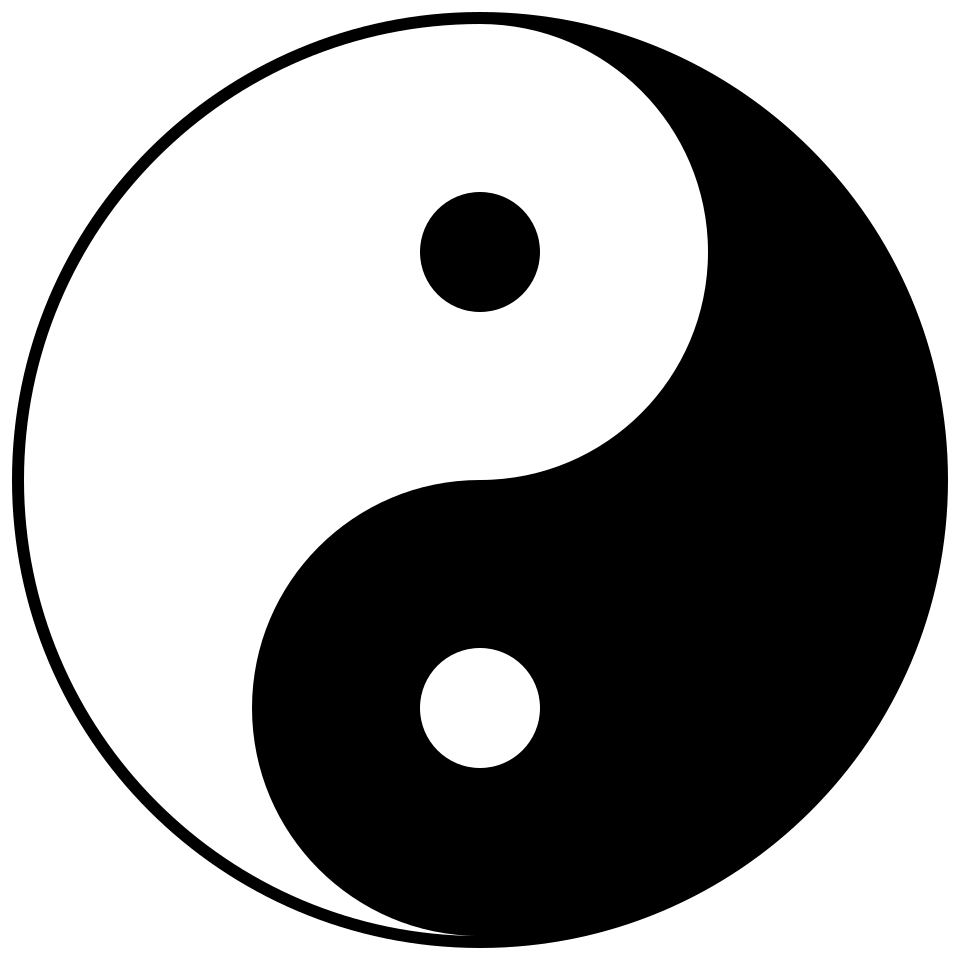
I don’t know that it has a meaning. I tend to consider dualities in Taoist terms. Every Yang has a seed of Yin; the Yang flows into Yin and back again.

What does it mean to be a good person?
View all responses
I don’t know that it has a meaning. I tend to consider dualities in Taoist terms. Every Yang has a seed of Yin; the Yang flows into Yin and back again.
What’s one thing you know now that would have saved your younger self a lot of pain?
View all responses
I believe the distinction between knowledge and wisdom is that one merely needs to be able to understand knowledge, but one must be able to live wisdom. For example, one can teach a five-year-old Jesus’ lesson about turning the other cheek, and they may understand every word but still be struggling to live it sixty years later.
My point is that I’m doubtful that knowing anything would have saved me pain because I would have had to live it, and that takes time, experience, and struggle.
What’s the best way to meet new people while traveling?
View all responses
Don’t travel in a big tour group or cruise. As a single or a couple, one can’t help but interact with locals. Stay where nationals of that country stay; eat where they eat.
What’s the most underrated life skill?
View all responses
Juggling. Because there is absolutely no way to learn it without failing thousands of times. It’s not the dexterity, but the tenacity, that is of value. Not to mention the lessons of neither rushing nor overreaching that it teaches. Some balls must be left to drop.
What’s a personal mantra or philosophy you live by?
View all responses
First, I don’t have a mantra. While I believe Transcendental Meditation to be a fine approach, other meditative techniques have resonated with me more on a personal level. Unless by “mantra” one is looking for a soundbite that encapsulates the entirety of one’s philosophical thinking — which I also do not have. (At least not a stable one.) Philosophically, I am a Traveler (or, identically – I would argue, a Student.) Epistemologically, this requires a humility about what can and can’t know (though, admittedly, not necessarily humility — generally speaking,) a willingness to empty one’s cup to allow for consideration of new information, and an openness to adopting foreign and unfamiliar ideas where they prove useful.
The genie grants you a wish. What is it?
View all responses
Oh no, I read the myth of Midas, I’m not falling for that one.
Luck, diligence, spontaneity, and inspiration
Mary oliver; A Poetry Handbook
are all needed to write a poem.
…above all let us never accept as cause for what we do not comprehend something we comprehend even less.
Marquis de sade; Juliette
…wise people don’t tell us what to do;
david brooks; How to know a person
they start by witnessing our story.
The race is not to the swift, nor the battle to the strong,
Hunter s. thompson; The Rum Diary
but to those who can see it coming and jump aside. Like a frog evading a shillelagh in a midnight marsh.
We do not see things as they are,
Anaïs Nin
we see them as we are.
If you could start a new business right now, what would it be?
View all responses
A “Human Skills for Humans School” that teaches all the important competencies that have been left out of an educational system that is 75% about making the workers of yesterday and 25% about making citizens, but which doesn’t care a whit about building emotional intelligence, self-confidence, natural setting problem solving, movement skills, creativity, primitive living, combat skills for a robot apocalypse, etc. Those worker bee skills are already starting to show their obsolescence and are very likely to continue to do so at an accelerating rate.
The bad news is that AGI and robots are sure to do almost all productive tasks better than humans by the end of the century. The good news is that we have plenty of room to be grow as a species.
What are some life hacks that you practice?
View all responses
As far as I’ve seen of so-called “life hacks” they seem to mostly be inelegant solutions for problems that either: a.) already have more reliable and tested solutions, or b.) are needlessly complicated / exaggerated to suggest they need a solution when they really don’t. The whole “life hack” industry seems to be people sitting around trying to figure out how to go viral by creating the illusion of cleverness. It is not Wú Wéi.
Do you believe in karma?
View all responses
As a general principle about how acting selflessly and as a force for good tends to help one find one’s way, YES. As a clockwork cause-and-effect accounting of one’s life activities, NO. In fact, in the latter sense, I believe the idea has quite a dark side that is frequently overlooked.


