What’s the best way to meet new people while traveling?
View all responses
Don’t travel in a big tour group or cruise. As a single or a couple, one can’t help but interact with locals. Stay where nationals of that country stay; eat where they eat.

What’s the best way to meet new people while traveling?
View all responses
Don’t travel in a big tour group or cruise. As a single or a couple, one can’t help but interact with locals. Stay where nationals of that country stay; eat where they eat.
If aliens arrived tomorrow, what’s the first thing you’d ask them?
View all responses
Do you speak English? 你会说普通话吗?¿Hablas español?
Alternatively, do you have a spare Babel Fish?
Anything else seems pretentious. I certainly don’t speak Alpha Centaurian.
What’s a personal mantra or philosophy you live by?
View all responses
First, I don’t have a mantra. While I believe Transcendental Meditation to be a fine approach, other meditative techniques have resonated with me more on a personal level. Unless by “mantra” one is looking for a soundbite that encapsulates the entirety of one’s philosophical thinking — which I also do not have. (At least not a stable one.) Philosophically, I am a Traveler (or, identically – I would argue, a Student.) Epistemologically, this requires a humility about what can and can’t know (though, admittedly, not necessarily humility — generally speaking,) a willingness to empty one’s cup to allow for consideration of new information, and an openness to adopting foreign and unfamiliar ideas where they prove useful.
What’s the best way to explore a new city?
View all responses
On foot, with few objectives locked in, and with a willingness to adjust to opportunity.
In other words, you should never be so obsessed with what a place once was that you miss that it still is — i.e. jumping around from ruin to ruin and never interacting with living natives.
My bar for a place to feel like home is that I don’t have to think every time about where I will eat or do my laundry. So, I’ve had this a number of times in a number of countries in which I had access to a kitchen(ette) and a washing machine.
So far, life is the longest trip I’ve ever taken. The challenge of this question is knowing what counts as a “trip.” I lived in India for over 12 years? Was that a trip? It didn’t feel like it. It felt like my home was in a different country. I think I once spent about two months one Summer in Hungary back in the 90’s? Was that a trip or family time? I’ve spent about a month (just under what would be required to do a “visa run” — more of a fresh stamp run) in Thailand. I suspect the latter is what the question aims at. While I’m pretty far toward the traveler end of the Traveler – Tribesman continuum, 30 days moving about without being someplace that feels home-like is where it starts to wear on me. (Of course, being a traveler, any place can feel homelike if I don’t need to think about where to eat on a daily basis or how to do laundry on a weekly basis.)
Of course, maybe the question is drug related. In which case, I once had psilocybe mushroom tea, and that trip lasted about five hours?
What’s your best tip for budget travel?
Learn to love living lean.
What’s something you do completely differently from how you were raised?
Travel.
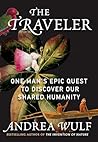 The Traveler: One Man’s Quest for Humanity from the South Seas to Revolutionary Paris by Andrea Wulf
I’m not big on tabulating the “best” this or that. It feels like it hamstrings experience and puts one in a comparison mode in which one is always living half in the past. If it looks good, eat it, and then move on to the next experience — giving that experience your presence.


