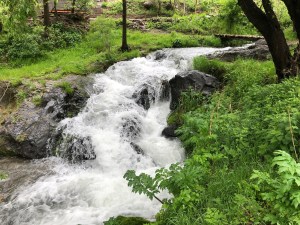
No. I do not think everything happens for a reason, but I do think it is beneficial to see the positive in challenging life events. Both approaches serve to keep one from feeling victimized by life, but the latter doesn’t require that one believe in some grand architect twiddling the dials on one’s life events — and isn’t a Panglossian rationalization.
Tag Archives: Taoist Philosophy
PROMPT: Erase
I’ll preface my comment by saying this kind of thinking is fraught with peril. The law of unintended consequences makes knowing whether one’s counterfactual would produce the intended results impossible.
For example, in the US (and some other countries of the developed world,) there has been a proclivity to run up massive debt — both budget and trade. In the US, servicing debt has passed defense spending and (given current trends) will surpass entitlements to become the largest component of the Federal deficit. I am among those who think this will probably end catastrophically, given the complete lack of effort to correct the situation. (Jaw-jacking and firing civil servants whose salaries make up a pittance in comparison to interest payments — while building yet more debt-inducing budgets — has [unsurprisingly] not proved useful.)
So, this is definitely a trend I wish didn’t exist, but almost certainly the American and world economies would not be as well off to date as they are had this trend been kept in check, and it’s possible something might be figured out that allows a softer landing than I presently expect. The old man lost his horse. Good news? Bad news? Who’s to say?
PROMPT: Chapter
Chapter 7. Chapter 8.
NOTE: Incidentally, I would not title a chapter of my memoirs “The Hard Years,” so as to avoid the assumption that that was when I worked in porn. People would either skip said chapter… or skip to it.
PROMPT: Happiness
That it’s a worthy object of pursuit, as if it is a stable state. I think both the Taoists and the Buddhists have instructive views on the matter. In Taoism, the Yang contains the seed of Yin and one flows inexorably into the other. In this view, the rock bottom worst life has to offer is a time to rejoice because the light will follow. Whereas, when one thinks life is the best it can get, a fall will come. As for Buddhism, our happiness may reflect an illusion that we’ve momentarily achieved our desires, when desires are inherently great white whales. Aim for contentment. Experience happiness when it comes.
BOOK: “Saiweng Lost His Horse” [塞翁失马] by Qixia Yu
Saiweng Lost His Horse 塞翁失马: A Story about Life and Values by Qixia YuMy rating: 5 of 5 stars
Author Amazon Page
This bilingual illustrated book tells the famous Taoist story often referred to as “good news? bad news? who’s to say?” (or words to that effect.) The story, originally contained in the Huainanzi (i.e. The Book of Master Huainan,) shows a wise old farmer subjected to the ups and downs of life. The old man’s neighbors are always surprised when the farmer neither celebrates positive events or bemoans negative ones — realizing the truth contained in the taiji symbol (yin / yang symbol) that the seed of the light is always in the dark and vice versa.
The book contains text in Simplified Chinese, pinyin, and English. It also has pretty illustrations. It’s very kid’s book-like (i.e. short, illustrated, and formatted as such;) though the story, itself, is not particularly juvenile.
I was surprised when this would not open on my laptop “Kindle for PC” reader as another book in this series had. (I like to read illustrated works (and Chinese writings) that way as it’s generally easier to take in than on my phone or Kindle because the big screen is easy to see and enlarge as necessary. That said, I was quite pleased with the ease with which I could magnify the text on my Kindle device. I had none of the frustration reading it on Kindle that I frequently have had with graphic novels and such in the past.
I enjoyed reading this story and found it quite helpful to me as a Chinese language learner. I’d highly recommend it for those learning to read Chinese.
View all my reviews
PROMPT: Any Philosopher
Diogenes the Cynic would be a hoot. Alternatively, Zhuangzi (莊子.) Obviously, my tastes run toward a philosopher that could teach me about how to be free, rather than to teach me some sort of rigorous approach to thinking. I’m stocked up on the latter, but in deficit of the former.
(I’m assuming this to be a “living or dead” question scenario. Usually, I prefer to talk to the living, but I don’t think modern academia has been good to the crazy sage philosopher. I might be able to find a Daoist hermit in a cave somewhere or maybe a Tibetan Nyönpa, but I couldn’t say what his or her name would be.)
PROMPT: Every Day
Be spontaneous.
Nameless / 无名 [Lyric Poem]
PROMPT: Positive Events
Positive? Negative? Who’s to say? Like the Taoist farmer, I’ll withhold judgement.
Surrender [Lyric Poem]

Let the flood sweep
one away — out
of the shallows,
into the deeps.
Don’t ever cry;
Don’t ever weep;
Just feel the speed
Carry one on.

![Photograph taken in Hualien, Taiwan at the Hualien Temple and Dongjing Temple (花蓮寺東淨寺) [Buddhist.]](https://berniegourley.com/wp-content/uploads/2026/03/img_1218.jpg?w=300)