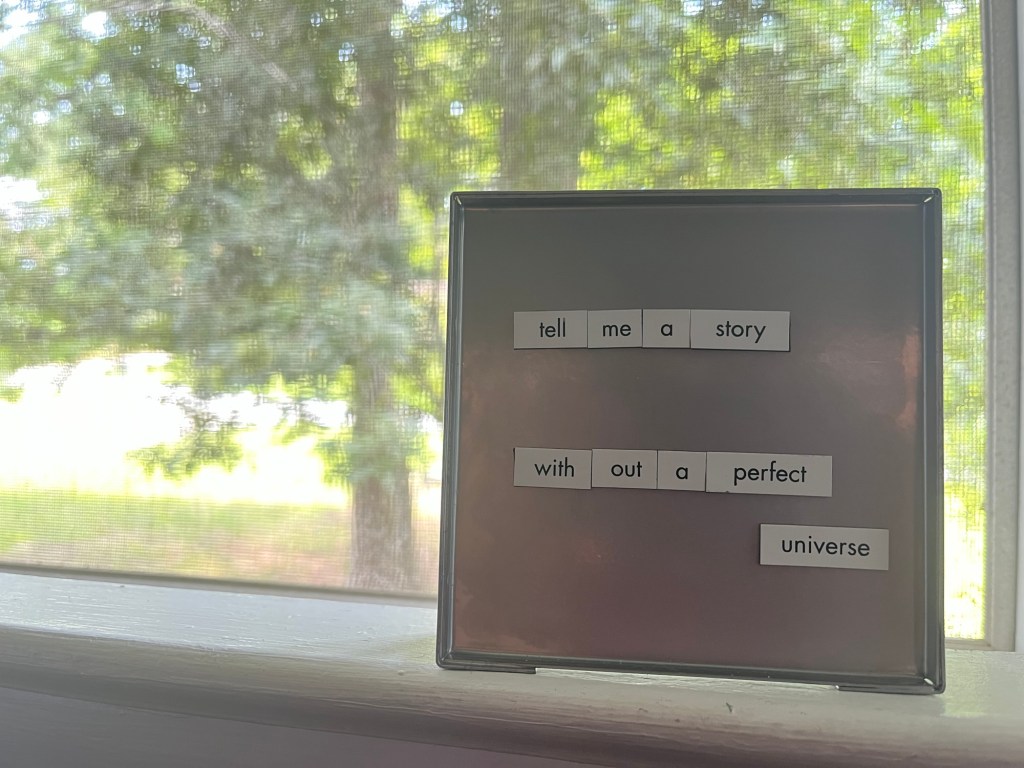
Story [Free Verse]
Reply


I have them all the time. When I was actively working on lucid dreaming / dream yoga, I was particularly attuned to them (as the practice necessitates.) The most common instance is when one sees something in one’s environs that one has never noticed before. It would happen all the time when I was living in Bangalore because it was such a visually chaotic and rapidly changing place that I could walk down a street ten times and not notice an unusual sign or building facade, and then — POW! — the moment I saw it I was in utter disbelief that it could have been their all the time.
I haven’t discounted (nor accepted) the simulation hypothesis, and I suspect whatever the world is, it’s not precisely any of the things we’ve thought it to be.
The aim of introduction is to conceal a person’s identity.
George Mikes, How To Be an Alien
From the beginning our philosophers have tried to teach us how to die,
Jonathan weiner, Long for this world
and our poets have taught us that to contemplate death
is to learn to live.
Nothing is harder to see into than people’s natures.
Zhuge liang [a.k.a. Kongming], The WAy of the General
To know how to eat is to know how to live.
Auguste Escoffier
Reality can be beaten with enough imagination.
Mark twain
Take this kiss upon the brow!
And, in parting from you now,
Thus much let me avow --
You are not wrong, who deem
That my days have been a dream;
Yet if hope has flown away
In a night, or in a day,
In a vision, or in none,
Is it therefore the less gone?
All that we see or seem
Is but a dream within a dream.
I stand amid the roar
Of a surf-tormented shore,
And I hold within my hand
Grains of the golden sand --
How few! yet how they creep
Through my fingers to the deep,
While I weep -- while I weep!
O God! Can I not grasp
Them with a tighter clasp?
O God! can I not save
One from the pitiless wave?
Is all that we see or seem
But a dream within a dream?
Plain and simple words are chosen,
Even to express tangled thoughts.
Then one comes upon a hermit,
And one glimpses the heart of Dao.
The clear stream burbles its soft song
Amid the shady ancient pine grove.
A woodsman passes with his cordwood;
A stranger listens to a lute song.
A strong feeling takes one over,
Bringing with it bliss and wonder,
And one's easy link with heaven
Is tender as the sound of water.
NOTE: The late Tang Dynasty poet, Sikong Tu (a.k.a. Ssŭ-k‘ung T‘u,) wrote an ars poetica entitled Twenty-Four Styles of Poetry. It presents twenty-four poems that are each in a different tone, reflecting varied concepts from Taoist philosophy and aesthetics. Above is a translation of the eighteenth of the twenty-four poems. Translated titles vary — e.g. Herbert A. Giles titled this translation “Actualities.”
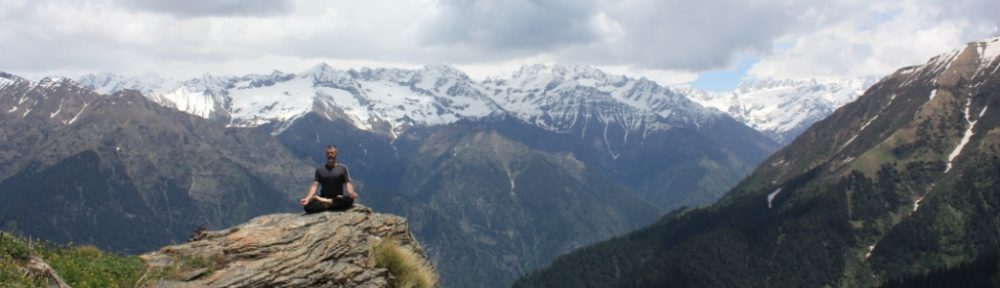
Climbing a mountain, I feel like I've escaped Plato's cave. My senses reel as though they're a crew of newly freed slaves. The sky is bluer, rivers green, each grit granule is clear. And even at the very edge, there's ease in feeling fear. By "ease" I mean not frozen stiff, but like a friend so dear that one can take one's grand peril, a gift received with cheer. Take me to the mountains, I say, where it's serene and real, and I can open up my sight to a world that's ideal.