PROMPT: First Time

Daily writing prompt
What’s a book, movie, or TV show that you wish you could experience again for the first time?

I would not be the same person. It would not be the same book.

PROMPT: Perfect Series Finale

Daily writing prompt
What’s a show that had the perfect series finale?

M*A*S*H

PROMPT: Movies or TV Series

Daily writing prompt
What movies or TV series have you watched more than 5 times?

Kung Fu Panda, Kung Fu Hustle, and The Matrix. Together, they contain the sum of all wisdom.

PROMPT: Cartoon

Daily writing prompt
What’s your favorite cartoon?

Currently, probably Rick & Morty. In my youth, I was Looney Tunes over Hanna Barbera, especially Roadrunner, Yosemite Sam, and Marvin the Martian.
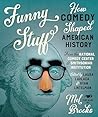
BOOKS: “Funny Stuff” ed. by Laura LaPlaca and Ryan Lintelman

Funny Stuff: How Comedy Shaped American HistoryFunny Stuff: How Comedy Shaped American History by Laura LaPlaca
My rating: 4 of 5 stars

Publisher Site — Rutgers University Press

Release Date: May 12, 2026

As the subtitle suggests, this book explores the nexus between American History and comedy across many, varied media (i.e. writing, theater, standup, improv, radio, television, movies, etc.) It’s an interesting book, but I don’t know that it has the right title. Considering the title, a reader might expect a fuller coverage of American History, drawing on whatever humorous outlets existed at the time (e.g. op-eds and satirical articles.) This book is more of a history of comedic content in the US with a substantial discussion of how comedy addressed / participated in changing views on sex, race, and sexuality and with occasional mention of how comedy was involved in other social issues, such as changing views on free speech and expression. You’re not going to learn how comedic writers addressed Smoot-Hawley or the Sinking of the Maine. (i.e. The book leads with comedic content and leans the discussion toward societal influence [rarely toward policy influence.] It does not lead with historical events and draw on appropriate comedic content.)

The book covers a lot of the same ground as Kliph Nesteroff’s The Comedians, though with quite different emphases. Nesteroff focuses on the gritty underside of comedy and the oft unseen dark side of comedians, while this book focuses on comedy as a factor in changing views on race and sex [as well as on the changing technological outlets for comedy.] Funny Stuff does spend a little more time on pre-20th century America than does Nesteroff, but not much more. Both books are heavily weighted toward the late 20th century to present. To be fair, there is much more volume of comedic output in this period. (That said, there were artists I expected coverage of, e.g. Josh Billings, that weren’t included. That’s where the book seems more like a history of comedy and its varied outlets.)

If you’re interested in the development of comedy in America, and its influence on social issues — most extensively attitudes towards race — I’d recommend this book.

View all my reviews

PROMPT: TV Shows

Daily writing prompt
What TV shows did you watch as a kid?

Andy Griffith Show, Carol Burnett Show, Dick Van Dyke Show… wow, they were not creative with names in those days.

PROMPT: Rewatch

Daily writing prompt
What movies or TV series have you watched more than 5 times?

No TV series. Though there might be episodes of “Seinfeld” that I’ve seen that many times (but others I may have never seen at all.)

Re: Movies: “Kung Fu Hustle,” “The Matrix” (the first one,) and “Kung Fu Panda” (the first one.) Nothing else comes to mind, but there probably are some. (Back from the days when cable ran the same content over and over.)

Five times is a lot of times to watch the same thing. If it’s really good, it will be too mentally / emotionally draining to watch repeatedly. And if it’s too bad, it will be tedious to do so. It needs to be in the sweet spot of light, but incredibly entertaining.

PROMPT: Leisure Time

Daily writing prompt
What do you enjoy doing most in your leisure time?

That’s trickier than it seems. I quite enjoy reading and many forms of bodily movement activities (e.g. swimming, yoga, taiji, qigong, exercise, etc.,) but I’d count them more as personal development activities than leisure activities. (Even something as seemingly non-purposeful as juggling.) I sometimes watch TV / movies, but I don’t know that I’d say I enjoy that so much as find it an opportunity to zone out.

PROMPT: Rewatched

Daily writing prompt
What movies or TV series have you watched more than 5 times?

Movies: The Matrix (1999), Kung Fu Hustle (2004), and – possibly – The Dark Knight (2008) and Inception (2010). [Really, I could watch any Christopher Nolan film more than once (and probably need to in order to fully get them.)]

TV Series: None. I can’t think of a series that I’ve watched more than once — except maybe in reruns as a kid, watching episodes out of sequence and on a hit or miss basis.

BOOKS: “The Comedians” by Kliph Nesteroff

The Comedians: Drunks, Thieves, Scoundrels, and the History of American ComedyThe Comedians: Drunks, Thieves, Scoundrels, and the History of American Comedy by Kliph Nesteroff
My rating: 5 of 5 stars

Amazon.in Page

This book presents a fascinating history of standup comedy and the various ancillary activities that comedians have taken on to make ends meet, to advance their careers, and – in a surprising number of cases – to pay for drugs — e.g. from writing to radio and television performances to hosting interview shows. The book’s exploration runs from the days of Vuadville to today’s world of Twitter and podcasts.

The book reveals a great deal about which readers may be unaware. If you, like me, watched The Marvelous Mrs. Maisel and wondered whether the mob was really that involved in the entertainment industry, turns out, they were. In fact, Nesteroff addresses the violence and threats experienced by comedians in a way that is much more explicit than in that TV show. There are tales of early insult comedians running afoul of wiseguys who were in the audience unbeknownst to the comedian. There is even a chapter devoted to the building of Las Vegas to meet certain needs of organized crime, as well as discussion of the mob’s decline (or, perhaps, legitimization) in the industry.

Another discovery that was interesting to me was how wild some of the early comedians were, both in their stage and in their personal lives. There were a number of names that were familiar to me from re-runs of highly censored network television programs. I’d wrongly assumed that these individuals were as bland and wholesome as their on-air personas. Buddy Hackett is a prime example of someone who wasn’t at all what I expected.

It’s remarkable to see how many ups and down standup comedy has had in its relatively short life span — cycles of boom and bust.

If you’re interested in standup comedy and how comedy has progressed as a form of entertainment in America, I’d highly recommend this book.

View all my reviews