BOOK: “How to Know a Person” by David Brooks

How to Know a Person: The Art of Seeing Others Deeply and Being Deeply SeenHow to Know a Person: The Art of Seeing Others Deeply and Being Deeply Seen by David Brooks
My rating: 5 of 5 stars

Publisher – Penguin Random House

This book’s subtitle, “The Art of Seeing Others Deeply and Being Deeply Seen,” gets pretty well to the crux, and among that mouthful the word that repeats, “Deeply,” is not to be overlooked. Brooks noticed that while on some level we are more readily connected than ever, there is also an epidemic of loneliness and personal dissatisfaction in the world the likes of which has never before been seen (and so that level on which we are hyper-connected must in some way be defective.) Brooks argues that most of us would benefit from a sea change in our approach to conversation, from asking more and better questions, from listening more carefully, from understanding how the other person’s world framing is different from one’s own, and from changing our conversational objectives (from things like making oneself look good or meeting societal conventions to making our interlocutor feel seen and worthing of one’s time and one’s interest.) In short, we should strive to be what Brooks calls “illuminators.”

The book devotes some special attention in its middle section to negotiating conversations that are difficult — how one can do a better job showing acknowledgment of one’s interlocuter’s perspective while in the same interaction expressing one’s own feelings and ideas.

I found this book to be highly engaging and perspective changing. Brooks uses fascinating and emotionally salient stories from the world, from his own life, and even from fiction. He also uses humor, anecdotes, and quotations to great effect. I learned a great deal from reading this book and would highly recommend it for anyone interested in being a better friend and conversationalist.

View all my reviews

PROMPT: Healthy Boundaries

Daily writing prompt
Write your guide to setting healthy boundaries in relationships.

1.) Close the bathroom door when you poop. (Especially when your spouse is having company over… or is on a Zoom call.)

PROMPT: Neighbor

What makes a good neighbor?

Neither a borrower, nor a lender be… plus, has good judgment about when to call the cops.

BOOKS; “Rental Person Who Does Nothing” by Shoji Morimoto

Rental Person Who Does NothingRental Person Who Does Nothing by Shoji Morimoto
My rating: 5 of 5 stars

Publisher Site — Harper Collins

This quirky little book is the memoir of a man who formed a business lending himself out as “rental person who does nothing.” At the time the book came out, Morimoto did this without charging his “customers” anything except travel expenses and any food and beverages consumed as part of the activity in question. [As I understand it, he eventually began charging a per session fee ($85 USD at the time of the 2022 BBC piece on him that I watched.)] The book does discuss Morimoto’s thoughts about how to charge (i.e. hourly or per session,) how much to charge, whether to find a different financing model (e.g. sponsorship or patronage,) and why he ultimately rejected them all (at least for a time.) In fact, the whole penultimate chapter (ch. 4) is about the economics of his business.

The most interesting aspect of the book is the psychological insight on offer. The first question that arises is why people would use a stranger for these activities, and not a friend. One might jump to the conclusion that the people who use his service have no friends, but this is generally wrong. There are a number of reasons why people who have friends use his service. First, many times friends can’t just sit and listen empathetically, but rather they have to try to solve the problem. This can be irritating because it is often dismissive of the challenges confronting the other person. But also, as Morimoto points out, it also creates a hierarchy (a top dog) in what would otherwise be a co-equal relationship. A fascinating second factor pointed out by the author is that adults, unlike children, rarely have general-purpose friends. Adults, instead, have contextual friends. So, if one wants to engage in an activity that is outside the domain of one’s contextual (work, bar, hobby, etc.) friendship, it might not be easy. There are many other psychological insights relating to what people ask him to do, the issue of reciprocity, and what Morimoto defines as “doing nothing” for the purposes of this business.

I found this quick and simple book to be packed with insights into human nature, and I’d highly recommend it for readers interested in what makes people tick.

View all my reviews

PROMPT: Personality Trait

Daily writing prompt
What personality trait in people raises a red flag with you?

Dogmatic thinking and the humor blindspots that correspond.

PROMPT: Good Life

Daily writing prompt
What are the most important things needed to live a good life?

Right mind, healthy body, and good company.

PROMPT: Friend

What quality do you value most in a friend?

The ability to converse intelligently on a wide range of subjects.

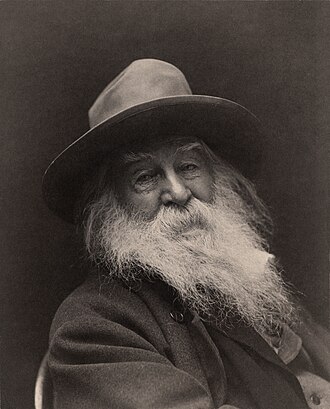
“Are you the new person drawn toward me?” by Walt Whitman [w/ Audio]

Are you the new person drawn toward me?
To begin with, take warning, I am surely far
different from what you suppose;
Do you suppose you will find in me your
ideal?
Do you think it so easy to have me become
your lover?
Do you think the friendship of me would
be unalloy'd satisfaction?
Do you think I am trusty and faithful?
Do you see no further than this facade,
this smooth and tolerant manner of me?
Do you suppose yourself advancing on real
ground toward a real heroic man?
Have you no thought, O dreamer, that is
may be all maya, illusion?

“I Sing the Body Electric” [4 of 9] by Walt Whitman [w/ Audio]

I have perceiv'd that to be with those l like
is enough,
To stop in company with the rest at evening
is enough,
To be surrounded by beautiful, curious,
breathing, laughing flesh is enough,
To pass among them or touch any one, or
rest my arm ever so lightly round his or
her neck for a moment, what is this then?
I do not ask any more delight, I swim in it
as in a sea.

There is something in staying close to men
and women and looking on them, and in
the contact and odor of them, that
pleases the soul well,
All things please the soul, but these please
the soul well.

“A Poison Tree” by William Blake [w/ Audio]

I was angry with my friend;
I told my wrath, my wrath did end.
I was angry with my foe:
I told it not, my wrath did grow.

And I watered it in fears,
Night & morning with my tears:
And I sunned it with smiles,
And with soft deceitful wiles.

And it grew both day and night.
Till it bore an apple bright.
And my foe beheld it shine,
And he knew that it was mine.

And into my garden stole,
When the night had veild the pole;
In the morning glad I see;
My foe outstretched beneath the tree.