Anything but myself. Unfortunately, that seems to be the main mode of social discourse in the world. People mostly want to hear enough about me that they feel justified in telling me more about them. I’m an ideas guy: philosophy, science, literature, technology, economy, international affairs, etc. (Also, travel, but that only works with travelers — a tiny segment of the population.)
Category Archives: science
PROMPT: Never Want to Visit
The molten core. Because it’s not a dry heat.
PROMPT: Don’t Understand
The substance of financial crises. Not to mention Quantum Mechanics and Calculus. Really, there’s virtually nothing that most people do understand. Have you met most people? They’re kind of dim.
But seriously, the thing that has been striking me lately is how often zero-sum thinking is applied to non-zero-sum games. Put simply, people often believe they are in a situation in which every gain by someone else corresponds to a loss for them, when that is often not the case. Manipulation to convince people otherwise is in full swing. People are being led to believe they have to worry if others are complimented or are doing well because it reflects poorly on them, when — in fact — it does not (necessarily.)
Orbit [Haiku]
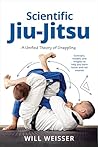
BOOK: “Scientific Jiu-jitsu” by Will Weisser
Scientific Jiu-Jitsu: A Unified Theory of Grappling by Will WeisserMy rating: 4 of 5 stars
Publisher Site – YMAA Publication Center
Release date: June 2, 2026
This book outlines principles of positioning, alignment, and movement used to gain advantage while grappling. It is not a technique-centric book but rather is a concept-centric one. Weisser does for Brazilian Jiu-jitsu what Jiichi Watanabe and Lindy Avakian did for Judo with their book alternatively titled The Secrets of Judo or The Art and Science of Judo. Watanabe and Avakian focused more on both technique and elementary physics than does Weisser, but there is common ground in ideas of what positions make a body strong and what movements bring vulnerability. The biggest area of divergence between Watanabe’s book and Weisser’s is simply the difference between Judo and Brazilian Jiu-jitsu. Watanabe and Avakian direct the vast majority of their attention to how one gets the opponent to the ground and relatively little on what to do when one gets there, and Weisser’s book is the other way around — i.e. primarily assuming at least one person is already on the ground.
Weisser’s book does assume that the reader has a background in Brazilian Jiu-jitsu, using terms specific to that system without necessarily providing elaboration. I say this just to point it out as (to be fair) I realized that I would have thought nothing of it if it used Japanese Jujutsu / Judo terminology in the same way. (I did have to go to Google at one point to elucidate what turned out to be a Dragonball-Z reference that went right over my head.)
Weisser’s book uses a combination of graphics, including photographs. I found it easier to see the linkage between what the author was describing in the text and what was in the photos in some cases than in others. Often, there was a single photo catching one static situation, and if the grapplers were closely entangled (as grapplers are want to be,) it was not so easy to see — even with different colored uniforms. [Note: I should point out that I was reading an ARC galley, and so that may all be sorted in the final formatting.]
As one who knows little of Brazilian Jiu-jitsu, but with some experience with other grappling systems, I found this book readable and thought-provoking. The statement of ideas is clear, and I’d recommend it for grapplers looking to engage in thinking about first principles of grappling.
View all my reviews
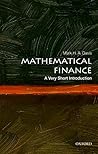
BOOK: “Mathematical Finance: A Very Short Introduction” by Mark H. A. Davis
Mathematical Finance: A Very Short Introduction by Mark H.A. DavisMy rating: 4 of 5 stars
Publisher Site – OUP
This is Oxford University Press’s Very Short Introduction to the field of the “Quants,” individuals who apply mathematics to questions of how to value financial assets and assess risks. The book begins by laying out how banking and financial markets work, then discusses how interest rates are determined, and then explores the quantification of various risks faced by lenders. The book finishes by discussing how the 2008 financial crisis impacted the field and how it operates in the wake of that event. (The 2008 crisis was described in an intriguing fashion in the book and movie The Big Short. It basically resulted from deceptive grading of mortgage-backed securities such that investors who thought they had the ultimate default-proof asset in fact had assets that not only could collapse, but — in fact — were bound to.)
Even though this book is a concise introduction, it shouldn’t be confused for a simple guide. It is not only mathematically intense but also jargon dense. It’s not a complete waste for someone without any advanced mathematics and / or economics / finance background to read, but there will be large patches that will likely be lost on one. (And if you’re not at all used to reading scholarly writing, it may be excessively daunting.)
If you want a quick guide to the field of quantitative finance, and you have an understanding of the mathematical notation used in calculus and statistics, I’d recommend this book. If you are interested in the topic but aren’t at all mathematical, you might start elsewhere (the aforementioned, The Big Short, might be a good place.)
View all my reviews
PROMPT: Favorite Month
Northern or Southern hemisphere? Landlocked or coastal? Temperate or Equatorial? I need more information.
PROMPT: Famous or Infamous
The most famous people I’ve met are famed for their scholarly or political contributions to society, which is to say 98% of the population have never heard of them.
What I am really sad to say is that I’ve never met anyone truly infamous. I keep hoping one of those scientists will turn evil, but they just stay nerdy.
PROMPT: Podcasts
I don’t properly listen to any, but I watch clips and segments from many on YouTube — mostly those of comedians, but some of a popular science or current events / international affairs / macroeconomic nature.
DAILY PHOTO: Science City, Kolkata