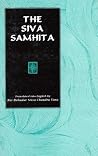
BOOK REVIEW: “Siva Samhita” Trans. by Srisa Chandra Vasu

Siva Samhita (English and Sanskrit Edition)Siva Samhita by Rai Bahadur Srisa Chandra Vasu
My rating: 4 of 5 stars

Available online

This book is considered to be one of three surviving classic texts of Hatha Yoga. (The other two being Hatha Yoga Pradipika [probably the most famous of the three because of a popular translation and commentary put out by the Bihar School] and The Gheranda Samhita.) Siva Samhita distinguishes itself among the three. It puts less emphasis on discussing technique (with the possible exception of Mudra, which — like the other two — it explores in depth, covering nine mudra with specificity) and puts greater emphasis on philosophical topics as well as yogic physiology (e.g. chakra and mapping physiology to the macro-scale natural world.) Siva Samhita only discusses four seated postures with specificity (three of which are cross-legged meditation postures,) and discusses pranayama (breathwork) mostly in generic terms. I wouldn’t say that this reflects a lack of interest in technical topics because one other topic that this book puts great emphasis on is the importance of the teacher (meaning there might not be much discussion of technique because of an assumption by the (unknown) author(s) that techniques should be entirely passed down verbally — teacher to student.

Even having read the other two texts, I found the Siva Samhita well worth exploring. The text takes its own distinct approach. I should point out that this version doesn’t include commentary or elaboration (beyond the occasional footnote.) The text is presented bilingually with Sanskrit and an English translation. I enjoyed reading the text and the translation felt skillful, but I think I would benefit from reading an edition with commentary, (provided the translator / commentator knew of what they spoke both in terms of Sanskrit language and Yogic practice.)

If you are a serious student and / or teacher of yoga, I’d highly recommend this text.

View all my reviews

BOOK: “Hatha Yoga Pradipika” by Swatmarama [Commentary by Muktibodhanada Saraswati]

Hatha Yoga PradipikaHatha Yoga Pradipika by Swatmarama
My rating: 5 of 5 stars

Publisher – Yoga Publications Trusk

Hatha Yoga Pradipika [HYP] is one of the foundational documents of Hatha Yoga and is said to date to the 15th century. This edition, from the Bihar School’s Yoga Publications Trust, is the most popular one (at least among those offering English language translation and commentary; Note: the original text is also included in Sanskrit.) The book offers clear and detailed commentary on each shloka. (Sometimes one commentary per shloka, but other times a few are addressed at one go, as seemed logical to the editor.)

The book’s 389 shloka are divided into four parts: asana & lifestyle (e.g. diet;) pranayama & shatkarma (cleansing practices;) mudra & bandha; and meditation & samadhi. People are sometimes surprised to find that asana (postures) are barely mentioned in Patanjali’s Sutras (and none specifically,) given how central postural yoga is to our present-day conception and practice of yoga. In HYP, we see an expanded focus upon asana, but still only to a modest level. While the text mentions that Shiva taught 84 asana, HYP discusses less than 20 (mostly grounded postures — i.e. seated and supine or prone reclined.) The second part discusses breathwork (i.e. pranayama) that will be familiar to many present-day yoga practitioners and cleansing practices (i.e. shatkarma) practiced by relatively few. Readers may find it interesting that the greatest number of shlokas are devoted to mudra and bandha, techniques often only taught in the pranayama or asana in which they are employed. The final section is on Samadhi, which is not a surprise given that it is the goal of yoga and its discussion features in all the classical yoga texts.

This edition has several ancillary features of note. First, there is an extensive introduction to set the stage for a modern-day reader. Second, there are many line drawn graphics to clarify the text. Third, there are appendices including listings of the shloka — both a Sanskrit and an English list (making it easier to find what one is looking for without wading through interspersed commentary) and a glossary of useful Sanskrit terms (Romanized.)

Not only was this book interesting for its tidbits of information about yogic technique and philosophy, it also offered insight into the evolution of yoga over time. The latter is a topic which I’ve been researching of late, and this is a crucial text for understanding the subject.

I’d highly recommend this book for students and teachers of yoga, particularly those interested in the philosophy and evolution of technique, and for understanding how Hatha Yoga is distinguished from the broader body of Yoga.

View all my reviews