I would not be the same person. It would not be the same book.
Tag Archives: literature
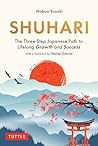
BOOK: “Shuhari” by Nobuo Suzuki
Shuhari: The Three-Step Japanese Path to Lifelong Growth and Success by Nobuo SuzukiMy rating: 5 of 5 stars
Release date: August 11, 2026
I was introduced to the concept of “shuhari” as a student of Japanese martial arts, and over time I discovered it to be one of the most useful concepts for personal growth and development. Shuhari is by no means exclusive to martial arts and is applied to arts in the broadest sense — really to endeavors of any type (as is true in this book which references not only martial arts, but literary arts, graphic arts, cinematic art, and even sciences.) The idea is this: one begins by repetitively practicing what one is taught in as close to an exemplary fashion as possible (shu,) then one starts adapting the principles one has cultivated to changing and unpredictable circumstances (ha,) and finally one abandons the forms and embraces the spontaneous (ri.) In short, we follow the rules (shu,) break the rules (ha,) and abandon the rules (ri.)
Recent years have seen a flood of books on cultural life philosophies, starting and continuing with those of the Japanese culture, but venturing out into Scandinavian (Sisu and Lagom,) Goan (Susegad,) and many others. One could easily fill a shelf each with the popular books on “ikigai” or “ganbatte.” It’s kind of a surprise to see that it’s taken this long to venture into the invaluable concept of “Shuhari.” It is an idea whose time has come to go global.
In a broad sense, this is a book on learning and creativity, and I’d highly recommend it for anyone looking to reevaluate their approach to learning and / or creating.
View all my reviews
BOOKS: “Four Quartets” by T. S. Eliot
Four Quartets by T.S. EliotMy rating: 5 of 5 stars
Available online
Four Quartets is a collection of four long poems by T.S. Eliot, written over several years before and during the Second World War. The poems are: “Burnt Norton,” “East Coker,” “The Dry Salvages,” and “Little Gidding.” They share a theme of metaphysical inquiry, particularly regarding time and man’s relation therewith. The book came out about five years before Eliot won the Nobel Prize for Literature, and was the last of his major poetry collections, and so it reflects a mature phase of his poetry writing.
I loved this collection, which combines food for thought with beautiful turn of phrase. As far as I could see, most of the disgruntlement with the collection had to do with Eliot’s religious / spiritual references, which offended the sensibilities of some of the most stridently atheist / agnostic individuals in the poetic community. Besides reflecting his own Christian worldview, Eliot had clearly been moved by reading the Bhagavad Gita and makes a number of references to Krishna.
Four Quartets is a pleasant read and I’d highly recommend it for poetry readers.
View all my reviews
PROMPT: Overrated
Joyce’s Ulysses springs to mind. I do love some of the language, but — overall — reading it was a bit like getting my teeth drilled. (But I have been known to have a different perspective upon giving a book a second chance.)
There are many long works that I thought could have used an editor (e.g. Moby Dick and Atlas Shrugged,) but still I see their literary appeal.
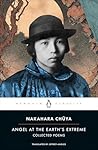
BOOK: “Angel at the Earth’s Extremes” by Chūya Nakahara [trans. & ed. by Jeffrey Angles]
Angel at the Earth’s Extreme: Collected Poems by Nakahara ChuyaMy rating: 5 of 5 stars
Publisher Site — Penguin Classics
Release date: August 4, 2026
Chūya Nakahara was a Japanese poet who lived in the early twentieth century and who wrote in both classic Japanese forms (notably Tanka) as well a modern Western-influenced styles, particularly from the French avant-garde movement — e.g. Dadaism. Though he lived only to the age of thirty, Chūya left a substantial body of poems. He only published one collection during his lifetime, and had edited a second that came out posthumously, but the volume under review includes many previously uncollected poems as well.)
While only the Tanka poems early in the book are of classical Japanese form, Japanese literary influence shows up throughout, such as via seasonality. I took particular note of a focus on Autumn, followed [not chronologically, but in terms of volume,] by Winter, which may give insight into the tone of the volume. Of course, I didn’t count season words, so it might be a reflection of what resonated in my reading. But there is also a certain haiku-esque feel that appears in the author’s descriptions and juxtapositionings.
I enjoyed the language of these poems, particularly in description of sensory experience, which I presume owes both to Chūya and to the translator, Jeffrey Angles. Some examples include: “moonlight makes no sound // as it pools on the grass…”; “Rustling like rice husks, // Rough and dry as a loofa“; “dark against the night sky, // fig leaves stir in the wind // through the gaps, sky appears // –a beautiful woman // missing her front tooth, // standing gracefully // under the nighttime sky.“
I’d highly recommend this book for poetry readers.
View all my reviews
PROMPT: Topics
Anything but myself. Unfortunately, that seems to be the main mode of social discourse in the world. People mostly want to hear enough about me that they feel justified in telling me more about them. I’m an ideas guy: philosophy, science, literature, technology, economy, international affairs, etc. (Also, travel, but that only works with travelers — a tiny segment of the population.)
PROMPT: Character
Tom Sawyer. I have zero capacity to convince anyone that whitewashing is powerful fun. It’s a skill I envy.
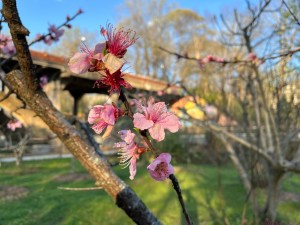
Peach Blossoms [Lyric Poem]

I see the Peach Blossoms of Spring,
And think of old Li Bai’s answer.
In wordless replies, the world sings;
In unpeopled worlds, there’s a dancer.
The referenced poem by Li Bai [李白] is entitled Question and Answer in the Mountains [山中问答] and is crudely translated as:
I'm asked why I live in mountains.
I laugh while giving no reply.
Peach Blossoms flow from sight & mind;
Beyond men, another Earth & Sky.
Or, in Chinese:
问余何意栖碧山,
笑而不答心自闲。
桃花流水窅然去,
别有天地非人间。
“Drinking Wine, no. 5” [饮酒·其五] by Tao Qian [陶潜] (a.k.a. Tao Yuanming [陶渊明])
I live amid a busy town,
But traffic sounds are never heard.
How can this possibly be true?
Deep in the mind, all is remote.
Picking 'mums by the eastern fence,
I peer at distant South Mountains.
Sunset flares in garish color.
Birds flock home in lines and clusters.
The scene conveys some great meaning,
But words to express it fail me.
NOTES: “Drinking Wine, no. 5” [饮酒·其五] is one of Tao Qian’s [陶潜] “Twenty Poems on Drinking Wine” [饮酒二十首.] It is the best-known piece from the collection. The original poem in Simplified Chinese script is:
结 庐 在 人 境,
而 无 车 马 喧.
问 君 何 能 尔?
心 远 地 自 偏.
采 菊 东 篱 下,
悠 然 见 南 山.
山 气 日 夕 佳,
飞 鸟 相 与 还.
此 中 有 真 意,
欲 辨 已 忘 言.
I’ve started reading a review copy of Arthur Sze’s Transient Worlds (from Copper Canyon Press, due out April 14, 2026.) The first chapter discusses this poem and various translations of it, encouraging readers to make their own translation. This is mine. For more information about the book, see: https://www.coppercanyonpress.org/books/transient-worlds-arthur-sze/
BOOK: “Of Love and Other Demons” by Gabriel García Márquez
Of Love and Other Demons by Gabriel García MárquezMy rating: 5 of 5 stars
Publisher – Penguin Random House
This novel revolves around the young daughter of an aristocrat in 18th century Cartagena, Sierva Maria, who is raised by slaves, goes native, and – after being bitten by a rabid dog – is sent to a convent for exorcism. The other central character is the priest, Father Cayetano Delaura, who is dispatched to evaluate the girl and perform the exorcism. Father Delaura doesn’t initially believe the girl is possessed. Sierva Maria speaks the African tribal languages of the slaves who raised her (rather than speaking in tongues as the Nuns believe,) and she is a psychological wreck in large part because the Sisters treat her horribly, believing her to be demon infested. In the process of cleaning Sierva Maria up, tending to her wounds, and coaxing her to speak to him, the priest falls in love with the girl.
It’s a compelling story. Gabriel García Márquez opens the book with a prologue in which he proposes that it was a legend he was told by his grandmother that formed the seed of the story and the real-life discovery of human remains with extremely long hair that trigger his writing. (Sierva Maria has long hair because it was never cut because it was promised to the Saints in prayer when she was saved from choking on her umbilical cord at birth.)
Being set in the 18th century, the book features a fascinating mix of people who believe the problems of Sierva Maria can only be demon possession, an Enlightenment-influenced doctor of the view that it there are more logical explanations, and the many shades in between — epitomized by Father Delaura’s migrating views on the subject.
I’d highly recommend this book for readers of historical fiction.
View all my reviews