BOOK: “A Thousand and One Limericks” Anthologized by Rosemary Gray

A Thousand and One LimericksA Thousand and One Limericks by rosemary-gray
My rating: 4 of 5 stars

Publisher Site

As the title suggests, this book consists of a thousand and one limericks (I didn’t count them, but at three a page, the math works -ish,) a few are well-known, most are groaners, but some are brilliant by virtue of being clever on multiple levels. I will offer two warnings by way of clarifying for whom this book is not. First, it ventures into all those corners of depravity with which the limerick is well-associated — i.e. it’s not a collection for prudes. Second, the collection shows the limerick’s unabashed joy in poking fun at the English language. There are many “misspellings” as poems use one spelling regime for all rhymes (i.e. highlighting English’s complete lack of phonetic consistency.) There are also a lot of slant rhymes and false rhymes… long story short, if you’re a grammar / spelling Nazi, this book will raise all the hackles.

Who is it for? Readers with a sense of humor who are not easily offended.

I have seen a few of these poems attributed to specific authors (e.g. Edward Lear or Ogden Nash) in other collections, but — oddly — this book offers no attribution or discussion thereof. The byline listed, Rosemary Gray, is actually in an anthologist / editor role. (She may have written some of the pieces, but I’m fairly sure I’ve seen a few published in earlier anthologies. Maybe these are all in the public domain, but — as I’ve said — I’ve seen some attributed (and I’m pretty sure some to individuals who died less than 70 years ago.) Long story short, if you can’t find a copy of this, it may be because there was a huge copyright infringement case or threat thereof.

I’d recommend this collection for limerick lovers.

View all my reviews

BOOKS: “Four Quartets” by T. S. Eliot

Four QuartetsFour Quartets by T.S. Eliot
My rating: 5 of 5 stars

Available online

Four Quartets is a collection of four long poems by T.S. Eliot, written over several years before and during the Second World War. The poems are: “Burnt Norton,” “East Coker,” “The Dry Salvages,” and “Little Gidding.” They share a theme of metaphysical inquiry, particularly regarding time and man’s relation therewith. The book came out about five years before Eliot won the Nobel Prize for Literature, and was the last of his major poetry collections, and so it reflects a mature phase of his poetry writing.

I loved this collection, which combines food for thought with beautiful turn of phrase. As far as I could see, most of the disgruntlement with the collection had to do with Eliot’s religious / spiritual references, which offended the sensibilities of some of the most stridently atheist / agnostic individuals in the poetic community. Besides reflecting his own Christian worldview, Eliot had clearly been moved by reading the Bhagavad Gita and makes a number of references to Krishna.

Four Quartets is a pleasant read and I’d highly recommend it for poetry readers.

View all my reviews

BOOK: “Lonesome Cities” by Rod McKuen

LONESOME CITIES LTD EDITLONESOME CITIES LTD EDIT by Rod McKuen
My rating: 4 of 5 stars

Google Books Page

Rod McKuen is the posterchild for poets who were loathed and brutalized by critics, yet who had massive popular followings. He is the Minecraft Movie of poets. McKuen was also a songwriter and recording artist. Poet and lyricist seem almost identical career fields (one makes money for being a simplified version of the other [the poor] one,) but I suspect in their differences one finds a big chunk of the resolution to the aforementioned disparity. At the end of this collection is a chapter entitled “13 Songs” that contains a baker’s dozen of poems that are pop lyric-esque. Until I got to these, I thought McKuen may have been getting an unfair wrap for being schmaltzy and pedestrian, but when I got to them, I could see the truth in the criticism.

This is not to say McKuen would have been as harshly judged today as he was in 1968 when this book came out. He was a bisexual man who is most famous for writing “Seasons in the Sun” (an unambiguously schmaltzy song made popular by Terry Jacks in a much more up-tempo version,) and in an era in which academics were “total squares.”

At any rate, this collection, which is largely organized by city, is a fun read.

View all my reviews

BOOK: “Angel at the Earth’s Extremes” by Chūya Nakahara [trans. & ed. by Jeffrey Angles]

Angel at the Earth's Extreme: Collected PoemsAngel at the Earth’s Extreme: Collected Poems by Nakahara Chuya
My rating: 5 of 5 stars

Publisher Site — Penguin Classics

Release date: August 4, 2026

Chūya Nakahara was a Japanese poet who lived in the early twentieth century and who wrote in both classic Japanese forms (notably Tanka) as well a modern Western-influenced styles, particularly from the French avant-garde movement — e.g. Dadaism. Though he lived only to the age of thirty, Chūya left a substantial body of poems. He only published one collection during his lifetime, and had edited a second that came out posthumously, but the volume under review includes many previously uncollected poems as well.)

While only the Tanka poems early in the book are of classical Japanese form, Japanese literary influence shows up throughout, such as via seasonality. I took particular note of a focus on Autumn, followed [not chronologically, but in terms of volume,] by Winter, which may give insight into the tone of the volume. Of course, I didn’t count season words, so it might be a reflection of what resonated in my reading. But there is also a certain haiku-esque feel that appears in the author’s descriptions and juxtapositionings.

I enjoyed the language of these poems, particularly in description of sensory experience, which I presume owes both to Chūya and to the translator, Jeffrey Angles. Some examples include: “moonlight makes no sound // as it pools on the grass…”; “Rustling like rice husks, // Rough and dry as a loofa“; “dark against the night sky, // fig leaves stir in the wind // through the gaps, sky appears // –a beautiful woman // missing her front tooth, // standing gracefully // under the nighttime sky.

I’d highly recommend this book for poetry readers.

View all my reviews

BOOK: “Falling Up” by Shel Silverstein

Falling UpFalling Up by Shel Silverstein
My rating: 5 of 5 stars

Publisher – HarperCollins Children’s Books

This is the third and final (not inclusive of posthumous greatest hits collections) poetry collection of Shel Silverstein. The collection is considered children’s poetry and has the usual features of such (rhyming verse and doggerel, moral lessons, and occasional grossness.) The poems are generally written in a suspensive form with a twist, i.e. a punchline but aimed more at silly than humorous.

The collection bounces between whimsical and absurd and is highly entertaining to read.

The book has pencil drawings of matching tone for most of the poems.

If you like silliness and rhyming verse, this is fun read.

View all my reviews

BOOK: “The Ruins” by Ye Hui [Trans. by Dong Li]

The Ruins: PoemsThe Ruins: Poems by Hui Ye
My rating: 5 of 5 stars

Publisher Site — Deep Vellum

This is a Chinese-English bilingual edition of Ye Hui’s first poetry collection. The poems use stark imagery with occasional instances of philosophizing and surreal statements to create a vivid and provocative set of poems.

As I’m learning Chinese, it was nice to have the original poems in Simplified Chinese script next to the English translations. While I’m not up to a reading level sufficient to taking on Modern Poetry (any poetry for that matter,) it was useful to peruse the Chinese text. I did appreciate how much vibrance the author wrings out of a relatively simple vocabulary.

I’d highly recommend this collection for poetry readers.

View all my reviews

BOOK: “The Wanderer’s Song” by Johann Wolfgang von Goethe [trans. by John Kent]

The Wanderer's Song: Essential Poems (Pushkin Press Classics)The Wanderer’s Song: Essential Poems by Johann Wolfgang von Goethe
My rating: 4 of 5 stars

Publisher Site — Pushkin Press Classics

This is a new translation of select poems of Johann Wolfgang von Goethe. It’s a clever and varied set of poems by one of German literature’s all-time greats, a polymath of the 18th and early 19th centuries.

It can be a challenge for a general poetry reader to relate to this work. Over two hundred years since most of these poems were composed, the collection reflects a worldview quite different from that which one finds today. That said, the translations are readable and pleasant and don’t feel strained or clunky, and the collection has instances of sublimity. Having no background in German Literature, I can’t say how true the translations are to source material, but they stood solidly as poems in their own right. The book does offer a substantial introduction by the translator for individuals who are particularly interested in the German literature, translation decisions, or the life of Goethe.

I would recommend this for poetry readers, even though casual readers may find it a bit archaic. If you like the Romantic poets, and haven’t given Goethe a try, it’s well worth the time investment.

View all my reviews

BOOKS: “Startlement” by Ada Limón

Startlement: New and Selected PoemsStartlement: New and Selected Poems by Ada Limon
My rating: 5 of 5 stars

Publisher Site – Milkweed Editions

Release: September 30, 2025

This is a Greatest Hits from six of author’s previous collections, plus twenty-one new poems. The poems are clever, personal, and often whimsical. They range from short to intermediate length and employ varied approaches to free verse poetry (with a few prose poems.)

This was my first time reading Limón’s work, and I enjoyed her poems tremendously. I’d highly recommend this book for poetry readers.

View all my reviews

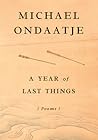
BOOKS: “A Year of Last Things” by Michael Ondaatje

A Year of Last Things: PoemsA Year of Last Things: Poems by Michael Ondaatje
My rating: 5 of 5 stars

Amazon.in Page

Release Date: March 19, 2024

This collection consists of free verse and prose poems, largely of an autobiographical nature (or presented as such.) A number of these autobiographical poems are at once travel poems, tales from the author’s visits to various countries.

While Ondaatje is more well-known for his critically acclaimed novels (e.g. “The English Patient” and “Anil’s Ghost,”) he’s not new to the poetic artform. The poems in this volume are clever, readable, nicely paced, and interesting. I enjoyed reading this book and would highly recommend it for poetry readers.

View all my reviews

BOOK REVIEW: Malabar Mind by Anita Nair

Malabar Mind PoemsMalabar Mind Poems by Anita Nair
My rating: 5 of 5 stars

Amazon page


This collection of 40 poems by Anita Nair begins with verse that is imbued with Indian-ness and has a timeless feel, and progresses into more modern and – at times — erotic territory. For those unfamiliar with Indian geography, the Malabar Coast is the southwest coast of India. It stretches from Goa down through Kerala, and as far as the southern tip of India. The author’s last name, Nair, is one used by members of a caste from the state of Kerala. The Malabar Coast is known for spice, tea, and coffee plantations inland, and coastal ports that carry those commodities to buyers around the world that date back long before the British colonized India. Because of the long history of the spice trade, this area has its own unique feel. That should give the reader some sense of the cultural elements suffused into this work.

The poems are generally free verse (though there’s a prose poem and perhaps some other forms,) and are mostly in the range of a couple of stanzas to about three pages, though the final poem, “The Cosmopolitan Crow” is a long form poem. The entire collection weighs in at around 100 pages. The author frequently uses a sparse form that presents lines of one to three words, but that isn’t the case for all the poems.

While there’s eroticism in parts, it’s relatively subtle and shouldn’t be an impediment to any but the primmest of readers. (Though I’ve been known to miscalculate the degree to which some folks get uptight about sexual and somatic content.)

I enjoyed this collection. I was sensual, evocative, and captured the feel of Kerala nicely.

View all my reviews