BOOK: “A Poetry Handbook” by Mary Oliver

A Poetry Handbook: A Prose Guide to Understanding and Writing PoetryA Poetry Handbook: A Prose Guide to Understanding and Writing Poetry by Mary Oliver
My rating: 5 of 5 stars

Publisher site — Ecco

This is an excellent soup-to-nuts primer on poetry writing. While it would be a great tool for someone just beginning their poetic journey — i.e. one who didn’t yet know iambic pentameter from trochaic tetrameter — it also offers some nuggets of wisdom for one who is farther down the road. Mary Oliver had some unique ways of thinking about, or expressing thoughts about, the art.

The book does cover ideas relevant to both modern and traditional poetry. In this regard it has an advantage over, say, Stephen Fry’s The Ode Less Traveled in that Oliver considered both free and metered verse to be poetry.

The author uses the occasional poem or fragment from a variety of poets to make her points but doesn’t get bogged down in examples or analysis of poems.

Among the discussions that seemed better or more insightful than those in other such books were reflections upon the role of imitative exercises as well as exploration of the value of workshops and feedback.

I’d highly recommend this book for poets and serious poetry readers.

View all my reviews

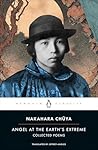
BOOK: “Angel at the Earth’s Extremes” by Chūya Nakahara [trans. & ed. by Jeffrey Angles]

Angel at the Earth's Extreme: Collected PoemsAngel at the Earth’s Extreme: Collected Poems by Nakahara Chuya
My rating: 5 of 5 stars

Publisher Site — Penguin Classics

Release date: August 4, 2026

Chūya Nakahara was a Japanese poet who lived in the early twentieth century and who wrote in both classic Japanese forms (notably Tanka) as well a modern Western-influenced styles, particularly from the French avant-garde movement — e.g. Dadaism. Though he lived only to the age of thirty, Chūya left a substantial body of poems. He only published one collection during his lifetime, and had edited a second that came out posthumously, but the volume under review includes many previously uncollected poems as well.)

While only the Tanka poems early in the book are of classical Japanese form, Japanese literary influence shows up throughout, such as via seasonality. I took particular note of a focus on Autumn, followed [not chronologically, but in terms of volume,] by Winter, which may give insight into the tone of the volume. Of course, I didn’t count season words, so it might be a reflection of what resonated in my reading. But there is also a certain haiku-esque feel that appears in the author’s descriptions and juxtapositionings.

I enjoyed the language of these poems, particularly in description of sensory experience, which I presume owes both to Chūya and to the translator, Jeffrey Angles. Some examples include: “moonlight makes no sound // as it pools on the grass…”; “Rustling like rice husks, // Rough and dry as a loofa“; “dark against the night sky, // fig leaves stir in the wind // through the gaps, sky appears // –a beautiful woman // missing her front tooth, // standing gracefully // under the nighttime sky.“

I’d highly recommend this book for poetry readers.

View all my reviews
BOOK: “The Ruins” by Ye Hui [Trans. by Dong Li]

The Ruins: PoemsThe Ruins: Poems by Hui Ye
My rating: 5 of 5 stars

Publisher Site — Deep Vellum

This is a Chinese-English bilingual edition of Ye Hui’s first poetry collection. The poems use stark imagery with occasional instances of philosophizing and surreal statements to create a vivid and provocative set of poems.

As I’m learning Chinese, it was nice to have the original poems in Simplified Chinese script next to the English translations. While I’m not up to a reading level sufficient to taking on Modern Poetry (any poetry for that matter,) it was useful to peruse the Chinese text. I did appreciate how much vibrance the author wrings out of a relatively simple vocabulary.

I’d highly recommend this collection for poetry readers.

View all my reviews