BOOKS: “Know Yourself and Your Enemy” by Qixia Yu

Know Yourself and Your Enemy 知己知彼百战不殆 (Bilingual Chinese Idiom Stories)Know Yourself and Your Enemy 知己知彼百战不殆 by Qixia Yu
My rating: 5 of 5 stars

Author Amazon Site

This illustrated bilingual book tells a story out of the Romance of the Three Kingdoms. It’s a popular tale of strategy in which the renowned strategist (and then Prime Minister) Zhuge Liang outfoxed the (also) renowned General Sima Yi as the latter brought a large army to the walls of the capital where Zhuge Liang was residing. The city was only weakly guarded because the bulk of forces were on campaign and they could not be recalled in time to be of service. Were it not for Zhuge Liang’s insightful stratagem, the capital would have been lost.

This is a great book for those learning Chinese for a few reasons. First, it contains pinyin and English translation. Secondly, it’s illustrated in a way that is not only aesthetically pleasing but which also helps a learner follow events – despite gaps in language understanding. Third, it’s an interesting story, and a nice break from the usual (re: dreadfully boring) beginner level reading fare. Finally, it’s a nice bite-sized chunk of writing for someone who still has to think out words and sentences. I don’t know that the author restricted themselves to any particular HSK level. It seemed to have some language beyond what was in HSK 3 / 4 readers I’ve read but is still relatively simple and straightforward in its language. Restricting to a simple level might be an issue with any historical work because there are going to be terms that are important but certainly aren’t among the most common words today (e.g. halberd.)

If you’re learning Chinese and are interested in strategy, martial arts, history, or Chinese literary classics, I’d highly recommend reading this book.

View all my reviews

“Drinking Wine, no. 5” [饮酒·其五] by Tao Qian [陶潜] (a.k.a. Tao Yuanming [陶渊明])

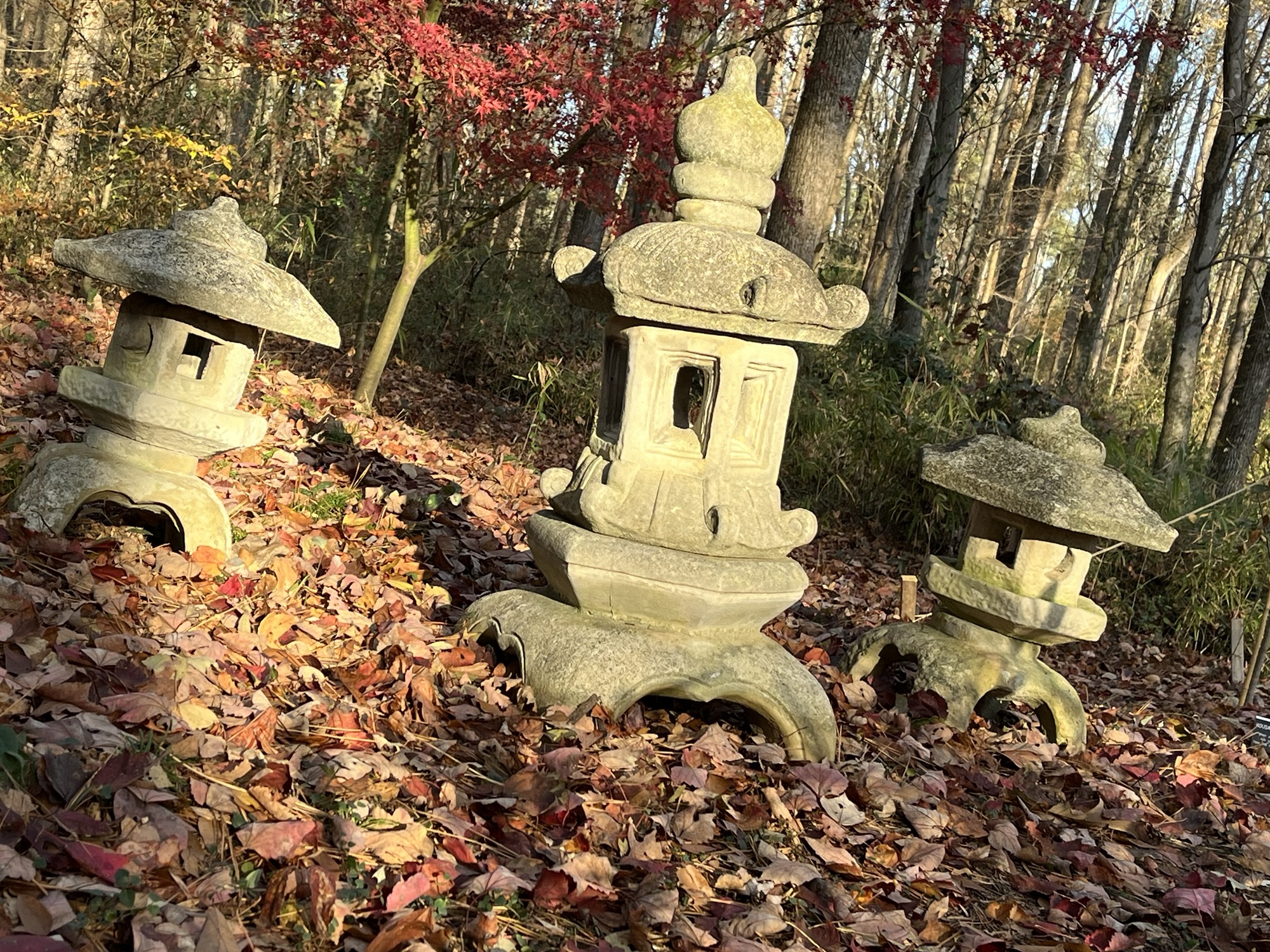
Taken in Hartwell, Georgia.
I live amid a busy town,
But traffic sounds are never heard.

How can this possibly be true?

Deep in the mind, all is remote.

Picking 'mums by the eastern fence,
I peer at distant South Mountains.
Sunset flares in garish color.
Birds flock home in lines and clusters.
The scene conveys some great meaning,
But words to express it fail me.

NOTES: “Drinking Wine, no. 5” [饮酒·其五] is one of Tao Qian’s [陶潜] “Twenty Poems on Drinking Wine” [饮酒二十首.] It is the best-known piece from the collection. The original poem in Simplified Chinese script is:

结 庐 在 人 境,
而 无 车 马 喧.
问 君 何 能 尔?
心 远 地 自 偏.
采 菊 东 篱 下,
悠 然 见 南 山.
山 气 日 夕 佳,
飞 鸟 相 与 还.
此 中 有 真 意,
欲 辨 已 忘 言.

I’ve started reading a review copy of Arthur Sze’s Transient Worlds (from Copper Canyon Press, due out April 14, 2026.) The first chapter discusses this poem and various translations of it, encouraging readers to make their own translation. This is mine. For more information about the book, see: https://www.coppercanyonpress.org/books/transient-worlds-arthur-sze/

BOOK: “The Emperor in Hell” [Book 5 of the “Journey to the West” Series] ed. by Jeff Pepper; trans. by Xiao Hui Wang

The Emperor in Hell: A Story in Simplified Chinese and Pinyin, 600 Word Vocabulary LevelThe Emperor in Hell: A Story in Simplified Chinese and Pinyin, 600 Word Vocabulary Level by Jeff Pepper
My rating: 4 of 5 stars

Publisher Site – Imagin8 Press

This is the fifth volume in a series that abridges and simplifies the classic Chinese novel, Journey to the West, so that it can be read by a language learner with about a HSK 3 grasp of Chinese. It tells the story from Chapters 10 and 11 of the original novel. Like the preceding volume, this one doesn’t deal with Sun Wu Kong (i.e. the Monkey King — protagonist of the novel overall,) and doesn’t even deal with the monk Xuanzang — the protagonist of the true story on which the novel was based.) These chapters tell a story that feels like a diversion, though it will be involved in the segue back to the actions of the main cast.

In this book, the Jing River Dragon King gets in trouble when he makes a bet with a fortune-teller. The Dragon King has to cheat to save his pride, but this runs him afoul of the Jade Emperor. The Dragon King appeals to the human Emperor, Taizong, who agrees to help. When wires get crossed, Taizong ends up in the underworld for judgement. With the help of others and with promises made, Taizong is allowed to return to earth.

It’s an interesting story and gives some insight into Chinese mythology. As is always the case with a book such as this, events of the story must be cut or rushed. Readers may vary in their views about whether the right material was cut or thinned.

I continue to enjoy this series. This book was a little more challenging to read than earlier volumes, not because the vocabulary was harder. I think it was more that contextual cues were fewer, owing to it not being so tightly tied to the overall story.

If you’re just learning to read Chinese, I’d recommend this series as an interesting story made readable to a language learner.

View all my reviews

BOOK: “The Young Monk” [Vol. 4 of the “Journey to the West” Series] ed. by Jeff Pepper / trans. by Xiao Hui Wang

The Young Monk: A Story in Simplified Chinese and Pinyin, 600 Word Vocabulary (Journey to the West Book 4)The Young Monk: A Story in Simplified Chinese and Pinyin, 600 Word Vocabulary by Jeff Pepper
My rating: 5 of 5 stars

Publisher Site — Imagin8

This book, Volume 4 of the Journey to the West series, takes a turn from the books thus far. While the first three volumes (Ch. 1-7) focus on Sun Wukong, the Monkey King, this volume leaves him under the mountain where the last volume left him, and — instead — focuses on the origin story of Xuanzang — the monk who is sent by the Buddha to India to get scriptures in the original book — based on the real-world monk who did travel to India to complete the selection of Buddhist scriptures available to Chinese Buddhists.

The monk’s story might not sound like it would be as thrilling as that of the superpowered immortal monkey, but it’s a gripping tale. The story begins before Xuanzang is born and ends in his eighteenth year. So, before he is assigned to travel West to get scriptures.

As I’ve said in earlier reviews, I really like the approach of this series. It has Simplified Chinese script, pinyin, an English translation, and a full glossary of terms used, and it’s organized so as to facilitate reading by a language learner.

I continue to recommend this series for language learners who need a linguistically simplified text to be able to read.

View all my reviews

BOOK: “The Ruins” by Ye Hui [Trans. by Dong Li]

The Ruins: PoemsThe Ruins: Poems by Hui Ye
My rating: 5 of 5 stars

Publisher Site — Deep Vellum

This is a Chinese-English bilingual edition of Ye Hui’s first poetry collection. The poems use stark imagery with occasional instances of philosophizing and surreal statements to create a vivid and provocative set of poems.

As I’m learning Chinese, it was nice to have the original poems in Simplified Chinese script next to the English translations. While I’m not up to a reading level sufficient to taking on Modern Poetry (any poetry for that matter,) it was useful to peruse the Chinese text. I did appreciate how much vibrance the author wrings out of a relatively simple vocabulary.

I’d highly recommend this collection for poetry readers.

View all my reviews

BOOK: “The Immortal Peaches” [Vol. 3 of “Journey to the West”] Ed. by Jeff Pepper / Trans. by Xiao Hui Wang

The Immortal Peaches: A Story in Simplified Chinese and Pinyin, 600 Word Vocabulary (Journey to the West Book 3)The Immortal Peaches: A Story in Simplified Chinese and Pinyin, 600 Word Vocabulary by Jeff Pepper
My rating: 5 of 5 stars

Publisher Site – Imagin8

This is the third volume in this Journey to the West series aimed at language learners. It covers Chapters 5, 6, and 7 of the book, which includes events from Sun Wukong’s return to heaven acknowledged with the title “Great Sage Equal to Heaven” through the conflicts that result from his lack of control and decorum to Buddha’s bet with Monkey King.

I’ve enjoyed this series. The pinyin is interspersed with an abridged and linguistically simplified Chinese telling of the story on a paragraph basis, and the English translation is at the end. This allows one relatively quick access to the pinyin without continually cheating by stray glance. Also, one can determine whether one wants to read the English translation before or after reading the Chinese, as is appropriate to one’s level and language learning strategy. The book also has a glossary of all the Chinese words it uses, and the words beyond the most basic (beyond HSK3, or so) are footnoted. (I read on kindle, so looking up translations of any words is as quick as highlighting them.)

This is a great language learning tool, featuring one of Chinese literature’s most engrossing stories. I’d highly recommend it for those learning Mandarin Chinese with Simplified script.

View all my reviews

BOOK: “Chinese Grammar Wiki BOOK: Upper Intermediate” ed. by John Pasden

Chinese Grammar Wiki BOOK: Upper IntermediateChinese Grammar Wiki BOOK: Upper Intermediate by John Pasden
My rating: 5 of 5 stars

Publisher Site — AllSet Learning

This is the third and final book in this series. It’s a straightforward grammar that’s easy to use and well-organized. The book contains basic rules in a concise format, examples, and any exceptions or points of confusion that may exist. With examples, it presents the Hanzi (Chinese characters,) pinyin (Romanized phonetic script,) and English translation adjacently. (This is a feature that I don’t like in readers, but which I find useful in a grammar.)

If you’re trying to learn the basics of Mandarin Chinese in Simplified Script, this is a useful series. I can’t speak to how good it is or isn’t for someone who intends to take the HSK tests, but for my purposes it was just what I needed with not much more (no extraneous information or complications.)

View all my reviews

BOOK: “Trouble in Heaven” [Vol. 2 “Journey to the West” (西游记) Series] ed. by Jeff Pepper / trans. by Xiao Hui Wang

Trouble in Heaven: A Story in Simplified Chinese and Pinyin, 600 Word Vocabulary Level (Journey to the West in Simplified Chinese)Trouble in Heaven: A Story in Simplified Chinese and Pinyin, 600 Word Vocabulary Level by Jeff Pepper
My rating: 5 of 5 stars

Publisher Site – Imagin8

This is an abridged and linguistically simplified telling of the story of chapters three and four of the Chinese classic novel, Journey to the West. It is written and organized for learners of Chinese who would like to start reading in Chinese.

The events covered in this volume are Monkey King’s (a.k.a. Sun Wukong’s) acquisition of weapons for himself and his companions, his discovery that his name is on the registry of the underworld (and, thus, he’s not as immortal as he’d believed at the end of Vol. 1,) his ascension to heaven where he is given the job of stable manager (a life and job he is happy with until his discovery that it is the lowest level job in heaven,) and his skirmishes with the forces of heaven when he takes on the title “Great Sage Equal to Heaven.”

The story is conveyed in Simplified Chinese script, and has pinyin interspersed at the paragraph level. I like this arrangement because one has access to the pinyin as needed, but it’s not immediately adjacent (as it is with many starter readers,) such that it’s not possible to “cheat” by seeing the pinyin in one’s peripheral vision. It also offers an English language telling of the story, but after the entirety of the Chinese. The book also has three glossaries that collectively define all the terms used in the book. The first contains all the proper nouns, the second is all the basic words, and the last is all the words that are a little outside the most basic reading level. (The latter are also footnoted throughout the text.)

I’m enjoying this series. It’s a gripping story, it’s arranged in a way that encourages one read by the Chinese characters alone, and it is readable by the most beginning level student. That’s a combination that isn’t readily found. I’d highly recommend this series for those learning to read Chinese.


View all my reviews

PROMPT: Topics

Daily writing prompt
Which topics would you like to be more informed about?

I’d like to know more about the capabilities and limitations of AI, a rabbit-hole that I have only recently stumbled upon, but which I am tumbling down hard. Particularly, how to best use it for language acquisition as I am currently learning Chinese and would like to increase my literacy so I can open myself up to a whole new world of books.

I’m also curious about pratfalls and physical comedy all of a sudden.

PROMPT: Excited

Daily writing prompt
Tell us about the last thing you got excited about.

Being able to read Chinese, even if is dumbed-down stories for beginners and I still have to look words up every few sentences. But it feels like I’ve stumbled upon a door to a whole new universe.