PROMPT: Topics

Daily writing prompt
Which topics would you like to be more informed about?

I’d like to know more about the capabilities and limitations of AI, a rabbit-hole that I have only recently stumbled upon, but which I am tumbling down hard. Particularly, how to best use it for language acquisition as I am currently learning Chinese and would like to increase my literacy so I can open myself up to a whole new world of books.

I’m also curious about pratfalls and physical comedy all of a sudden.

PROMPT: Excited

Daily writing prompt
Tell us about the last thing you got excited about.

Being able to read Chinese, even if is dumbed-down stories for beginners and I still have to look words up every few sentences. But it feels like I’ve stumbled upon a door to a whole new universe.

BOOK: “Old Master Q Chinese Idioms LOL 5” by Wong Chak

Old Master Q Chinese Idioms LOL 5Old Master Q Chinese Idioms LOL 5 by Wong Chak
My rating: 4 of 5 stars

Publisher Instagram – Ng Hing Kee

This collection of chengyu (four-character Chinese idioms) are presented by means of humorous comic strips. Each idiom takes up one page, which includes: the chengyu in both Traditional Chinese characters and pinyin (Romanized phoneticization,) very brief literal and colloquial definitions as well as a statement of the general circumstances under which the idiom might be used, and a four to six panel comic strip that shows the reader a humorous scenario for which the idiom is applicable.

The book is divided into five parts, and at the end of each part there are a few pages of exercises to test the reader’s understanding of that section’s material. (Answer keys are provided — upside-down at the end of each quiz.)

As someone learning Chinese, I found this book to be useful. However, it doesn’t require any Chinese literacy to learn. If you’re interested in compact bits of wisdom or quotes, you may find this book worthwhile.

View all my reviews

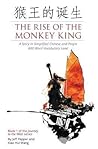
BOOKS: “Rise of the Monkey King” ed. / trans. Jeff Pepper & Xiao Hui Wang

The Rise of the Monkey King: A Story in Simplified Chinese and Pinyin, 600 Word Vocabulary Level (Chinese Edition)The Rise of the Monkey King: A Story in Simplified Chinese and Pinyin, 600 Word Vocabulary Level by Jeff Pepper
My rating: 5 of 5 stars

Publisher Site – Imagin8

This is an abridged and linguistically simplified telling of the first two chapters of Journey to the West. It contains the birth story of Sun Wukong (i.e. the Monkey King) and describes his studies with a sage in an attempt to become immortal.

As someone learning Chinese but at a point where I can only read grammatically and lexically simple content, it’s not easy to find reading material that is both fun to read and readable. The discovery of this series was a godsend. It’s hard to get more thrilling than the story of the Monkey King, and it helps that I’ve already read translations – and so have a bit of context to piece together challenging sentences and to avoid the misunderstandings that can arise when reading a new language. It’s much easier to be a disciplined reader when reading something that is neither a children’s book nor the life story of a preternaturally typical person [which is the usual adult equivalent of a beginner level reader.]

I was pleased by how this book was laid out. Often reading material for learners puts the Chinese characters (hanzi,) the Romanized phonetics (pinyin,) and the English translation all in adjacent rows. While this has its advantages, it also makes it too easy to cheat by eye saccade and not be reading as well as one thinks one is. This book does have all three elements, but it alternates paragraphs of hanzi and pinyin but then puts the translation in an unbroken format after the Mandarin. The book also has a glossary of the book’s vocabulary.

Whether you’ve already read Journey to the West or not, if you’re just learning to read Simplified Chinese, I’d highly recommend this book.

View all my reviews

BOOKS: 千字文 [Thousand Character Essay] by 周兴嗣 [Zhou Xingsi]

千字文千字文 by 周兴嗣
My rating: 4 of 5 stars

A version with English commentary can be found at the IFA Gallery

This short work, consisting of just one-thousand characters, is first and foremost a teaching tool for children. While it presents a thousand of the most important Chinese characters, it also delivers lessons on history, ethics, philosophy, and culture by way of short sayings.

It’s arranged into 250 4-character phrases (125 sentences) and reads as a lyric poem, though because it dates to the Sixth Century, the degree to which the rhyme scheme holds varies depending upon the which spoken language one speaks (e.g. Mandarin, Cantonese, or Hakka.)

There have been different versions of this work over the centuries.

This is a much beloved work of literature among Chinese, though its sayings do not necessarily hold up as well as works like Sunzi’s Art of War or Laozi’s Daodejing. Some do, but most are much less relevant than when written.

As someone learning Chinese, I’d highly recommend this work as a way to expose oneself to language while gaining insight into Chinese culture.

View all my reviews

PROMPT: Talk

Daily writing prompt
Who would you like to talk to soon?

I’d like to be able to talk to anyone in Mandarin soon, unfortunately my pace of learning is so glacial as to preclude talking “soon” — at least on broad and undefined topics. [Note: When I say “anyone” I mean anyone who speaks Mandarin and has interesting things to say.]

BOOKS: “Chinese Grammar Wiki BOOK: Intermediate” ed. by John Pasden, et. al.

Chinese Grammar Wiki BOOK: IntermediateChinese Grammar Wiki BOOK: Intermediate by John Pasden
My rating: 5 of 5 stars

Publisher Site – AllSet

I’ve found this series helpful in offering a basic guide to grammar for learning Mandarin through Simplified Characters and pinyin. It provides plenty of examples and is not dense with explanation and elaboration but rather focuses on the core principles as well as demonstrations of common pitfalls. It covers the B1 grammar points which is a designation used by, but not original to, the series. (As far as I can tell, it’s a European standard that has been applied across languages to organize the concepts one should be able to express at a given level of language learning.

This is the second book of the series that I’ve worked through (the third if one counts the “Just the Basics” level which is a subset of the Beginner level book,) and I intend to continue on to the “Upper Intermediate” guide.

This may not be the series you want if you’re a linguist looking for nuanced insight into Chinese grammar, but it’s excellent for your average language learner. [It also seems to be quite affordable compared to many competing grammar books and series.]

View all my reviews

“Spring Thoughts” by Li Bai [w/ Audio]

Yan grass shimmers like silken jade.
Qin mulberry trees' green leaves droop.
Your homecoming is now at hand
As heartbreak has me thin and stooped.
Spring Winds and I are strangers --
Why, past my curtains, the inward swoop?

Chinese Title: 春思; Original poem in Simplified Chinese:

燕草如碧丝, 秦桑低绿枝;
当君怀归日, 是妾断肠时。
春风不相识, 何事入罗帏?

Note: this is poem #7 in “300 Tang Poems” [唐诗三百首]

BOOKS:  木兰辞 [Ballad of Mulan] by Anonymous

The Ballad of Mulan: 木兰辞 (Simplified Chinese Characters with Pinyin)The Ballad of Mulan: 木兰辞 by Song Nan Zhang
My rating: 5 of 5 stars

Available online at YellowBridge

This is a short lyric poem (15-1/2 quatrain, or 62 lines) that tells the story of a young woman who disguises herself as a man and joins the military to fill a slot that would otherwise have required her aged and infirm father to serve. The tiny poem packs in ten-plus years, during which Hua Mulan serves with great distinction and then returns home to take care of her parents. It’s a well-known tale that emphasizes the importance of filial piety and sacrifice. Though outside of China (as well as Taiwan and other Chinese cultural enclaves,) many may know it from the Disney version which has been panned for ditching the Confucian values and replacing them with ones that were thought would resonate better with a Western audience.

The poem is mostly arranged in quatrains of five-character lines with alternate line rhymes.

It’s a quick read and there is no room for the detailed tales of heroism that are depicted in adaptations.

If one is looking for a culturally insightful telling of the story of Hua Mulan, this is the right place to look. I’d highly recommend reading it.

View all my reviews

BOOKS: 三字经 by 王应麟 [“Three Character Classic” by Wang Yinglin]

三字经三字经 by 章炳麟
My rating: 5 of 5 stars

Available online — Project Gutenberg

This is a Confucian primer written in lines of three characters. It’s a children’s book in the sense that it’s aimed at children, but not necessarily with respect to being presented in a manner most conducive to childhood learning. (While it’s concise, the material isn’t presented in an interesting or memorable form. i.e. It’s intended for brute force rote memorization.)

The book consists of five sections, ranging between twenty-four and one hundred and six lines (72 to 318 characters per chapter.) The first introduces Confucian virtues. The second offers a broad overview of classics of Chinese philosophy. The third section lists the dynasties of China. The penultimate section describes ideal behavior from a Confucian perspective. The last, and briefest, section is largely a pep talk on studying hard.

As someone learning Mandarin Chinese, it’s interesting to see how sentences are formed in this sparse format, and this text offers insight into Chinese history and philosophy, in addition to providing a good early reader.

If you are interested in learning elementary Confucianism or you’re learning Chinese and looking for short and simple texts for reading, I’d recommend one look into the Three Character Classic.

View all my reviews