BOOK: 齐天大圣 by Yinuo Wang

齐天大圣 Monkey King: A Bilingual Chinese Storybook (Pinyin & English) with HSK Vocabulary (Learn Chinese with Mythology:Bilingual Pinyin Edition 9)齐天大圣 Monkey King: A Bilingual Chinese Storybook (Pinyin & English) with HSK Vocabulary by Yinuo Wang
My rating: 4 of 5 stars

Amazon Page

This book collects episodes from the classic Chinese novel, Journey to the West, and condenses each into a page or two. Specifically, these are episodes from early in the story of Journey to the West, before the protagonist (a.k.a. Sun Wu Kong / the Monkey King / the Great Sage Equal to Heaven) actually departs on his journey to the west with a monk to get Buddhist scriptures. It is Sun Wu Kong’s origin story in a highly condensed form.

The illustrations of the book are aesthetically pleasing and are colorful and non-threatening (i.e. suitable for young readers.) Also, the book has quizzes and vocabulary building exercises at the back.

My biggest criticism of the book would be that it bites off more than it can chew. With single pages for major events and no room for transitions, the plates are a bit incongruous and don’t feel like a story as much as like viewing someone’s scrapbook. A lesser criticism would be that with a loose translation style (which is fine,) it sometimes translates the same characters in two different ways. (As it does with the title card which it translates quite literally as “The Great Sage Equal to Heaven” and the opening page where it translates the same four-character phrase quite loosely as “The Great Monkey King.”) This would not be an issue if the book were not a book for learning to read.

As I said, this is more like Sun Wu Kong’s scrapbook than his life story, but it is a nice way to practice beginner level reading. I’d recommend it for those beginning to read Chinese, particularly if one already knows the Journey to the West story.

View all my reviews

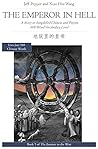
BOOK: “The Emperor in Hell” [Book 5 of the “Journey to the West” Series] ed. by Jeff Pepper; trans. by Xiao Hui Wang

The Emperor in Hell: A Story in Simplified Chinese and Pinyin, 600 Word Vocabulary LevelThe Emperor in Hell: A Story in Simplified Chinese and Pinyin, 600 Word Vocabulary Level by Jeff Pepper
My rating: 4 of 5 stars

Publisher Site – Imagin8 Press

This is the fifth volume in a series that abridges and simplifies the classic Chinese novel, Journey to the West, so that it can be read by a language learner with about a HSK 3 grasp of Chinese. It tells the story from Chapters 10 and 11 of the original novel. Like the preceding volume, this one doesn’t deal with Sun Wu Kong (i.e. the Monkey King — protagonist of the novel overall,) and doesn’t even deal with the monk Xuanzang — the protagonist of the true story on which the novel was based.) These chapters tell a story that feels like a diversion, though it will be involved in the segue back to the actions of the main cast.

In this book, the Jing River Dragon King gets in trouble when he makes a bet with a fortune-teller. The Dragon King has to cheat to save his pride, but this runs him afoul of the Jade Emperor. The Dragon King appeals to the human Emperor, Taizong, who agrees to help. When wires get crossed, Taizong ends up in the underworld for judgement. With the help of others and with promises made, Taizong is allowed to return to earth.

It’s an interesting story and gives some insight into Chinese mythology. As is always the case with a book such as this, events of the story must be cut or rushed. Readers may vary in their views about whether the right material was cut or thinned.

I continue to enjoy this series. This book was a little more challenging to read than earlier volumes, not because the vocabulary was harder. I think it was more that contextual cues were fewer, owing to it not being so tightly tied to the overall story.

If you’re just learning to read Chinese, I’d recommend this series as an interesting story made readable to a language learner.

View all my reviews

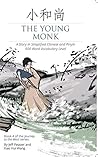
BOOK: “The Young Monk” [Vol. 4 of the “Journey to the West” Series] ed. by Jeff Pepper / trans. by Xiao Hui Wang

The Young Monk: A Story in Simplified Chinese and Pinyin, 600 Word Vocabulary (Journey to the West Book 4)The Young Monk: A Story in Simplified Chinese and Pinyin, 600 Word Vocabulary by Jeff Pepper
My rating: 5 of 5 stars

Publisher Site — Imagin8

This book, Volume 4 of the Journey to the West series, takes a turn from the books thus far. While the first three volumes (Ch. 1-7) focus on Sun Wukong, the Monkey King, this volume leaves him under the mountain where the last volume left him, and — instead — focuses on the origin story of Xuanzang — the monk who is sent by the Buddha to India to get scriptures in the original book — based on the real-world monk who did travel to India to complete the selection of Buddhist scriptures available to Chinese Buddhists.

The monk’s story might not sound like it would be as thrilling as that of the superpowered immortal monkey, but it’s a gripping tale. The story begins before Xuanzang is born and ends in his eighteenth year. So, before he is assigned to travel West to get scriptures.

As I’ve said in earlier reviews, I really like the approach of this series. It has Simplified Chinese script, pinyin, an English translation, and a full glossary of terms used, and it’s organized so as to facilitate reading by a language learner.

I continue to recommend this series for language learners who need a linguistically simplified text to be able to read.

View all my reviews

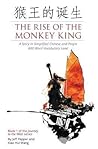
BOOKS: “Rise of the Monkey King” ed. / trans. Jeff Pepper & Xiao Hui Wang

The Rise of the Monkey King: A Story in Simplified Chinese and Pinyin, 600 Word Vocabulary Level (Chinese Edition)The Rise of the Monkey King: A Story in Simplified Chinese and Pinyin, 600 Word Vocabulary Level by Jeff Pepper
My rating: 5 of 5 stars

Publisher Site – Imagin8

This is an abridged and linguistically simplified telling of the first two chapters of Journey to the West. It contains the birth story of Sun Wukong (i.e. the Monkey King) and describes his studies with a sage in an attempt to become immortal.

As someone learning Chinese but at a point where I can only read grammatically and lexically simple content, it’s not easy to find reading material that is both fun to read and readable. The discovery of this series was a godsend. It’s hard to get more thrilling than the story of the Monkey King, and it helps that I’ve already read translations – and so have a bit of context to piece together challenging sentences and to avoid the misunderstandings that can arise when reading a new language. It’s much easier to be a disciplined reader when reading something that is neither a children’s book nor the life story of a preternaturally typical person [which is the usual adult equivalent of a beginner level reader.]

I was pleased by how this book was laid out. Often reading material for learners puts the Chinese characters (hanzi,) the Romanized phonetics (pinyin,) and the English translation all in adjacent rows. While this has its advantages, it also makes it too easy to cheat by eye saccade and not be reading as well as one thinks one is. This book does have all three elements, but it alternates paragraphs of hanzi and pinyin but then puts the translation in an unbroken format after the Mandarin. The book also has a glossary of the book’s vocabulary.

Whether you’ve already read Journey to the West or not, if you’re just learning to read Simplified Chinese, I’d highly recommend this book.

View all my reviews

POEM: The Reader

I tore up your world, remaking
it in a style that was my own.

I wiped the crown from your King’s head,
and painted myself on the throne.

Your cast kept me good company
when I felt like being alone.

Your story became the sum of
my knowledge, both known and unknown.

For these sins and so many more,
I refuse to ever atone.

POEM: The World According to a Reader

I’ve built cities in my brain,
cities that no one would recognize.

I’ve danced around Dublin with Dedalus and Bloom,
but no Dubliner would recognize his fair city
from my mental projection.

It doesn’t matter how masterful Joyce is in his description.
I’ve only visited the version that I tossed up in my mind
as I tore through his poetry,
and which was torn down in the wake of my reading.

And yet I treasure that false metropolis.

It’ll do — for now.