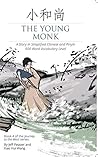
BOOK: “Trouble in Heaven” [Vol. 2 “Journey to the West” (西游记) Series] ed. by Jeff Pepper / trans. by Xiao Hui Wang

Trouble in Heaven: A Story in Simplified Chinese and Pinyin, 600 Word Vocabulary Level (Journey to the West in Simplified Chinese)Trouble in Heaven: A Story in Simplified Chinese and Pinyin, 600 Word Vocabulary Level by Jeff Pepper
My rating: 5 of 5 stars

Publisher Site – Imagin8

This is an abridged and linguistically simplified telling of the story of chapters three and four of the Chinese classic novel, Journey to the West. It is written and organized for learners of Chinese who would like to start reading in Chinese.

The events covered in this volume are Monkey King’s (a.k.a. Sun Wukong’s) acquisition of weapons for himself and his companions, his discovery that his name is on the registry of the underworld (and, thus, he’s not as immortal as he’d believed at the end of Vol. 1,) his ascension to heaven where he is given the job of stable manager (a life and job he is happy with until his discovery that it is the lowest level job in heaven,) and his skirmishes with the forces of heaven when he takes on the title “Great Sage Equal to Heaven.”

The story is conveyed in Simplified Chinese script, and has pinyin interspersed at the paragraph level. I like this arrangement because one has access to the pinyin as needed, but it’s not immediately adjacent (as it is with many starter readers,) such that it’s not possible to “cheat” by seeing the pinyin in one’s peripheral vision. It also offers an English language telling of the story, but after the entirety of the Chinese. The book also has three glossaries that collectively define all the terms used in the book. The first contains all the proper nouns, the second is all the basic words, and the last is all the words that are a little outside the most basic reading level. (The latter are also footnoted throughout the text.)

I’m enjoying this series. It’s a gripping story, it’s arranged in a way that encourages one read by the Chinese characters alone, and it is readable by the most beginning level student. That’s a combination that isn’t readily found. I’d highly recommend this series for those learning to read Chinese.


View all my reviews

PROMPT: Cultural Heritage

What aspects of your cultural heritage are you most proud of or interested in?

I’m not sure whether this prompt is directed toward the culture of my ancestors (Irish) or the culture in which I was raised (American.) If it is the former, then the answer is certainly the great literary and poetic talent that was born of the culture (i.e. Yeats, Wilde, Shaw, Heaney, Beckett, Joyce, etc.) But if it is the latter, then it is certainly the great literary and poetic talent that was born of the culture (i.e. Whitman, Poe, Hemingway, Hughes, Twain, Dickinson, Faulkner, etc.)

BOOK: Sát Thát by Lê Vân [Illustrated by Nguyễn Bích]

Sát ThátSát Thát by Lê Vân
My rating: 4 of 5 stars

Publisher Site – Kim Dong Books

This illustrated book tells the story of the Vietnamese (Tran Dynasty) victories over the invading Yuan Dynasty (Mongolian-controlled China.) It’s a quick read with only a few lines of text per page, while the bulk of each page is a line-drawn monochrome illustration. The illustrations themselves are sufficiently clear and detailed to allow one to follow the general flow of the story.

I used a translator and don’t know how accurate it was or –more particularly — how true to the original it was, except to say that the translator produced a coherent story that seemed to be consistent with other sources.

This book focuses entirely on the military campaigns and takes a bit of a jingoistic tone. As I understand it, it doesn’t tell the whole tale as many consider the Mongol incursions to have been successful because they exacted a tribute from the Vietnamese (which was their ultimate goal,) despite the Mongols’ lack of military success. That said, it was an impressive set of military victories for the Tran Dynasty, and the Vietnamese have every right to take pride in them.

I discovered this book in the publisher’s bookstore in Hanoi and thought it was a small enough text with sufficiently detailed illustration to give me some insight into the story, even without any real grasp of the language. I did find reading the book to be informative and interesting and would recommend it for readers military history.

View all my reviews
“Thou Strainest Through the Mountain Fern” (A Fragment) by William Wordsworth [w/ Audio]

Thou strainest through the mountain fern,
A most exiguously thin
Burn.
For all thy foam, for all thy din,
Thee shall the pallid lake inurn,
With well-a-day for Mr. Swin-
Burne!
Take then this quarto in thy fin
And, O thou stoker huge and stern,
The whole affair, outside and in,
Burn!
But save the true poetic kin,
The works of Mr. Robert Burn'
And William Wordsworth upon Tin-
Tern!

“Upon the Road of My Life” by Stephen Crane [w/ Audio]

Upon the road of my life,
Passed me many fair creatures,
Clothed all in white, and radiant.
To one, finally, I made speech:
“Who art thou?”
But she, like the others,
Kept cowled her face,
And answered in haste, anxiously,
“I am good deed, forsooth;
You have often seen me.”
“Not uncowled,” I made reply.
And with rash and strong hand,
Though she resisted,
I drew away the veil
And gazed at the features of vanity.
She, shamefaced, went on;
And after I had mused a time,
I said of myself,
“Fool!”

“Song” by James Joyce [w/ Audio]

My love is in a light attire
Among the apple trees,
Where the gay winds do most desire
To run in companies.

There, where the gay winds stay to woo
The young leaves as they pass,
My love goes slowly, bending to
Her shadow on the grass.

And where the sky’s a pale blue cup
Over the laughing land,
My love goes lightly, holding up
Her dress with dainty hand.

“Changed” by Henry Wadsworth Longfellow [w/ Audio]

From the outskirts of the town
Where of old the mile-stone stood,
Now a stranger, looking down
I behold the shadowy crown
Of the dark and haunted wood.

Is it changed, or am I changed?
Ah! the oaks are fresh and green,
But the friends with whom I ranged
Through their thickets are estranged
By the years that intervene.

Bright as ever flows the sea,
Bright as ever shines the sun,
But alas! they seem to me
Not the sun that used to be,
Not the tides that used to run.

“A Decade” by Amy Lowell [w/ Audio]

When you came, you were like red wine and honey,
And the taste of you burnt my mouth with its sweetness.
Now you are like morning bread,
Smooth and pleasant.
I hardly taste you at all for I know your savour,
But I am completely nourished.

“Precept-Breaking Monk” by Ikkyū [w/ Audio]

A precept-breaking monk for eighty years --
still, I'm ashamed of Zen that ignores cause and effect.
Sickness is the result of past karma.
Now how can I honor my endless connections?

Translation by Kazuaki Tanahashi and David Schneider in: Essential Zen. 1994. HarperSanFrancisco. p. 126.

“The Fish” by William Butler Yeats [w/ Audio]

Although you hide in the ebb and flow
Of the pale tide when the moon has set,
The people of coming days will know
About the casting out of my net,
And how you have leaped times out of mind
Over the little silver cords,
And think that you were hard and unkind,
And blame you with many bitter words.