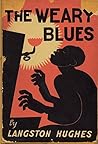
BOOKS: “The Weary Blues” by Langston Hughes

The Weary BluesThe Weary Blues by Langston Hughes
My rating: 5 of 5 stars

Available online — Lehigh University

Langston Hughes was one of the greats of 20th century American poetry, and The Weary Blues was his first collection (1926,) containing some of his most beloved (and anthologized) pieces, including: “The Negro Speaks of Rivers” and “I, too, sing America” [a.k.a. Epilogue; which plays off Whitman’s “I Hear America Singing.”] I’ve always loved how Hughes used the rhythm of repetition and the technique of standing in for the everyman (as he famously did in “The Negro Speaks of Rivers,” but in other of his poems as well.) He also had a gift for concision.

These sixty-nine poems deal in a wide range of themes including race, travel, love, etc. Music, be it Jazz or Blues, is an ever-present force in Hughes work. In addition to the aforementioned classics, among my favorite pieces from the collection are: “Winter Moon,” “March Moon,” “‘The Night is Beautiful'” [a.k.a. Poem,] “When Sue Wears Red,” “Water Front Streets,” “Long Trip,” “Seascape,” “Suicide’s Note,” “Songs to the Dark,” and “Lament for Dark Peoples.”

I’d highly recommend this collection for poetry readers.

View all my reviews

The Negro Speaks of Rivers by Langston Hughes [w/ Audio]

I've known rivers:
 I've known rivers ancient as the world and older than the flow of human blood in human veins.

My soul has grown deep like the rivers.

I bathed in the Euphrates when dawns were young.
 I built my hut near the Congo and it lulled me to sleep.
 I looked upon the Nile and raised the pyramids above it.
 I heard the singing of the Mississippi when Abe Lincoln went down to New Orleans, and I've seen its muddy bosom turn all golden in the sunset.

I've known rivers:
 Ancient, dusky rivers.

My soul has grown deep like the rivers.

BOOKS: Echo & Critique by Florian Gargaillo

Echo and Critique: Poetry and the Clichés of Public SpeechEcho and Critique: Poetry and the Clichés of Public Speech by Florian Gargaillo
My rating: 4 of 5 stars

Amazon.in Page

Out Now (May 10, 2023)

This book examines seven poets’ attempts to halt the proliferation of clichés, euphemisms, doublespeak, etc., words and phrases that not only corrupt the language but are often used to disguise bad behavior or to camouflage dismaying truths. It focuses on a technique, echo and critique, in which the poet employs one or more of these disconcerting words or phrases (or clever variants of them,) but does so in a way that reveals the chicanery within them.

The poets whose work is discussed are: Auden, Randall Jarrell, Langston Hughes, Claude McKay, Robert Lowell, Josephine Miles, and Seamus Heaney. These poets go head-to-head with cliché and doublespeak in the form of bureaucratese, propaganda, political speak, and business talk — with particular emphasis on war, race, and politics.

The book makes some interesting points. There are more readable discussions of the subject of corruption and manipulation of the English language, though none that I’m aware of on this particular approach to combating it. This volume is largely aimed at scholars, and not so much the popular readers. That said, I found it well worth reading.

View all my reviews