Wen Fu 11 “Banal & Sublime” [文赋十一] by Lu Ji [陆机] [w/ Audio]

Some shoots and stalks stand out --
Taller than the masses.
Their form eludes pursuit,
Sound slips through, like gases.
Great lines are always disjunct:
Don't weave with mid'ling lyrics.
They're pent up and peerless:
Chop them? A win that's pyrrhic.
Jade flecks make mountains shimmer,
Pearly waters enchant.
The thicket mustn't be clipped
If Kingfisher's glory, grant.
Stitched words end under snow,
Work the weft, steady and slow.

The original in Simplified Chinese is:

或苕发颖竖,离众绝致。
形不可逐,响难为系。
块孤立而特峙,非常音之所纬。
心牢落而无偶,意徘徊而不能揥。
石韫玉而山辉,水怀珠而川媚。
彼榛楛之勿翦,亦蒙荣于集翠。
缀下里于白雪,吾亦济夫所伟。

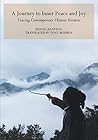
BOOKS: “A Journey to Inner Peace and Joy” by Zhang Jianfeng [Trans. by Tony Blishen]

A Journey to Inner Peace and Joy: Tracing Contemporary Chinese Hermits by Zhang Jianfeng (2015-04-07)A Journey to Inner Peace and Joy: Tracing Contemporary Chinese Hermits by Zhang Jianfeng by Unknown Author
My rating: 5 of 5 stars

Publisher Site

In 1993, Bill Porter (a.k.a. Red Pine) came out with a book called “Road to Heaven” that documented his experiences meeting with hermits in rural China. For many, both in and certainly out of China, the continued existence of this lifestyle might have come as a surprise. This book follows up over twenty years later, showing that Buddhists and Daoist hermits are still alive and well in the mountains of interior China.

The book not only offers beautiful descriptions of the lands where these men and women live, but also insight into their mindsets and how they live such minimalist lives. It’s a light and compelling look at individuals like those one might read of in “Outlaws of the Marsh,” only living in the present day (though living lives not unlike their historical counterparts did more than a thousand years ago.)

The book offers many color photos of the hermits and the landscapes in which they live.

I’d highly recommend this book for anyone interested in the way of reclusive existence.

View all my reviews

“‘Truth,’ said a traveller” [Poem XXVIII] by Stephen Crane [w/ Audio]

“Truth,” said a traveller, 
“Is a rock, a mighty fortress;
“Often have I been to it,
“Even to its highest tower,
“From whence the world looks black.”


“Truth,” said a traveller,
“Is a breath, a wind,
“A shadow, a phantom;
“Long have I pursued it,
“But never have I touched
“The hem of its garment.”


And I believed the second traveller;
For truth was to me
A breath, a wind,
A shadow, a phantom,
And never had I touched
The hem of its garment.

“Bad Government” by Guan Xiu [贯休] [w/ Audio]

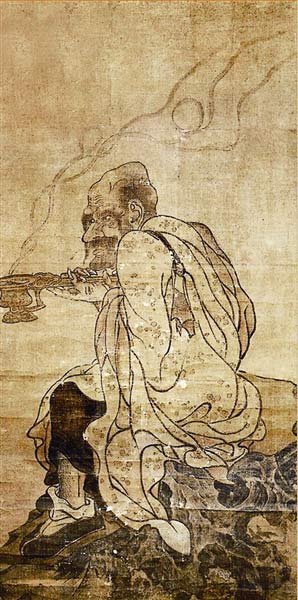
“Venerable Ingatha” by Guan Xiu [One of his 16 Arahat paintings]
Sleet and rain, as if the pot were boiling.
Winds whack like the crack of an axe.
An old man, an old man,
At sunset, crept into my hut.
He sighed. He sighed as if to himself,
"These rulers, so cruel. Why, tell me
Why they must steal till we starve,
Then slice the skin from our bones?

For a song from some beauty,
They'll go back on sworn words;
For a song from some tart,
They'll tear down our huts;
For a sweet song or two,
They'll slaughter ten thousand like me,
Like you. Weep as you will,
Let your hair turn white,
Let your whole clan go hungry...
No good wind will blow,
No gentle breeze
Begin again.

Lord Locust Plague and Baron Bandit Bug,
One east, one west, one north, one south.
We're surrounded.

NOTE: This the J.P. Seaton translation found in The Poetry of Zen (2004); Shambhala Publications: Boston, MA, pp. 67-68. For the author’s name, Seaton uses “Kuan Hsiu,” the Wade-Giles romanization of the name.

“Monody” by Herman Melville [w/ Audio]

To have known him, to have loved him
After loneness long;
And then to be estranged in life,
And neither in the wrong;
And now for death to set his seal—
Ease me, a little ease, my song!
By wintry hills his hermit-mound
The sheeted snow-drifts drape,
And houseless there the snow-bird flits
Beneath the fir-trees’ crape:
Glazed now with ice the cloistral vine
That hid the shyest grape.

“The Place of the Solitaires” by Wallace Stevens [w/ Audio]

Let the place of the solitaires
Be a place of perpetual undulation.

Whether it be in mid-sea
On the dark, green water-wheel,
Or on the beaches,
There must be no cessation
Of motion, or of the noise of motion,
The renewal of noise
And manifold continuation;

And, most, of the motion of thought
And its restless iteration,

In the place of the solitaires,
Which is to be a place of perpetual undulation.

“Drinking Alone in the Rainy Season” by Tao Yuanming [陶渊明] (a.k.a. Táo Qián, or 陶潜]

Whatever lives must meet its end --
That is the way it has always been.

If Taoist immortals were once alive,
Where are they today?

The old man who gave me wine
Claimed it was the wine of the immortals.

One small cup and a thousand worries vanish;
Two, and you'll even forget about heaven.

But is heaven really so far away?
It is best to trust in the Tao.

A crane in the clouds has magic wings
To cross the earth in a moment.

It's been forty years of struggle
Since I first became reclusive.

Now that my body is nearly dead,
My heart is pure. What more is there to say?

NOTE: This is the translation of Sam Hamill found in The Poetry of Zen (2004); Shambhala Publications: Boston, MA, p.24.

“Daybreak” by John Donne [w/ Audio]

STAY, O sweet, and do not rise!
The light that shines comes from thine eyes;
The day breaks not: it is my heart,
Because that you and I must part.
Stay! or else my joys will die
And perish in their infancy.

“To a Butterfly” by William Wordsworth [w/ Audio]

Stay near me—do not take thy flight!
A little longer stay in sight!
Much converse do I find in Thee,
Historian of my Infancy!
Float near me; do not yet depart!
Dead times revive in thee:
Thou bring'st, gay Creature as thou art!
A solemn image to my heart,
My Father's Family!

Oh! pleasant, pleasant were the days,
The time, when in our childish plays
My sister Emmeline and I
Together chased the Butterfly!
A very hunter did I rush
Upon the prey:—with leaps and springs
I follow'd on from brake to bush;
But She, God love her! feared to brush
The dust from off its wings.

BOOKS: “Rise of the Monkey King” ed. / trans. Jeff Pepper & Xiao Hui Wang

The Rise of the Monkey King: A Story in Simplified Chinese and Pinyin, 600 Word Vocabulary Level (Chinese Edition)The Rise of the Monkey King: A Story in Simplified Chinese and Pinyin, 600 Word Vocabulary Level by Jeff Pepper
My rating: 5 of 5 stars

Publisher Site – Imagin8

This is an abridged and linguistically simplified telling of the first two chapters of Journey to the West. It contains the birth story of Sun Wukong (i.e. the Monkey King) and describes his studies with a sage in an attempt to become immortal.

As someone learning Chinese but at a point where I can only read grammatically and lexically simple content, it’s not easy to find reading material that is both fun to read and readable. The discovery of this series was a godsend. It’s hard to get more thrilling than the story of the Monkey King, and it helps that I’ve already read translations – and so have a bit of context to piece together challenging sentences and to avoid the misunderstandings that can arise when reading a new language. It’s much easier to be a disciplined reader when reading something that is neither a children’s book nor the life story of a preternaturally typical person [which is the usual adult equivalent of a beginner level reader.]

I was pleased by how this book was laid out. Often reading material for learners puts the Chinese characters (hanzi,) the Romanized phonetics (pinyin,) and the English translation all in adjacent rows. While this has its advantages, it also makes it too easy to cheat by eye saccade and not be reading as well as one thinks one is. This book does have all three elements, but it alternates paragraphs of hanzi and pinyin but then puts the translation in an unbroken format after the Mandarin. The book also has a glossary of the book’s vocabulary.

Whether you’ve already read Journey to the West or not, if you’re just learning to read Simplified Chinese, I’d highly recommend this book.

View all my reviews