The Teapot Dome Scandal. Because of the way History is taught (or was in my day) I have this name indelibly etched in my brain (taking up valuable — i.e. limited — real estate) that has no significance because I have no idea what said event was. Was it about teapots? Was it about domes? Was it about both? If so, what’s a “teapot dome?” The curved part at the top? How big of a teapot related scandal could there be, really.
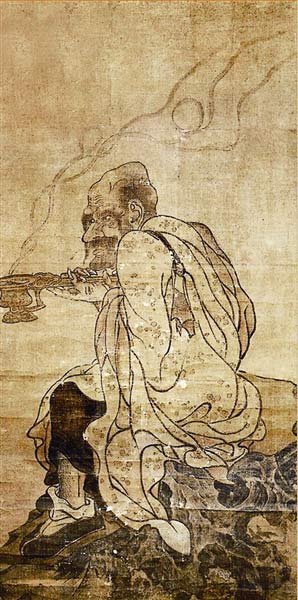
“Venerable Ingatha” by Guan Xiu [One of his 16 Arahat paintings]
Sleet and rain, as if the pot were boiling.
 Winds whack like the crack of an axe.
   An old man, an old man,
   At sunset, crept into my hut.
 He sighed. He sighed as if to himself,
 "These rulers, so cruel. Why, tell me
 Why they must steal till we starve,
 Then slice the skin from our bones?

 For a song from some beauty,
 They'll go back on sworn words;
 For a song from some tart,
 They'll tear down our huts;
 For a sweet song or two,
 They'll slaughter ten thousand like me,
   Like you. Weep as you will,
   Let your hair turn white,
   Let your whole clan go hungry...
  No good wind will blow,
  No gentle breeze
   Begin again.

 Lord Locust Plague and Baron Bandit Bug,
  One east, one west, one north, one south.
  We're surrounded.
NOTE: This the J.P. Seaton translation found in The Poetry of Zen (2004); Shambhala Publications: Boston, MA, pp. 67-68. For the author’s name, Seaton uses “Kuan Hsiu,” the Wade-Giles romanization of the name.
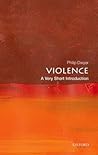
Publisher Site – Oxford University Press
This is a brief overview of various types of violence, starting with the question of what counts as violence. The book explores violent acts carried out by individuals, mobs, movements, governments, and religions. It reflects upon how the nature of violence has changed over the centuries while hinting at potential reasons for said changes (along with counterarguments.)
This book raised some provocative questions, such as: Why would people go to watch executions? Does Steven Pinker’s hypothesis that humanity is becoming less violent hold water? [Pinker made this argument in his book The Better Angels of Our Nature, but it has been refuted on number of grounds — definitional, methodological, etc. Though Dwyer only briefly touches on Pinker’s book and its critics in this book and a detailed critique will require looking elsewhere.] How (and why) do violent tendencies vary across cultures. And, when and how did governments end up with a monopoly on legitimate use of force.
I found this book interesting and informative and would recommend it for those looking for answers as to why and how our species is so violent.