Amazon.in Page
This is the autobiography of the comedic legend, Lenny Bruce. The first half (or so) of the book discusses Bruce’s life before standup comedy. This includes time as a sailor (US Navy) during the Second World War, as a sailor in the merchant marine, as a farmhand, and brief stint as a grifter. The second half takes place while Bruce is a working comedian but focuses heavily on his legal troubles including multiple Obscenity trials and one for Narcotics.
Being the work of a comedian, it’s no surprise that this book is funny — frequently of the laugh-out-loud variety. However, it may come as more of a surprise how interesting it is as the account of a man’s life. Besides some interesting stories, such as: how Bruce got discharged from the Navy, how he acquired priest’s uniforms to conduct a con, his experiences getting high with a Turkish sailor as a merchant marine, and the ins and outs of his marriage to a stripper, one gains some insight into Bruce’s philosophy and why he insisted on being maximally edgy, even at the cost of blackballed by clubs. The book holds up surprisingly well, considering it was first published in the early / mid-1960’s.
If you’re interested in outlandish people, standup comedy, or free speech, this book is well worth reading, and will not disappoint. (If you liked “The Marvelous Mrs. Maisel,” it’ll definitely be up your alley.)
Amazon.in Page
This play is an amusing cautionary tale on the dangers of “Bunburying” and / or leading a double life. “Bunburying,” a term coined by Wilde in this play, is the act of concocting meetings with a fictitious friend to get out of tedious familial (and other social) obligations. Don’t want to go to Aunt Bessie’s potluck? Tell her that your friend with a plausibly absurd name (e.g. Bunbury) has ruptured a disc in his back and desperately needs your assistance. Bunburying is the specialty of one of the two bachelor characters this story is built around, a man named Algernon. The other, Jack, goes by the name Ernest when he is in London, and has to invent the story that he has a brother when his town and country dichotomy of personalities starts to be seen through by those other than Algernon.
This humorous tale revolves around both Algernon and Jack finding desirable fiancés while being tangled in the web of their own duplicity. Much of the humor comes from the interactions of Algernon and Jack, two men who are quite alike, though Jack thinks himself more respectable. Algernon is more at ease with his own scamp-like nature and plays a role similar to that played by Lord Henry in Wilde’s novel, The Picture of Dorian Gray. That is, Algernon offers many a quotable line that at least has the appearance of wisdom — if, often, a kind of nihilistic wisdom.
The truth is rarely pure and never simple. Modern life would be very tedious if it were either, and modern literature, a complete impossibility!
Algernon
Oh! it is absurd to have a hard and fast rule about what one should read and what one shouldn’t. More than half of modern culture depends upon what one shouldn’t read.
ALgernon
It is awfully hard work doing nothing. However, I don’t mind hard work where there is no definite object of any kind.
Algernon
One has a right to Bunbury anywhere one chooses. Every serious Bunburyist knows that.
Algernon; [fyi: “Bunburying” is the use of appointments with ficticious individuals to get out of one’s duties and obligations.]
There once was a prolific reviewer
who reviewed everything from shipyards to sewers.
With great dispassion,
he reviewed an assassin,
and wished he'd written one review fewer.
A cow is an animal, &
animals are creatures.
So, having strong proclivities
is a cardinal feature.
Calling them "creatures of habit"
must be for a reason.
If creatures did not form habits
the term would lose cohesion.
But I digress, I must admit.
Let me get to my point.
You see, a sloping pasture must
be murder on the joints!
A random beast, who stood this way
& that, would balance out,
but standing each day - just one way -
could cause a hip blowout.
A cow that grazes on a pitch
must have unequal legs.
Maybe, all it would take would be
two tiny pirate pegs.
For wearing pegs on the downslope
side would align the hips,
but then on walks down to the barn
cows would be prone to trips.
For now, there's just one solution:
bovine chiropractors!
Because the cost will be so great,
I'm seeking benefactors.
So many historic figures
whose look we think we know.
Did Jesus of Nazareth sport
hippie hair & a halo?
Perhaps, he did have quite long hair
but not the tawny blonde
of which so many "portraitists"
seemed to be quite fond.
The Shakespeare that we recognize
is drawn from memory.
Kings oft declared true depiction
a form of treachery.
Past commoners' appearances
are lost in bygone days.
We know Van Gogh from a mad mind,
and know him thirty ways.
Do you know whose look we do know?
Every teen now alive.
There're pics from every angle
stored on redundant drives.
To find oneself within a crate -
packed inside and labeled "Freight"
seems like the worst that things can get,
but then I peered out through the slit,
and what a thing it was to see
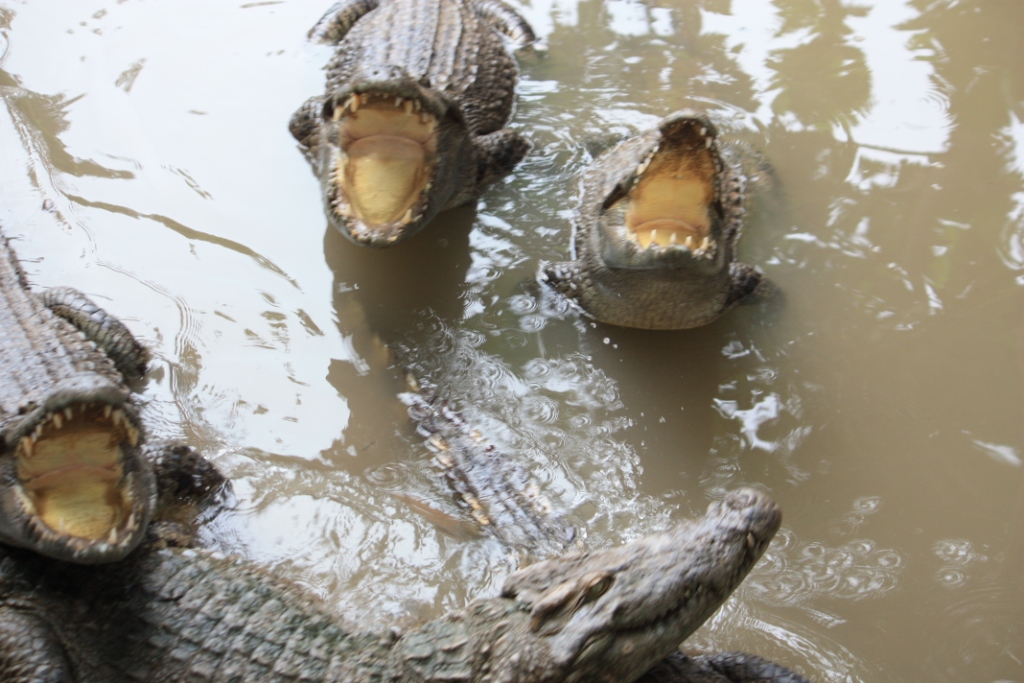
a croc's keen eye stare back at me.
It had so many freakin' teeth,
both on the top and underneath!
I concluded the box 'tweren't so bad.
To stay a while, I would be glad!
Nietzsche said:
“And if thou gaze long
into an abyss,
the abyss will also
gaze into thee.”
I must admit
the first several times
that I read this quote,
I couldn’t tell if it was wise,
or just had the patina of
wisdom that comes from
parallel sentence structure.
Crisscrossing subject and object
lends a ring of sagacity.
“If you can’t take
Mohammad to the mountain,
the mountain must come to
Mohammad.”“Ask not what your country
can do for you,
but what you can do
for your country.”“If you can’t get the carrots
out of the refrigerator,
get the refrigerator
out of the carrots.”
Yes, that last one is nonsense,
but it’s not nonsense like:
“The banana pirouetted fuchsia
all over the underside of
an A-sharp chord.”
The carrot quote probably took
your mind some time —
if only milliseconds —
to relegate to the
trash heap.
That’s why this sentence structure
is beloved by godmen &
politicians: because you can
sound wise even if you’re
kind of an idiot.
So, I was ready to classify Nietzsche’s
quote pseudo-wisdom when I realized
that my smartphone was the Abyss,
and it was certainly staring back at me.
It stared through all the data collection &
neuroscientific and psychological
research designed to keep
a person scrolling.
Maybe Nietzsche was on to something
that even he didn't fully understand.
A for Albatross:
"An Albatross around one's neck" is usually used by those who never read the opium-addicted Romantic's poem, and -- more importantly -- who don't have the foggiest what an "albatross" is.
B for Birds [and Bees]:
If you were really taught about "the birds and the bees," you are NOT prepared to have sex.
C for Cat:
A "cat nap" is a short sleep. I had a cat. It slept eighteen-hours a day, usually for several hours at a time. [Also, "'til the cows come home" means when you put the feed out. They will reliably show up. If your cows are coming home late, that's on you.]
D for Duck:
Re: "having your ducks in a row." Baby ducks naturally follow in a line. If you're having to man-handle your ducks into rows, you should learn wu wei - the Taoist principle of effortless action.
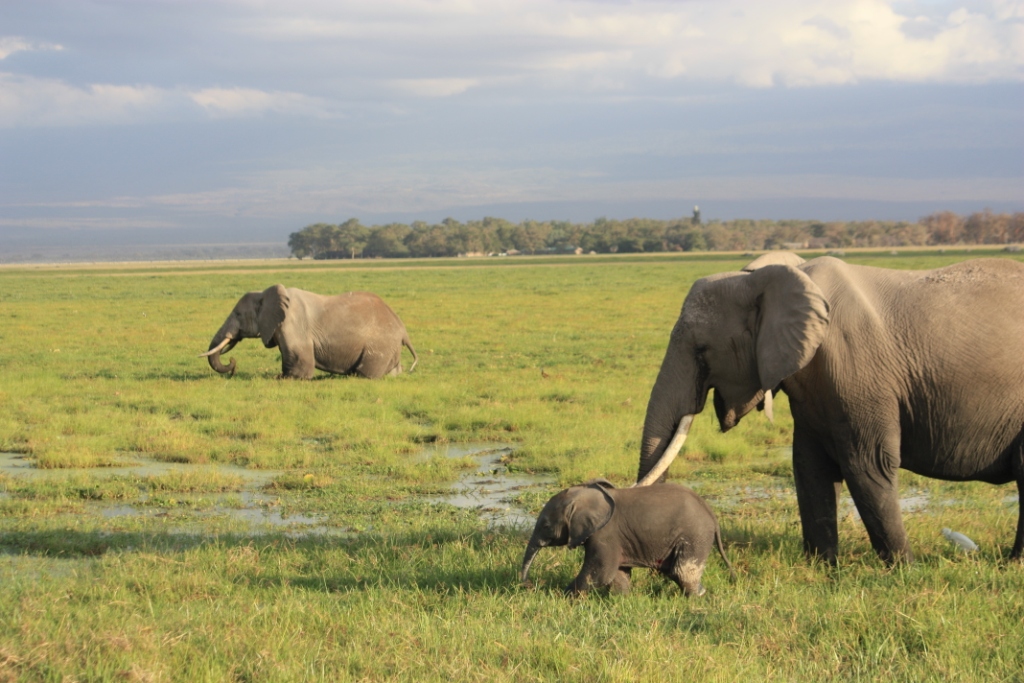
E for Elephant:
If there's "an elephant in the room," it is definitely not a good time to talk matters over. Get the hell out, now!
F for Fish:
"Fish out of water" may be fine, but -- to be fair -- "man in water" is just as accurate. A little waddling Gentoo Penguin could outswim Michael Phelps in the 400m and be finishing its kipper snacks while Phelps was still slogging through his first length. And Phelps is among the fastest our species can put in water. If the average human were dropped in the ocean, he'd thrash around until he got a lungful of water and died...and that's a kilometer offshore.
G for Goose:
With respect to a "wild goose chase"... fun fact: if you chase a goose, it might well chase you back. I once read a book on the most dangerous animals (for humans) and, to my surprise, the goose was in it. They don't kill many, but they put their fair share of people in the hospital with beak-cracked shins.
H for Horse:
So, about "straight from the horse's mouth." If you got your information from a talking horse and are proud that it was 'right from the source,' you might want to consider cutting your acid blotters into smaller pieces.
I for Indian:
Not sure how the term "Indian burn" came to be, but I've lived in India for almost a decade and have never known anyone to induce a friction burn by twisting the forearm of another person. You may be saying, "Well, it's meant as in, 'Native American burn.'" But I still don't see any evidence for that. [Don't get me started on 'Indian giving' as an insult against someone who has the gall to want their stolen shit back.] Now, if you called it the "shitty little American schoolboy burn," that -- I would totally buy.
J for Jackal:
Jackals are, like anyone who's ever eaten at McDonald's, opportunistic omnivores, but to make them out to be the exemplars of "exploiting situations' is a bit harsh. For example, did you know a Jackal won't cheat on its spouse, even when an opportunity falls right in its lap.
K for Kangaroo:
I don't know who came up with "kangaroo courts" but I don't think we know enough about marsupial jurisprudence to cast aspersions upon the Kangaroo legal system. I think it is -- like many instances on this list -- simply deflecting.
L for Leopard:
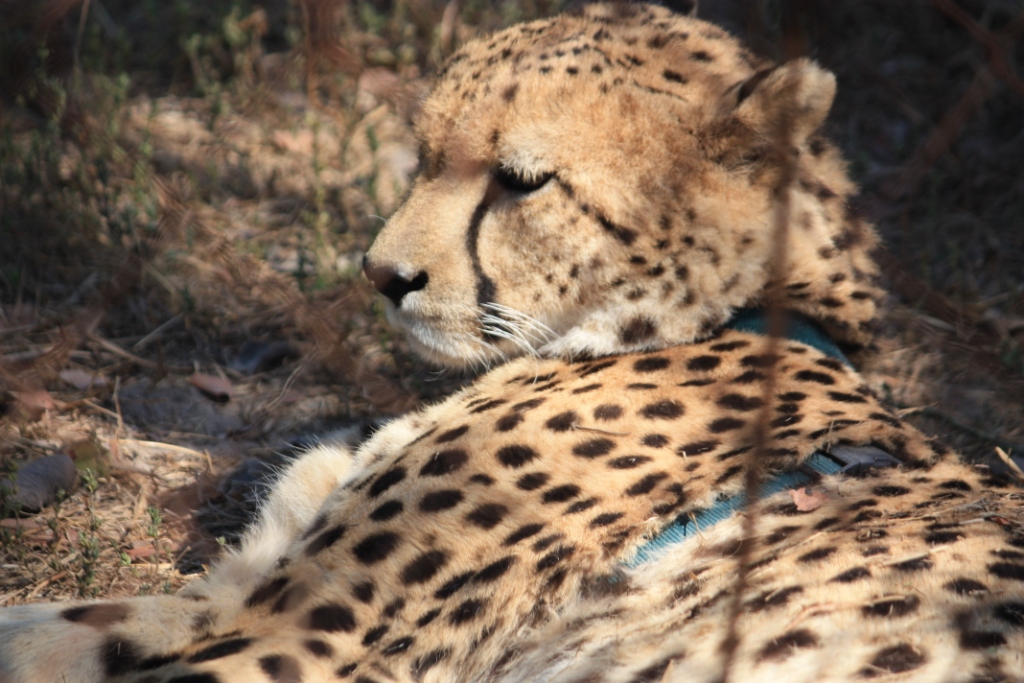
Why would a leopard even want to change its spots? Certain humans (frequenting the Wal-Mart) go to great lengths to appropriate leopard spots. If they are fashionable for a plus-sized woman's stretch pants, why would the leopard think any differently.
M for March Hare:
They say "mad as a March Hare" because March is mating season. I think the saying should be "Horny as a March Hare." Alliteration intact.
N for Nightingale:
I suspect ninety-nine percent of those who use "sings like a nightingale" couldn't pick a nightingale's song out of an audio lineup of bird noises.
O for Oyster:
"The world is your oyster" is supposedly a great thing. But when I elaborate by saying, "The world is your slimy raw foodstuff that has a twenty percent chance of making you vomitously ill," it doesn't sound like a good thing.
P for Pony:
We need to stop people from bitching about the fact that their pony only knows one trick. It's a fucking pony. You should be grateful it knows the one trick.
Q for Quail:
To "quail at ______" means to be timid in the face of some stimulus. I don't think it's particularly fair. If you were considered a delicacy, you'd be a bit skittish, too.
R for Rat:
If you "smell a rat," it's definitely dead, and -- ergo -- will not be plotting against you.
S for Sheep:
I shouldn't have to point out that a "wolf in sheep's clothing" is completely naked.
T for Turkey:
A "Turkey voting for Christmas" is said to be acting against its own interests, but since everybody eats turkey for Thanksgiving and many people have ham for Christmas, I'd say the turkey knows exactly what it's doing. Even if it's one of the unlucky Christmas turkeys, it still got another month of living. Hell, there are humans who rack up million-dollar medical bills for the same outcome.
U for Underdog:
The first use of the term "Underdog" was in 1859, long before the cartoon from my youth. Is there an "Uber-dog" or an "Overdog?" How did this even enter someone's mind?
V for Viper:
"A nest of vipers," is another bit of anthropomorphizing. The premise of the idiom is that it's a group of nasty people getting together. Whereas the snakes in a viper's nest are as likely to be as good as any.
W for Weasel:
When someone uses ambiguous words to obscure their meaning, we say they're using "weasel words." But as far as I can see, weasels have the good sense to keep their mouths shut. (Unlike those secret-betraying horses.)
X for XYZ:
People say, "for XYZ reasons" when they mean for an extensive list of reasons that no one seems to know.
Y for Yak:
Somehow, we use "yak" for the act of being relentlessly chatty, and -- once again -- I must say that I've found yaks to be less than gabby.
Z for Zebra:
"A zebra can't change its strips." See: "L for Leopard."