BOOK: “The Virtues of the Table” by Julian Baggini

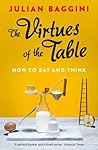
The Virtues of the Table: How to Eat and ThinkThe Virtues of the Table: How to Eat and Think by Julian Baggini
My rating: 4 of 5 stars

Publisher Site – Granta

This book examines the nexus of food and philosophy, from the ethics of butchery to the virtue of authenticity to whether hedonism is a necessary component of eating philosophically. Much of the book challenges or debates conventional wisdoms such as whether local foods are inherently better, whether dining is always and everywhere a social activity (or should be,) and whether organic is always preferable. The book covers a wide variety of topics including: mindfulness, gratitude, skepticism, fasting, willpower, spontaneity, technology, etc.

The book offers many ideas for reflection though sometimes it felt like it rambled on for more than the issue in question necessitated.

Each chapter ends with a discussion of a particular food and its preparation as thought relevant by the author. This is a nice grounding mechanism for discussion that tends otherwise to be cerebral and philosophic.

I’d recommend this book for anyone interested in thinking more about food and its intersection with philosophy of life.

View all my reviews

BOOKS: “John Brown” by W.E.B. Du Bois

John BrownJohn Brown by W.E.B. Du Bois
My rating: 5 of 5 stars

Available free online at Project Gutenberg

“John Brown’s Raid on Harpers Ferry” is one of those historic events like the “Teapot Dome Scandal” that American kids have to memorize a rote fact about to regurgitate on an American History test a couple times during their scholastic lives, never to be thought of much again, forever a familiar name lacking all depth of understanding. (At least that’s how it was in my day.) Unlike the Teapot Dome Scandal, which I suspect is not learned about in detail because it was somewhat complex and boring, I think the minimalist coverage of John Brown might reflect a bit of national embarrassment. For Brown’s tale is not complicated, and it’s certainly not boring. Brown thought slavery was an abomination, and he devoted his life to freeing slaves by whatever means he could, which culminated in a raid on an arsenal at Harper’s Ferry, West Virgina, at the convergence of the Potomac and Shenandoah Rivers, a raid intended to liberate weapons to the cause of arming freed slaves and other abolitionist fighters.

It’s a shame that more is not learned about John Brown because he was such a fascinating and principled individual, and in a sense his story isn’t just an embarrassing tale of a sparse few virtuous people against a mainstream that was — at best — indifferent to slavery. But there is a potential for pride in the fact that Brown and those who fought with him were able to see slavery for what it was and to stand strong against that mainstream, to make the fight of the oppressed their fight and — in the case of Brown and others — to pay the ultimate price in the conduct of that fight.

W.E.B. Du Bois’ biography of John Brown came out in 1909 and may not be written in the novel-esque style that a writer today would write it, but it is well-written and readable. Du Bois’ book is a full biography of Brown, if focused on his abolitionist aspect. Du Bois tells a little of Brown’s backstory and of his work life and then explores his experiences fighting in Kansas. However, this book does really shine in its account of the Harpers Ferry Raid and its aftermath.

Readers interested in American History or the biographies of virtuous individuals are urged to read this account of the life of John Brown.

View all my reviews

BOOK: “Trouble in Heaven” [Vol. 2 “Journey to the West” (西游记) Series] ed. by Jeff Pepper / trans. by Xiao Hui Wang

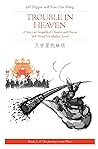
Trouble in Heaven: A Story in Simplified Chinese and Pinyin, 600 Word Vocabulary Level (Journey to the West in Simplified Chinese)Trouble in Heaven: A Story in Simplified Chinese and Pinyin, 600 Word Vocabulary Level by Jeff Pepper
My rating: 5 of 5 stars

Publisher Site – Imagin8

This is an abridged and linguistically simplified telling of the story of chapters three and four of the Chinese classic novel, Journey to the West. It is written and organized for learners of Chinese who would like to start reading in Chinese.

The events covered in this volume are Monkey King’s (a.k.a. Sun Wukong’s) acquisition of weapons for himself and his companions, his discovery that his name is on the registry of the underworld (and, thus, he’s not as immortal as he’d believed at the end of Vol. 1,) his ascension to heaven where he is given the job of stable manager (a life and job he is happy with until his discovery that it is the lowest level job in heaven,) and his skirmishes with the forces of heaven when he takes on the title “Great Sage Equal to Heaven.”

The story is conveyed in Simplified Chinese script, and has pinyin interspersed at the paragraph level. I like this arrangement because one has access to the pinyin as needed, but it’s not immediately adjacent (as it is with many starter readers,) such that it’s not possible to “cheat” by seeing the pinyin in one’s peripheral vision. It also offers an English language telling of the story, but after the entirety of the Chinese. The book also has three glossaries that collectively define all the terms used in the book. The first contains all the proper nouns, the second is all the basic words, and the last is all the words that are a little outside the most basic reading level. (The latter are also footnoted throughout the text.)

I’m enjoying this series. It’s a gripping story, it’s arranged in a way that encourages one read by the Chinese characters alone, and it is readable by the most beginning level student. That’s a combination that isn’t readily found. I’d highly recommend this series for those learning to read Chinese.


View all my reviews

BOOKS; “Rental Person Who Does Nothing” by Shoji Morimoto

Rental Person Who Does NothingRental Person Who Does Nothing by Shoji Morimoto
My rating: 5 of 5 stars

Publisher Site — Harper Collins

This quirky little book is the memoir of a man who formed a business lending himself out as “rental person who does nothing.” At the time the book came out, Morimoto did this without charging his “customers” anything except travel expenses and any food and beverages consumed as part of the activity in question. [As I understand it, he eventually began charging a per session fee ($85 USD at the time of the 2022 BBC piece on him that I watched.)] The book does discuss Morimoto’s thoughts about how to charge (i.e. hourly or per session,) how much to charge, whether to find a different financing model (e.g. sponsorship or patronage,) and why he ultimately rejected them all (at least for a time.) In fact, the whole penultimate chapter (ch. 4) is about the economics of his business.

The most interesting aspect of the book is the psychological insight on offer. The first question that arises is why people would use a stranger for these activities, and not a friend. One might jump to the conclusion that the people who use his service have no friends, but this is generally wrong. There are a number of reasons why people who have friends use his service. First, many times friends can’t just sit and listen empathetically, but rather they have to try to solve the problem. This can be irritating because it is often dismissive of the challenges confronting the other person. But also, as Morimoto points out, it also creates a hierarchy (a top dog) in what would otherwise be a co-equal relationship. A fascinating second factor pointed out by the author is that adults, unlike children, rarely have general-purpose friends. Adults, instead, have contextual friends. So, if one wants to engage in an activity that is outside the domain of one’s contextual (work, bar, hobby, etc.) friendship, it might not be easy. There are many other psychological insights relating to what people ask him to do, the issue of reciprocity, and what Morimoto defines as “doing nothing” for the purposes of this business.

I found this quick and simple book to be packed with insights into human nature, and I’d highly recommend it for readers interested in what makes people tick.

View all my reviews

BOOK REVIEW: “War is a Racket” by Smedley D. Butler

War is a Racket: The Antiwar Classic by America's Most Decorated SoldierWar is a Racket: The Antiwar Classic by America’s Most Decorated Soldier by Smedley D. Butler
My rating: 5 of 5 stars

PDF available online

This impassioned essay is a call for a more restrained — some would call it isolationist — application of military force. Regardless of how one might feel about the isolationist stance, you’ll likely be moved by the essay’s central premise that we have too much war because it’s profitable — not profitable for those who fight and die in wars but for businessmen and politicians.

Butler, a US Marine Corps General, was a fascinating character — a two-time Congressional Medal of Honor recipient who served in the Philippines, Tianjin (during the Boxer Rebellion,) at various places across Central America and the Caribbean, and in the First World War in Europe. He was also a whistleblower about a plot to unseat FDR. Butler writes in a conversational style that exudes a commanding presence.

I’d highly recommend this essay for its critical insights by one of the most impressive Marine Corp officers of all time.

View all my reviews

BOOK: Sát Thát by Lê Vân [Illustrated by Nguyễn Bích]

Sát ThátSát Thát by Lê Vân
My rating: 4 of 5 stars

Publisher Site – Kim Dong Books

This illustrated book tells the story of the Vietnamese (Tran Dynasty) victories over the invading Yuan Dynasty (Mongolian-controlled China.) It’s a quick read with only a few lines of text per page, while the bulk of each page is a line-drawn monochrome illustration. The illustrations themselves are sufficiently clear and detailed to allow one to follow the general flow of the story.

I used a translator and don’t know how accurate it was or –more particularly — how true to the original it was, except to say that the translator produced a coherent story that seemed to be consistent with other sources.

This book focuses entirely on the military campaigns and takes a bit of a jingoistic tone. As I understand it, it doesn’t tell the whole tale as many consider the Mongol incursions to have been successful because they exacted a tribute from the Vietnamese (which was their ultimate goal,) despite the Mongols’ lack of military success. That said, it was an impressive set of military victories for the Tran Dynasty, and the Vietnamese have every right to take pride in them.

I discovered this book in the publisher’s bookstore in Hanoi and thought it was a small enough text with sufficiently detailed illustration to give me some insight into the story, even without any real grasp of the language. I did find reading the book to be informative and interesting and would recommend it for readers military history.

View all my reviews

BOOK: “The Future of Humanity” by Michio Kaku

The Future of Humanity: Terraforming Mars, Interstellar Travel, Immortality and Our Destiny Beyond EarthThe Future of Humanity: Terraforming Mars, Interstellar Travel, Immortality and Our Destiny Beyond Earth by Michio Kaku
My rating: 4 of 5 stars

Author Booksite

As the title suggests, this is one of the books for which theoretical physicist Michio Kaku dons his futurist cap to speculate about what is to come. Other of his books that might be included in this “series” are: Visions, Physics of the Future, The Future of the Mind, and Physics of the Impossible. This particular book focuses on how humanity will spread beyond the planet (and, perhaps, beyond the universe) to survive the (probably distant, but – also – inevitable) threats to the species. While there are other topics discussed, such as the search for immortality and transhumanism, those topics are often framed as necessities of interstellar expansion.

As one would expect of a physicist, the book is highly focused on the physics of the subject. There is little discussion of the psychological difficulties, nor of biological issues such as the fact that humanity is not so lone wolf as we think, and taking off to other planets and living in space without the Earthly life we are interdependent on would involve challenges we have difficult fathoming. All of the challenges that are usually treated with handwaves in science fiction are also handwaved off here.

The book is fun and interesting reading. It’s probably more insightful of science fiction than of our future, but that doesn’t make it less compelling. The seven years since this book was published have seen a lot of change, and there may be a book on this subject that has more of a finger on the pulse, but I still enjoyed reading it. [The downside of writing about the future, even with a focus on the distant future, is that one risks becoming obsolete rather quickly.]

If you’re interested in how humanity might survive into the future, I’d recommend this book. If you enjoy popular science and / or science fiction, you’ll probably find it intriguing.

View all my reviews

BOOK: “How to be an Alien” by George Mikes

How to Be an Alien: A Handbook for Beginners and Advanced PupilsHow to Be an Alien: A Handbook for Beginners and Advanced Pupils by George Mikes
My rating: 5 of 5 stars

Publisher Site – Penguin

This book is hilarious… unless you’re British — in which case it probably reads like a swift kick in the crotch. Well, if you’re from continental Europe, many of the comparisons with Britian are no more favorable to Europe and are just as comically searing. But if you’re American, it’s a laugh riot. Well, except for when it delivers reminders of the absurdity of xenophobia, triggering realizations that one’s own country is in the midst of a crisis of that malady. However, the book is not primarily a rebuke of xenophobia, but rather an accounting of what immigrants to Britain find strange and unwieldy about their new country.

George Mikes, born Mikes György, was a journalist and humorist of Hungarian birth who lived most of his life in England, and it’s this experience that the author draws upon to describe of what immigrants to Britain must accustom themselves.

Among Mikes’ prolific body of writings, there are a number that take this form — humor disguised as a how-to guide. The first one that I read was How to Be God, which was his last such book. The book under review was his first and continues to be the most popular.

I’d highly recommend this book for humor readers… unless you’re British… or European… or are experiencing dread over the Pheonix-like rebirth of xenophobia in the world. If there’s any one left after that who reads in English, this is the book for you.

View all my reviews

BOOK: “Long for this World” by Jonathan Weiner

Long For This World: The Strange Science of ImmortalityLong For This World: The Strange Science of Immortality by Jonathan Weiner
My rating: 4 of 5 stars

Author’s book site

This book considers the science around the question: will there come a day when human beings live forever (or at least considerably longer than we’ve achieved to date? — i.e. hundreds or thousands of years.) A secondary question, explored in the last of the book’s three parts, is should we want to?

It was a courageous decision to write this book because it focuses heavily on the ideas of one particularly controversial figure, Aubrey de Grey. And by “controversial” I don’t mean to the general public, a public which has limited understanding of the science involved, but rather a man who is controversial to many (perhaps, most) of his peers. Of course, with a Pulitzer under one’s belt, one can afford to take a few chances. (Weiner won in 1997 for The Beak of the Finch, a popular science work on evolutionary biology.) To be fair, Weiner does not present Grey’s ideas from the perspective of an acolyte. On the contrary, he is clearly skeptical and not shy about presenting the countervailing arguments put out by others in the gerontological field.

I can see several reasons why Weiner chose to focus on Aubrey de Grey. First, De Grey is an eccentric figure, and that makes for more interesting reading. Second, De Grey also takes the boldest possible stance on the topic (i.e. that there is no reason humanity won’t be able to overcome aging and death, given sufficient time and effort.) Finally, De Grey has a readily digestible roadmap for eliminating aging. De Grey identifies seven problems that must be solved, arguing that the last — i.e. defeating cancer — is the only one that will present a true challenge in the long run.

While I wasn’t converted to a belief that immortality is inevitable (and that wasn’t the book’s objective, though it may be de Gray’s,) the book does offer interesting food-for-thought, both on the scientific question of what it would take and on the philosophical question of whether we should want to.

If you’re interested in aging and mortality, I’d recommend reading this book.

View all my reviews

BOOK: “Hell’s Angels” by Hunter S. Thompson

Hell's AngelsHell’s Angels by Hunter S. Thompson
My rating: 5 of 5 stars

Publisher Site – Penguin

This, the first published book of Hunter S. Thompson, is said to be from his pre-Gonzo period, but it bears many of the hallmarks Thompson would later be famous for: inventive colorful language, immersion in scenes of debauchery, and insight into the American cultural landscape.

The book is part exposé of the Hell’s Angels motorcycle gang, an organization shrouded in a reputation that was as much myth as reality and whose tightknit inner circle made obtaining an accurate picture a challenge. It would take someone as fearless / crazy as Thompson to get close enough to learn about the gang and then to tell enough truth to make at least some of the members unhappy.

The book also takes the temperature of America and reports on what ails the country. One might think this would not be worth reading, given that its insight of America is from the late sixties (it came out in ’67.) However, as I read the penultimate chapter, I was surprised to find how much of what was being said could be seen as prophetic. Thompson wrote about the Angels not as a romantic throwback to wild west outlaws (as many saw them,) but as a class of people who were ill-equipped to make a living in an ever more technologically advanced America, leaving them with little money and loads of resentment. He wrote of them as “prototypes,” and his description connects up to the latest model. It was at that point that I started seeing Thompson not only as a brilliant creative writer, but — perhaps — as a prophet.

I’d highly recommend this book for anyone curious about the Hell’s Angels or American outlaws, more generally.

View all my reviews