Hitler killed the short-stache (a.k.a. the “toothbrush mustache.”) Imagine that, almost 70 years after his death, he still holds power over people’s decisions about facial hair.
This is a misplaced take-away lesson. It’s the unbridled narcissism, the icy hatred, and the irrational exuberance in the power of evil of Hitler that should be abandoned (yet, somehow, those intangibles still quietly exist.) It’s not the superficial aspects of Hitler that should be shunned, but the ones at the bastard’s core.
I’m not saying the toothbrush-stache was a good look. On the contrary–as one who has had a mustache his entire adult life and has worn a beard now for several years–I’m a little offended by the lack of commitment to one’s choice of facial hair that the toothbrush-stache represents. (Incidentally, I feel the same about the sole patch and mutton chops.) In my mind, one should go full-stache or go home to shave.
Still, there being no accounting for taste, I think those individuals who would otherwise find the short-stache appealing (i.e. you know, indecisive types who wear culottes and eat with sporks) should revive the toothbrush mustache as a big fuck-you to Hitler–don’t let tyrants boss you around from the grave.
Toothbrush mustache admirers of world, unite! (No, I won’t be joining you.)
In the interest of enhancing global understanding and camaraderie, I’ve built a translator of common first world (FW) problems–putting them in terms of their Rest of the World (RoW) equivalents.
FW: This food needs salt.
RoW: This food needs food.
FW: My health insurance premiums went up $20 per month.
RoW: My right foot, which recently turned from purple to black, just fell off.
FW: My car is in the shop again.
RoW: My right foot, which recently turned from purple to black, just fell off.
FW: It’s raining again today.
RoW: My house was washed off its foundations and is currently floating down the Brahmaputra River.
FW: Looks like those devils from the other party got a majority in the legislature.
RoW: This coup was particularly bloody.
FW: Squirrels are getting into my bird feeder.
RoW: A tiger ate my family.
FW: A traffic jam made me late for Pilates class.
RoW: While limping through the Kyber Pass to get antibiotics for my right stump, I was socked in by an unanticipated blizzard.
FW: My GPS says this road cuts under the interstate, but now I’ve got to go around.
RoW: What’s GPS?
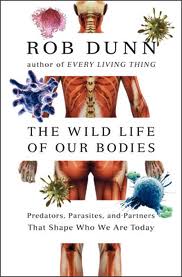
I was sitting at an outdoor cafe as I thought about how to write this post. I’d just finished reading chapter 5 of the Rob Dunn book entitled The Wild Life of Our Bodies, and was reflecting upon how interesting it was to be reading two books whose central premise–in broad brush strokes–was the same. As I was ruminating, a family of four–a couple and their two daughters, an infant and a preschooler/kindergartener–came and sat down at an adjacent table.
For a while the preternaturally-cute infant crawled around on the table top, but as the mother became concerned that the wriggly little child might fall or spill scalding coffee, she eventually set the child down. The child proceeded to crawl around on the ground–ground on which one could easily imagine pigeons trolling for crumbs. [Full-disclosure: I didn’t actually see any pigeons, or even any noticeable filth on the ground for that matter, and–while this is India–it was a major coffee chain attached to the side of a popular up-scale shopping mall, and so that particular ground was probably at least hosed down daily.] The child crawled on all-fours, except that she had the plastic number placard which told the waitress where to bring the order in one of her hands, and she would alternate between dragging it across the ground and–when she got tired of crawling–she would roll onto her rump and pop a corner of the placard into her mouth.
If reading the preceding scene made you a bit queasy, you should be reading one [or both] of books mentioned above. Doing so gave me a totally different perspective on this event. There was a point when I–like many–would have assumed the little girl would get some sort of ailment and that her parents would pay in lost sleep for letting the kid crawl on the ground in an urban public space, but I’m now more inclined to think that probably nothing will happen, and she could–theoretically–end up better off for the wear. I’m not advocating wallowing in filth, but I have come to see biological stressors in a new light. I wouldn’t go so far as to advocate letting a child crawl around sticking things in his or her mouth that have been on the ground at a cafe, but it would no longer surprise me to hear that this child lived a healthier life than children of germophobic (properly “mysophobic”) first-world moms who are about one cookie-off-the-kitchen-floor from forcing their children to live in a bubble.
The reader may be wondering two things: 1.) how these books could mitigate one’s queasiness, and 2.) what the books even have in common. If you’re familiar with Nassim Nicholas Taleb, it’s likely you associate him with criticisms of the misuse of statistical methods, and the failure to understand under what conditions the usefulness of these methods break down. While Taleb does consider a wide range of examples in his popular books Black Swan, Fooled by Randomness, and–most recently and most relevantly–Antifragile, the world of business is where Taleb’s background lies and where much of his discussion is centered. The Dunn book, one the other hand, fits squarely in the domain of biology and medicine.
Both of these books take as their core idea that there are systems that must face constant and occasionally serious challenges to grow stronger, and that the removal of these challenges can have adverse and sometimes dire consequences. Taleb looks at such systems in a broad and general sense, and coins a term, “antifragile”, to describe such systems. A system is antifragile if it gets stronger (i.e. in some way better) when subjected to stresses. This shouldn’t be confused with robustness, which is being indifferent to stressors. Robust systems can take or leave stressors, but antifragile systems need them or they become weakened. Dunn’s book deals with a specific example of an antifragile system, our guts. The biologist suggests that our war on parasites and germs has created a whole raft of problems never before seen. It’s probably not a new idea to most readers, as there are ongoing arguments about the risks of our antibacterial frenzy.
While first-world dwellers tend to take a superior view of those poor third-worlders and their myriad ailments–a number of which have been stamped out in the developed world–Westerners may not even be aware that there are a number of ailments that exist almost exclusively in the first world. Increasing evidence is developing that certain forms of diabetes and allergies are linked to “clean living.” Interestingly, while one might readily imagine how a digestive tract ailment like Crohn’s Disease is tied to insufficiently populated digestive ecosystem, there’s reason to believe that diverse issues such as autism and anxiety disorders may also be linked to loss of internal predators and the imbalances their loss causes.
It’s not entirely a coincidence that I’m reading these books concurrently. I’ve been interested in the issue in a broad sense as of late. How does the craving of comfort weaken a population? What are the risks of indiscriminately weeding the stressors out of one’s life? (As seems to be a major objective of modernity.) Of course, stressors are not eliminated, but instead stressors that are relatively feeble may become the 800 lb. gorilla of stressors.
Amazon recently put out a list of 100 Books to Read in a Lifetime. I appreciate the mega-bookseller taking a less doctrinaire approach than, say, The Guardian’s 1000 Novels Everyone Must Read. Also, props to Amazon for including a number of contemporary works—though I guess that is self-serving of them (i.e. $10 versus $0 sales price)—so never mind.
Whenever I see one of these lists—and there are so many of them—I always feel a bit inadequate. I suspect I’m not alone, given a recent generic list posted by The Millions, entitled 28 Books You Should Read If You Want To. That author’s approach is laudable. She doesn’t hand out exact titles as if we all need the same books, but rather suggests the kind of books one should consider reading (but only if you want to.)
I read like a fiend. While I usually don’t read rapidly (I can; I learned how in grad school, but I prefer savoring to injecting words), I’m constantly reading. So it’s a little disappointing to see how I stack up in the grand scheme of list-makers.
So this brings me to the point of this post, which is to boost my self-esteem by building a list of books, all of which, I’ve read. As I considered the books I’ve read that I would be so bold as to recommend “everyone” read, I saw trends. First, I read a lot of thin books, or, perhaps, they stick with me more. Don’t get me wrong, I’ve read some monsters Moby Dick (on everybody’s list—I don’t know why), Atlas Shrugged (on the Libertarian Book-of-the-Month Club list, and not much else), and 1Q84 (given a few years, it’ll be on all the lists.) However, it’s the thin books that have stuck with me, and they often get kicked aside by the [other] pretentious list makers. Also, shorter forms (e.g. essays, short stories, poems, and novellas) often don’t get properly recognized because everyone wants to talk about novels and tomes.
Second, while I like to consider myself an international reader (e.g. I’ve read a fair number of translated Japanese and Chinese classics), the fact of the matter is that I’ve had a skewed reading history. I’m an American, and have disproportionately read books that are either by Americans or that speak to the American worldview / mindset (my list will be both.) This isn’t so much an issue for most of the list makers as they simply propose that every Nigerian, Thai, and Peruvian should read a canon devoid of any Nigerian, Thai, and Peruvian authors (but instead that is 50% British, 30% American, and 20% all others.) While the list may be targeted toward U.S. audience, these books are good for everybody, and everybody should read outside the familiar.
Without further ado, my list, 30 Thin Books That Every [Attention-Challenged] American Should Read:
Because poetry is good for the soul. Yes, this anthology is skewed toward dead poets, but it’s not only thin, it’s cheap. It’s got Whitman, Dickinson, Frost, Sandburg, and Hughes.
Because, screw totalitarianism, that’s why. This is like 1984, but without the villainy clubbing one over the skull. Therefore, you can introduce the kids to commie-hating early and without giving them nightmares—well not bad ones. Plus, it’s thinner than 1984.
Because virtue is good for the soul. This is Plato’s account of Socrates’ defense at his own trial and his subsequent explanation of why he was going to drink the hemlock. Yes, it’s technically three books, but they are often bundled together as one book. Even with all three, it’s pretty thin.
Because Orwellian dystopia isn’t the only dystopia. In Huxley’s book, tyranny wasn’t a matter of force, but manipulation. This book shows how dystopia can be disguised as utopia by keeping the population adequately drugged and well-sexed.
Because satire is good for the soul. No sacred cows escape roasting in this thin volume. A naïve young man travels out into the world to find that evil is ubiquitous.
Because how often does a book coin a common phrase. (FYI- “A Clockwork Orange” was a phrase Burgess borrowed for the book that was common in some parts, but Heller invented the term “Catch-22.”) The story revolves around the notion that one can’t get out of the war by reason of insanity, because if one is trying to get out of the war one is sane by definition, and if you are insane, you don’t try to get out.
Because if you’re going to break the law, you should know how to do it do it virtuously and not like a dirtbag. (Hint: It’s more painful than you think.) This essay tells of Thoreau’s imprisonment because he refused to pay taxes that would fund the war with Mexico. It’s usually bundled with other essays.
Because books are good. The title comes from the temperature at which books burn, and it’s set in a dystopian future in which the protagonist, “Fireman” Guy Montag, goes around collecting and burning books.
Because you should know how to turn someone down (e.g. I would not eat them on a boat, I would not eat them with a goat.) Or, because learning to be playful with words may serve one well. Or, because you should try new things. In the story, an unnamed narrator is subjected endlessly to green eggs and ham, which he steadfastly, refuses until the end.
Because you think you’ve got a weird family. Hamlet exacts revenge when he finds out that his uncle killed his father to marry his mother and usurp the throne.
Because you don’t want to underestimate Mother Nature when you strike out to build your indomitable American spirit. This is the true story of a college graduate who gives away his bank account, burns his pocket-money, cuts ties with his upper-middle class family, and sets off to become self-made. Ultimately, he ends up in Alaska, and it does not end well.
Because, stop being such a gloomy-Gus. Admittedly, this is an unconventional choice– both because it’s not particularly skillfully written and a few of its conclusions may not be as true as they once were. However, it does inject a dose of reality for those who view the world through shit-colored glasses. As the title suggests, the authors argue that life in America is getting better year after year. We are getting healthier and richer. Being economists, they present much of their findings as graphic representations of statistical data.
Because sometimes the world actually looks better through shit-colored glasses, Seriously, because you need to know how to get on with it when life is at its toughest. Viktor Frankl was a psychiatrist and Holocaust survivor who writes about what kept people going at places like Auschwitz.
Because, just get on with it. This was actually a kind of “Notes to Self,” written by the Roman Emperor to remind himself to be virtuous, to live, and to not fear death.
Because you don’t get enough of the word “rickety” these days. But seriously, you get to “see” a lot of America through Kerouac’s poetic language. It follows the road trips of a beat generation protagonist through America.
Because Faulkner’s language rocks, and this is a gripping and gritty tale. It’s the story of an upper class co-ed who’s dragged down into the underworld and some desperate times by a couple bad decisions, not the least of which was going for a ride with a stupid drunk.
Because you need a pep talk to think for yourself. Emerson proposed that one stand as an individual and stop letting political parties, religions, or other organizations decide what one believes. Emerson and Twain both saw a sad trend brewing in which people were starting define their beliefs by identifying with a party and then letting that party’s opinion leaders tell them what to think. Sadly, this trend only grew since there day to the point that many people have extremely strong beliefs that they can’t begin explain in a logically and factually consistent way.
Because one day China is going to collect on our debts, and well need some grasp of their culture. Seriously, you should read outside your culture. In the process, you’ll find that the Taoist stream of thought isn’t all that far off our own—“f#@k authority and pretentiousness and all the bureaucratic formalities.”
Because, screw Melville, this is the great American novel. Yes, I realize that it’s not particularly thin, but compared to Moby Dick it is—and it reads more quickly because there aren’t long drawn out sections on the minutiae of whale pineal glands and what not. This book follows the adventures of that rapscallion, Huck, as he flees a drunk father and a lady who wants to make him civilized, and takes to rafting on the Mississippi with an escaped slave. Yes, it has the n-word like a billion times, but if you read all the words (and not just that one) you’ll see there’s a positive message about the development of mutual friendship and respect between Huck and Jim.
Because you need to get outside more. It’s the story of a dog who is taken from the good life as a pet in California to the wilds of Alaska, and what said dog must do to survive.
Because you need to be concise AND coherent. In the age of Twitter, people are mastering the former while losing the latter. This is a thin books that tells you most of what you need to know to write intelligibly in English.
Because America has a dark side, and nobody writes it better than Poe. Any of the many collections of Poe’s short stories (some including poems and/or long-form works) will do. One definitely wants “The Pit and the Pendulum,” “Tell-tale Heart,” “The Murders in the Rue Morgue,” “A Descent into the Maelstrom,” and, of course, the title poem.
Because we need an injection of Stoicism to counteract the prevailing trend toward whining and moaning. Epictetus was a slave who became one of the most famous Greek sages. His sayings are mostly about not crying over spilt milk, but to be careful not to be the one who spills the milk. In other words, don’t whine about what the world gives you, devote your energies to being virtuous and conscientious.
Because you should understand your place in the ecosystem, and Lewis Thomas describes it artfully and concisely. This is a series of essays that covers a lot of ground with respect to the subjects of biology and physiology.
Because you may just want to take over the word someday. This is advice about how to rule. It may not make one popular as a middle manager, but there are bits of wisdom throughout.
Because someday it’s all going to come to an end, and it will probably end badly. This is the story of a father and son wandering through a post-apocalyptic wasteland. I realize I’ve put a lot of dystopianism on this short list, but I’m going to say that’s part of the American condition. America has had it good for long enough to realize that all things come to an end.
Because we should not give the short story short shrift, and Hemingway—like Poe—did them well. Besides the title story, this collection includes “The Killers”, “The Gambler, The Nun, and the Radio”, and “A Clean, Well-lighted Place.”
Because you need to get out of the country and experience some of the rest of the world. This is about the travels from Paris to Pamplona of a group of men who’ve all fallen for the same woman with that woman—of course—along for the ride.
Because you need to get out of the house, away from your cubicle, and out into nature. This is an essay extolling the virtues of putting one foot in front of the other like you mean it.
This is the story of a little boy’s dreamtime journey to a world inhabited by “monsters” and his interaction with them. Like Green Eggs and Ham, you should have read this as a kid. If you didn’t, I’m sorry about your defective parents, but get over it. Since you probably don’t want to read this as an adult on the Metro going to work, you can get Christopher Walken to read it for you on YouTube.
So that is it. That is my list of 30 Thin Books that Every [Attention-Challenged] American Should Read.
I saw a review of Anne Rice’s book recently, and it got me thinking about how an actual interview with a vampire would go.
Interviewer (I): So, about this whole turning into a bat thing. It seems to me that a man is much bigger than a bat. Therefore, my first question is do you conserve mass? In other words, do you get really dense as a bat, and, if so, how do you even get off the ground? If not, you must shed mass, but then how do you get it back?
Vampire (V): I am the prince of darkness. I rule the night. I take whatever form suits my needs.
I: Well, that’s not really a proper answer, now is it? That’s sort of a politician on the Sunday morning talk shows answer.
V: [Bares fangs and growls]
I: Well then, moving on. Are you at all concerned about the many blood-borne illness out there: HIV, Hepatitis, Ebola, Rift Valley Fever, etc.?
V: I’m immortal. I can’t be killed by your puny germs.
I: So, that’s a… no?
V: Hrrumph!
I: Moving on. Have you ever had anyone put Vaseline on their neck or something else really gross–you know to prank you?
V: You suck!
I: One could say the same of you, my friend. Ha!… You know… because you suck on people’s necks… Well, then, moving on. Which would you rather have: a wooden stake to the heart or a silver bullet in the chest?
V: Silver bullets are for werewolves, you imbecile.
I: Yeah, but it’s still got to be quite unpleasant, wouldn’t you say?
V: [Sighs loudly] OK, I’d have to take the silver bullet, but the longer this interview goes on, the more fond I grow of the stake.
I: I love steak, too, but that’s besides the point. Any way, who would you rather have as an enemy: Bram Stoker’s Van Helsing, who’s very smart but has no kung fu; or the Hugh Jackman Van Helsing who’s all buff and studly but not the sharpest tool in the shed?
V: It matters not. They are both humans and, as such, no match for me.
I: Really, because in both the book and the movie…
V: [hisses like a rabid cat, fangs out] Human propaganda. Are we done yet?
I: Not quite. What’s the hurry? Got a hot rendezvous with a Victorian wench on the docket?… Anywho. What would you say are the pros and cons of working the night-shift? I’d think it would be rather easy to get a parking space, but, then again, you don’t really need one if you turn into a bat. But, then again, all that flapping must get tiring…
Among the Kindle Daily Deals yesterday was a book entitled Escape from North Korea: The Untold Story of Asia’s Underground Railroad by Melanie Kirkpatrick. It was well-timed to a news story about a Korean War Veteran, Merrill Newman, whose video statement as a prisoner of the DPRK was released the same day. Anyway, I bought the book and I’m hooked. The stories it contains are a mix of chilling and thrilling.
As I began reading, I wondered why no one had made a major Hollywood blockbuster based on an escape from North Korea. It’s a journey fraught with peril. There’s so much to go wrong from being shot in the back crossing the Tumen River to being repatriated to being double-crossed by smugglers to falling into the hands of traffickers or other predators. Adding to the challenge is the fact that most North Koreans are severely undernourished, and each is on his or her own for the first part of the trip–getting across the border. Furthermore, it’s not uncommon for North Koreans to stick out physically because they’re unusually small and, as pointed out by one of Kirkpatrick’s sources, prone to bad hair and split ends.
I know these are words that writers despise but the screenplay practically writes itself.
Then I remembered, oh yeah, this will never be a movie because China’s government would be one of the villains, and Hollywood isn’t in the business of making films that PO the Chinese any more. Why is China the villain? Well, it’s not the main villain. That distinction, of course, goes to the Kim dynasty, presently personified by Kim Jong Un–who has been the biggest bastard yet when it comes to escapees. China’s policy is one of repatriation. It would be kinder for China to just execute the North Koreans themselves. One of the stories early in the book is about an entire family that was to be sent back who–having eaten their first decent meal in a long time–decided to die full and committed suicide while in Chinese custody. Lest one think that this is a Communist thing, Kirkpatrick points to Vietnam as one of the countries that quietly helps North Korean escapees get to safety. Like the democracies that do so, Vietnam keeps this on the down-low to avoid cheesing off the Chinese, but at least they do it.
Why would such a movie be good? Because everybody needs to know what’s going on, and movies are the surest injection point into the public consciousness. There have been books and documentaries about this for years, but I don’t think most people realize how bad it is.
I should point out that there have been films on the subject. The Crossing, made in South Korea, is probably the most well-known feature film on the subject. It’s about a father who crosses the border to get medication for a wife, but ends up stuck on the other side of the border during which time his wife dies and his boy becomes–for all intents and purposes–an orphan. This film is apparently based on a true story.
And there have been a number of documentaries on the subject. The Defector: Escape from North Korea is one of the best.
This is the book trailer for the Kirkpatrick book.
Left to its own devices, the mind is like Indian traffic: chaotic, noisy, slow-moving, relentless, and brimming with latent rage. Meditation is a tool to help unsnarl the traffic jams so that one can observe the mind as something other than indecipherable chaos.
Meditation isn’t the end game. If one goes to the gym daily to lift weights, but one has no interest in–or use for–putting one’s muscles to practical use, one is engaging in an act of vanity more than one of personal development. In the same way, if one builds one’s awareness of the mind, and doesn’t use it for betterment in one’s daily life, what is the point? What do I mean by betterment? I mean defeating the petty elements of one’s nature that cause oneself and others suffering and that keep one living in a world of delusion.
Meditation trains one to take note of the daydreams and obsessive thoughts that run through one’s mind, and to do so progressively sooner—before they can coalesce into a full-blown avalanche of negativity and delusion. In meditation, we observe these errant thoughts and then let them float on down the river. As one lives one’s waking life, however, one may take time to consider what these thoughts and daydreams are doing for one. Often one can remain ignorant of the purposes these thoughts serve, realizing only that they make one feel better temporarily.
A few of the purposes that these errant thoughts may serve are:
martyrdom (i.e. thinking the world is against one so whatever goes wrong is the result of outside forces)
-ego-boosting (imaging one has the confidence to do something one doesn’t in reality)
-empowerment (fantasizing one has power in the face of feelings of powerlessness)
-wishful thinking (imagining a perfect life just a PowerBall ticket away)
So, if these thoughts make one feel better, why shouldn’t one let them fly? For one thing, they keep one from seeing the situation as it is. The fantasy or obsessive thought becomes one’s reality and one remains ignorant of what is real. The problem is that if one wants to fix the problem, one must know what it is (i.e. have a true view of it.) If one imagines that one has no role in the problem, then how can one fix the problem? If the problem is one’s unhappiness, one can always do something—even if one can’t change the external situation. One’s unhappiness is a function of one’s mind, and is, therefore, under one’s control.
Second, by giving into obsessive thoughts and fantasies, one becomes dependent upon them as crutches, and becomes stuck in a cycle of helplessness.
Third, when one removes oneself from the problem, one denies one’s power to change the situation—or the emotional result. One makes oneself vulnerable to manipulation. If one doesn’t recognize the ability of another person to “make one mad,” one denies them that power. (But this requires accepting that one has a responsibility for one’s emotional state, a sometimes uncomfortable proposition.)
I have a theory that the steadfast pursuit of an enlightened mind will either result in enlightenment or insanity. Why should it result in insanity? Because, the process involves stripping away the coping mechanisms that got one through each day. If one has the internal confidence (i.e. fudōshin, or immovable spirit) to stare in the mirror and see one’s flaws and weaknesses, one may achieve an enlightened state. If one lacks such confidence, seeing those flaws and weaknesses may be depressing. Of course, fudōshin is just one side of the coin, it also matters whether one has the relative freedom from stress to lead an introspective life or whether one feels the constant pressure that propels most people back into old habits. It’s easier to make positive changes when one’s life radically changes, then the power of routine and habit lose hold.
The challenge is that the pursuit of an enlightened state of mind is a constant job. Some branches of Buddhism and other mystic religions suggest that enlightenment is a tipping point, and that once one achieves that state one is forever enlightened. I’m not in a position to refute such beliefs, but it seems that it’s more like being a sober AA member–there is an ever-present potential to revert to old habits of the mind. So, one must be ever vigilant. There’s no rest until one is dead… as far as I know.
I was writing some six-words on Smith Magazinethe other day. I do this now and again as an exercise to get the creative juices flowing. There are a series of themes, and I try to write in as many of them as I can in less than 20 minutes, writing in a free form, stream of consciousness style.
When I got to the category HAPPINESS the first six-word to jump to mind was: “Picture your unhappiness in its underwear.” This one drew a nice response, which began me thinking about whether this advice might have actual merit–as opposed to being a non-nonsensical statement that might at best function as a Zen koan.
As I thought about it, three legs of the stool came to mind.
1.) Have a sense of humor. Anger and sadness have a hard time taking hold if one can manage a good laugh. I’ve found that being able to dance personal tragedy into comedy has been a great coping mechanism. One does have to be conscientious about not becoming a snarky person. One risks beginning to see the world through a crap-colored lens just as a means to comic fodder (or from a martyrdom complex.)
Perhaps even if one can’t formulate humor, one can still use laughter. There’s a system called laughter yoga that is based on the belief that you can create the same range of physiological responses from “forced” laughter as one does from spontaneous laughter. It’s a sort of chuckle pranayama (breathing exercises.) While I don’t know much about the system, I can believe that it has merit based on what I’ve read about human emotions.
2.) Lay the source of your unhappiness bare. This sounds simple enough. One must know what is making one unhappy in order to turn that frown up-side-down.
That being said, human beings have an astounding ability to attribute all negative happenings in their lives to external factors. Like politicians, we like to take responsibility for what is going right (regardless of whether we are responsible or not), and we love to place the blame for failure firmly elsewhere (even it it’s mostly our fault.) This may be an evolutionarily-hardwired coping mechanism, but it can keep one in the doldrums. If one continually says, “He makes me so mad” or even, “His actions make me so mad,” then you’re forfeiting control over your emotional state. Jerks and bitches might be an intermediary cause of unhappiness, but ultimately one’s own perceptions and responses lead to the negative emotional state.
This is where the hard work of mind training comes into play. Instead of being swamped by negative thoughts, one has to recognize them early, find the root cause, and recognize that our desire to for things to be a certain way is ultimately what makes us unhappy. We may want people to think we are smart or beautiful, and intimations to the contrary (whether intended or not) make us fume.
Don’t be an angry monkey!
One of the few things I remember explicitly learning in high school was about what our psychology teacher called a “gestalt of expectations.” Like most ideas one remembers though only taught once, I remember it because it had a memorable story attached to it. The story goes like this: “A man is driving through the desert in the American southwest. Now, out in the southwest, gas stations can be few and far between. So the man runs out of gas, and realizes that the station he passed 20 miles back is his safest bet because–contrary to what he had thought– the next one going forward might be another 50 miles. So he starts walking. It’s hot. He’s hungry. He’s thirsty, and only has some lukewarm water that’s getting hotter by the minute. The backs of his hands and his face are getting sunburned. He starts thinking about how the little two-pump gas station is going to gouge him. He realizes he’s desperate, and so he figures the attendant is probably going to sell him gas at $6 a gallon, a bottle of cold water for $8, and don’t forget the jerrycan at $20. These thoughts and the heat keep making him madder and madder. Finally, he gets to the station, and the attendant comes out and say, ‘Oh my, Mister, you must have had a horrible time.’ And so the man on the verge of heat-stroke punches out the attendant, a kid who only wanted to help him out.” Once one starts attributing one’s unhappiness to external sources, one can easily mis-attribute unhappiness because one thinks one knows what is in the minds of others, when really one doesn’t.
3.) Unhappiness, like standing around in one’s underwear, is–at most–a temporary state. As Taoists have been known to suggest, one’s darkest hour is a time to rejoice, for surely it will get better from there. The only way one can remain in a perpetually unhappy state is to carry it with one long past its time. Just like the only way that can always be rained on is if one carries around a complicated mechanism with a showerhead and tank and keeps refilling that tank so that the shower never runs out. Otherwise, the dry season will come eventually.
I get that nobody cares about the backside of a rodent. It’s clearly the toothy, gnawing front end that’s on people’s minds. So how is a “rat’s ass” synonymous with “flying fuck?” This isn’t a rhetorical question, people. I’d really like an answer.
So the fact that it’s preceded by “Who gives a…” makes me assume that a “flying fuck” isn’t anything that anyone much cares about. It’s like a rat’s ass, a goat’s gonads, or politician’s promise–no one cares. But wait. It seems to me that a flying fuck would be something that all parties concerned would take great interest in. Alright, I’m not hip to all the maneuvers of the Kama Sutra, but I imagine a flying fuck to be when a man with a woody gets a running start, leaps up in the air in a horizontal configuration, and comes down so as to impale his partner’s lady bits. That’s like throwing a javelin to land a whole-in-one in the cup on the green of the 9th hole.
Is this a flying fuck?
Even if I was a thrill-seeker, unconcerned about the threat of a sprained penis (it’s a real thing, look it up), I think my wife would care enough to be firmly opposed. If people weren’t scared of the flying fuck, it’d be all the rage.
Alright, let’s assume I’ve misinterpreted the term. Let’s say that a “flying fuck” really refers to being a member of the Mile High Club. Everybody cares about that. The man wants to celebrate it. The woman doesn’t want to be caught in a slutwalk of shame back to her seat. You can be damn sure the guy who’s locked out of the lavatory after having eaten a vending machine tuna salad sandwich from Concourse B cares greatly. Everybody cares about the flying fuck.
I can’t even imagine what else a flying fuck could be, but whatever it is I have trouble believing that nobody cares.
It can’t just be the alliteration. Acrobat’s accountant, billionaire’s bunion, crooner’s cookie-jar, etc… are all alliterations that we care less about than a flying fuck.
So if you can shed some light, I’d be happy to hear an explanation. I do, truly, give a flying fuck.
India, land of the Kama Sutra, is prudish. America is known for being pretty puritanical–at least if you don’t compare it to Muslim countries. In the U.S., for some reason, we would rather a child see a human cleaved into eight individual pieces with a machete than to be witness to a nipple slip. Well, India censors the innuendo and sexual references that sailed right past the FCC.
On the street, my wife and I can expect odd looks for holding hands and worse for a smooch. In the city, this rarely amounts to more than a sidelong glance, but we’re told in the countryside the people can be more vocal. (We’ll see, we’re planning our first trip into the countryside for next weekend.) On the other hand, young men routinely hold hands with other men, and the same is true of pairs of young women. Same-sex hand-holding is par for the course, but hand holders of the opposite sex are breaking mores. Some may say that the difference is same-sex hand holding isn’t sexually-charged, but I think it strains credulity to think both that different-sex hand holding is always inherently sexually charged and same-sex hand holding is never sexually charged.
Anyway, one would expect that a country that was so comfortable with same-sex public displays of affection (PDA) would have liberal views about homosexuality. No. Until 2009 homosexuality was a crime, and there is still rampant Ahmedinejad-style denial that homosexuality exists in this country. (Ahmedinejad is the Iranian president who– in an act of denial that was stunning, though in character–stated that homosexuality doesn’t exist in Iran.) To add another wrinkle, I’ve read that some men, who would be fighting-mad to be described as anything other than straight, routinely engage in behaviors that most would find indicative of homosexuality or bisexuality (we are talking well beyond hand holding or a kiss on the cheek here.)
There are a couple of reasons why young people who vehemently identify as straight might engage in sexual behaviors that are not. First, there are those who are homosexual and are either in the closet or in denial. One expects that there are many people who fit into this category in India because of the tremendous pressure to live a traditional family life–whatever else one may do on the side. In many countries, “denial” and “the closet” might cover the gamut of explanations for such anomalous behavior. However, in India there is a second reason that one might associate with places where men and women are strictly segregated over long periods of time (think a prison.) That is some of these the aforementioned people presumably are heterosexual, but have no sexual outlet because they don’t have any private interactions with people of the other sex who are not their blood relatives. So in an ironic twist, in society’s attempt to rigorously enforce and control a “traditional” paradigm of heterosexual familial units, more unions that do not fit that model are created than otherwise would be.
So you may be wondering whether I’ll be explicit about what I find “puzzling” about Indian sexuality. It’s a little puzzling that the culture that brought us the Kama Sutra and vast orgiastic bas reliefs on the temple at Khajuraho would have a problem with a couple hugging in the park or who choose for themselves with whom they are intimate. The overwhelming trend across most of the world is to become more tolerant of consenting adult’s freedom to exercise their sexuality as they see fit. Granted, there are certainly other examples where there has been a countervailing trend. Caligula’s Rome versus the Rome of today. Also, it should be noted that over a recent time span India seems to becoming more tolerant, and thus following the trend—if slowly.
Another thing I find puzzling is that by some measures the Indian approach seems to work. Following the incentives, I’d expect the Indian system of arranged marriage and limited premarriage intergender interaction to result in nothing but heartache. Indians will point out that their divorce rate is infinitesimally low. However, one then has to then consider other questions such as whether it results in more spousal murders, marriage related suicides, and vow-breaking. In other words, are there other means of marriage terminations that take place in a society that for all intents and purposes doesn’t allow divorce?
There is something particularly pernicious in Indian society called dowry murders. This is when a man and his mother set the man’s bride on fire so that they can erase the marriage and start all over in search of more bling. (That’s got to max out the bad karma.) Dowries were made illegal because of this, but both dowries and dowry murders continue. India does have a high suicide rate (though not as high as the US’s), but I have no idea whether any studies have been done to try to isolate the role of a bad marriage. I also can’t say whether there is evidence that “stepping out” on the marriage is higher in India. While there is plenty of evidence that this goes on, like anything related to sex, few Indians talk about it.




















 Tiger Riding for Beginners