If you could go back in time and give your younger self advice, what would it be?
Don’t be an ass!

If you could go back in time and give your younger self advice, what would it be?
Don’t be an ass!
Change your relationship to sensation.
Feel it all but stop assigning it meaning and value judgements.
The best advice I ever got was, “Don’t give unsolicited advice!” It surprised me a little because I wasn’t even talking to the guy. A stranger just came up to me out of the blue and shouted it in my face… but it is wise advice.
“Shut the hell up!” Sadly, more often than not, no.
Be your authentic self.
And stop touching yourself so much.
But the first advice wouldn’t be understood, and the second would be ignored, so I’m not sure that it would be a productive undertaking.
“Never argue with a stupid person. In the end, they’ll still be stupid, and you’ll just be frustrated.”
Eat more veggies, mind your joints, beauty is everywhere, all is impermanence, and very few things in life actually matter (see item 4.)

Don't fill your vaults with glowing, shiny stones.
It's invitation to all cheats and thieves.
Don't know by mind what you don't know by bone.
Make sure you've lost before you up and grieve.

Then when you grieve, take time to fully feel.
Don't let your mind write stories so untrue
that they turn melancholy like a wheel
that gathers and grows with each turn anew.

Be kind and true, but not so kind and true
so as to kill with gifts or a mean tongue.
Don't do what would be best that you not do,
and only sing of those heroes unsung.

Oh, every piece of wisdom has its day,
so don't hitch so tight that you're led astray.
A few weeks ago I did a post entitled, 10 Easy Pieces of Wisdom: and Why “Secret Wisdom” is Bullshit. That article’s premise was that understanding what one needs to do to be wise is simple, but the process of doing it is inescapably arduous–often to the point of seeming Sisyphean. (For those who aren’t brushed up on their Greek Mythology, Sisyphus was the guy who was punished by having to roll a rock up to the top of the hill only to let it roll back down, and the repeating the process ad infinitum.) I’m not saying that it’s a Sisyphean task, just that it can feel that way and one has to press forward through that feeling.
This post has the same premise, but applied to fitness. Fitness and wisdom have more in common than you might first think–they are both about improvement of the self. Unfortunately, the commonality that’s relevant here is that both invite crowds who will try to convince you they have an end-run around hard work. One of my past martial arts teachers, who was also in law enforcement, said that “cons only work on people with larceny in their hearts.” So it is that the con-men that are trying to sell “enhanced formula supplements” or “a 15 minute per week workout” can only sell to the people who want something for nothing. (Clue: what you get for nothing is nothing worth having.)
Without further ado, here are the 10 easy pieces:
1.) Know Thyself. This is a two-parter:
First, don’t let your ego write checks your body can’t cash. Some students want to jet right into the most advanced exercises. That’s like a third grader taking trigonometry; it’s ultimately less than productive. These are the individuals who tear ligaments, and who you don’t see again for six months–if ever. For virtually everyone, advanced exercises–be it a muscle-up or a yogasana like Urdhva Dhanurasana (A wheel pose, chakrasana, that is entered from a standing back bend)–require a lot of time spent in capacity building via fundamental exercises.
I’ll give an example, I saw someone on television yesterday doing the most horrendous single-armed push up. The only thing that kept this individual from damaging himself is that his range of motion was so tiny (he may have still injured himself.) His problem is that he heard that single-arm push-ups were cool, and he wanted to get straight to it. In reality, one needs to build into that exercise starting from a good solid standard push up, and then doing preppers (preparatory exercises) that gradually shift the load onto one arm. But maintaining form as well as one can. For example, putting one hand on a block off to the side, and gradually shifting it out to arm’s length.
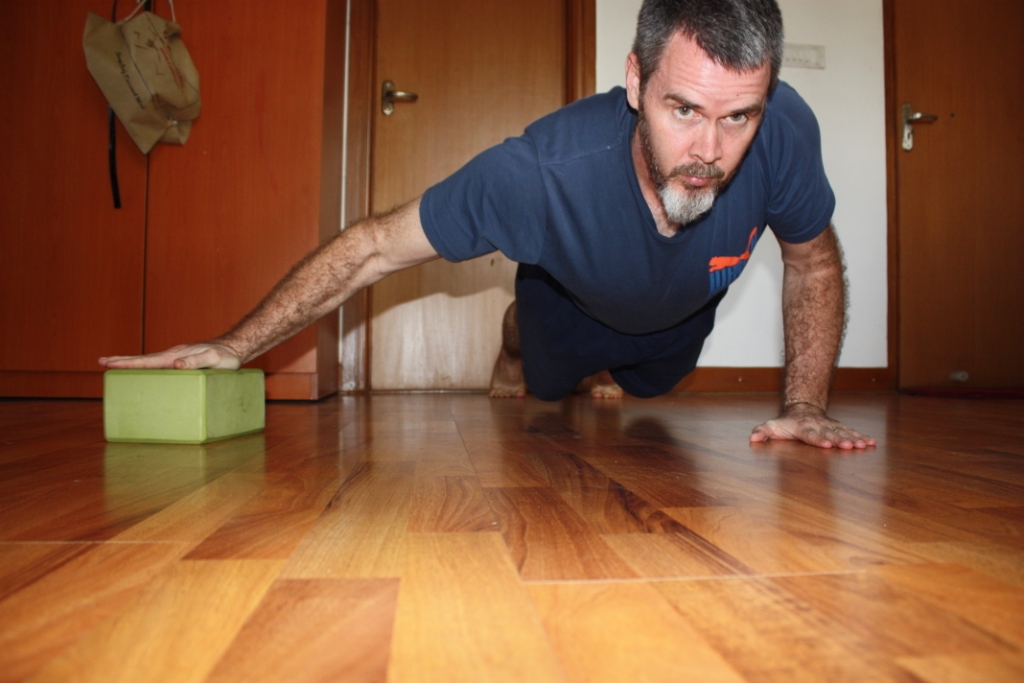
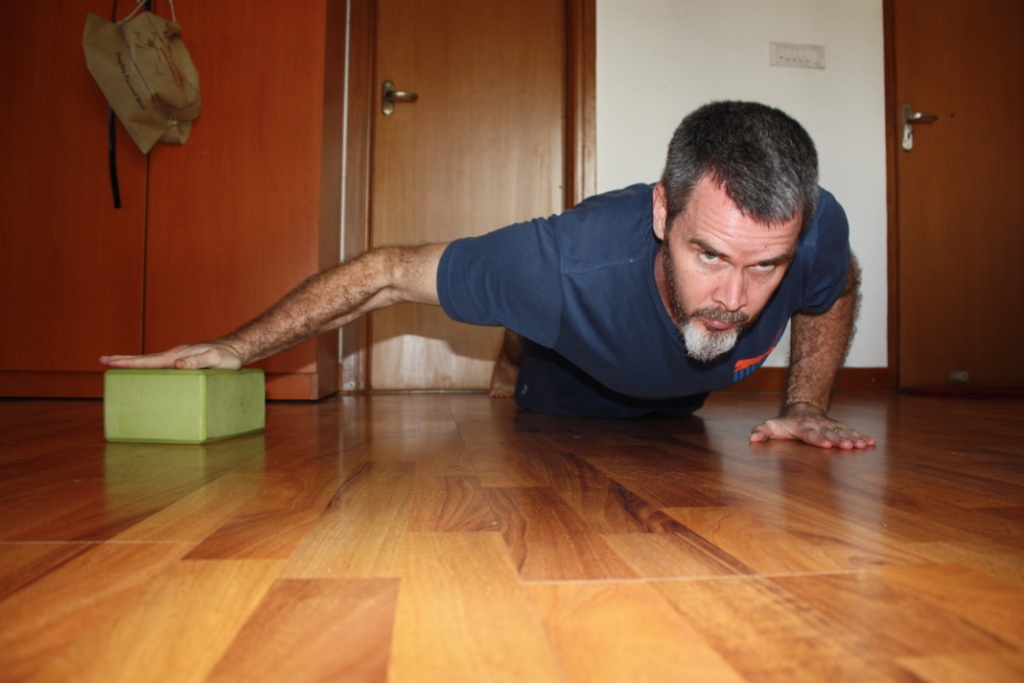
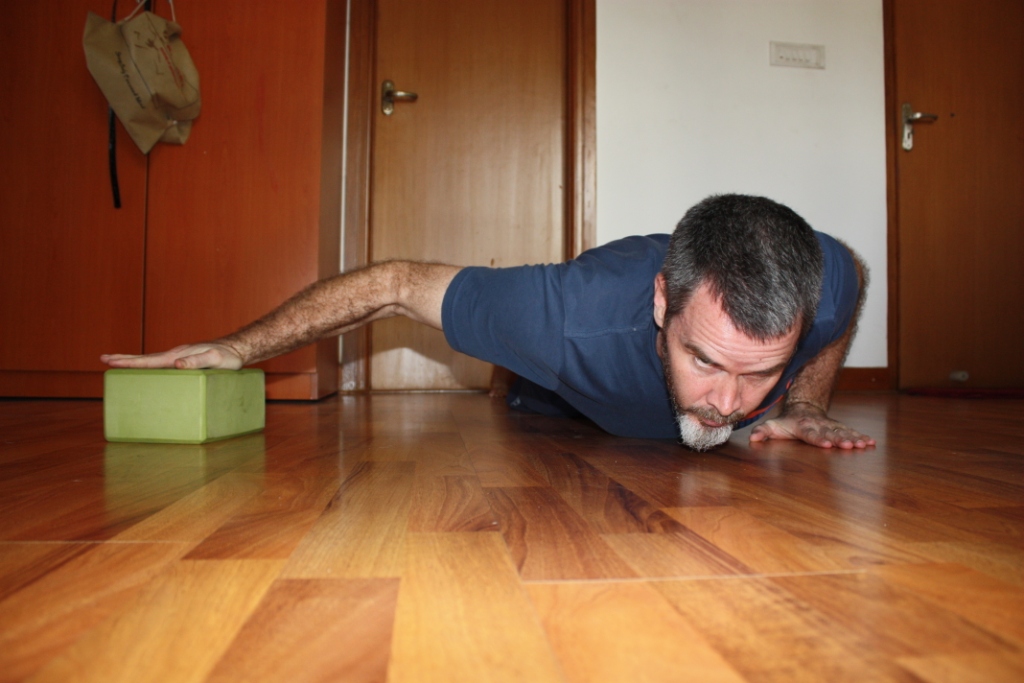
Second, on the other hand, don’t half-ass everything because you mistake discomfort for agony. This confusion cause people to greatly underestimate their capabilities. While you may think your teacher or trainer is a Sadist (only rarely are they are, really), the fact is that they are trying to give you one of the greatest gifts you can ever receive, which is the realization that you are capable of far more than you think you are–if you’re willing to gut it out through the challenging parts.
2.) Diet is the 800 pound gorilla of cutting weight. The simplified mathematics of this that adding exercise (while critically important to fitness) only marginally adds to the calories burned part of the equation. (Believe it or not one burns a lot of one’s calories just through baseline activities–breathing, walking, sleeping, etc.) However, when you cut caloric intake that’s all reduction from the intake side of the equation. However….
3.) Don’t make your goal weight loss, but rather to have a healthy and more functional body. Weight loss tends to be about external validation. That is, one wants to appear more attractive to someone else (or everybody else.) That’s a sucker’s game. People won’t necessarily notice–depending upon how often they see you and how self-absorbed they are. If you shed pounds at a healthy rate, people around you all the time don’t necessarily notice a day-to-day change.
On the other hand, as one starts feeling healthier and develops movement capacity beyond your previous capability, that can’t be taken away by anyone.
4.) When your body has been properly prepared through fundamentals, advanced maneuvers practically fall into place. I was taught a scorpion prepper just a couple of weeks ago, and was surprised to find it was much easier than expected. I still have a lot of work to do to take it to the full pose. For example, I’m still using a wall so I don’t over-rotate in the arched back position, but I bring my heels off the wall once I’m up. Next I’ll do away with the wall. Then it will be time to start bending my knees. My point is that work on back stretches, core strengthening, and headstands made it relatively easy to get into the first stage.
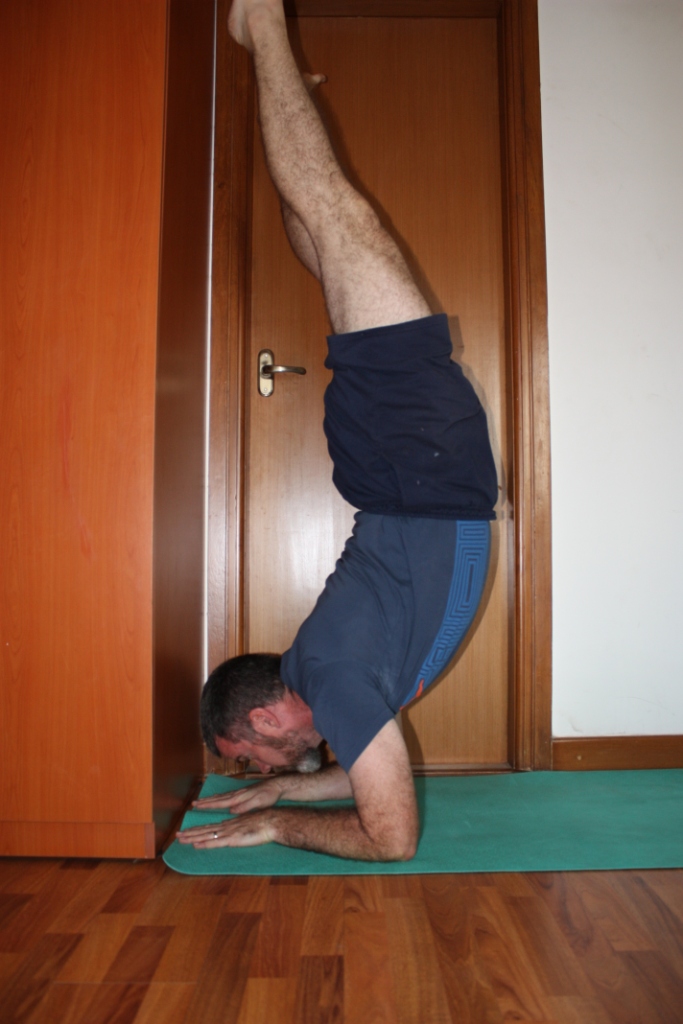
5.) Reveling in small victories can kill progress. The handstand provides a classic example. In the beginning, one starts kicking up against a wall. Even this can be a challenge in the beginning. However, as soon as it becomes doable, one should start gradually taking the training wheels off. This may begin as cautiously as pulling one leg away from the wall at a time. Then do away with the wall altogether. Then the suffering begins anew as one sheds the kick up in favor of a more controlled manner of ascent into the handstand.
6.) Don’t be quantitative. A journalist once asked Muhammad Ali how many sit-ups he did in his training regimen. Ali said, “I have no idea. I don’t start counting until they start hurting.”
I’ve heard guys pleased with themselves because they do “sets of 100 push-ups.” This is often impressive only until you see the person actually do the exercise, and then–more often than not–you notice that they haven’t actually done one push-up. Rather, they’ve done a whole lot of mild elbow bends from a roughly plank-like position. It’s better to do 10 push-ups with a full-range of motion and controlled ascent and descent than to fool yourself with weak form.
7.) Don’t mindlessly workout. Shun the distraction of headphones, television, or cellphones . If you find working out to be so mind-numbingly boring that you need a distraction, you should re-evaluate the nature of your workouts. You should be “listening” to your body throughout the process. If your goal is to have a greater command over your body and its movement, e.g. you are a martial artist, dancer, yogi, etc., then this is particularly important.
First of all, with respect to boredom, boredom is the product of a weak mind. So you might consider working the mind out as well. Secondly, if you are truly bored, you should be upping your game.
While this may be one of my least popular points in this post, if you don’t believe me, ask Al Kavadlo.
8.) Rest is part of the process. It’s not stepping away from the process. As your body rests, your mind should be alert and taking stock of the effect of the practice on your body. Rest breaks aren’t zone out time. Also, part of having a healthy body is building a healthy parasympathic nervous system and immune system. Your body requires rest to heal, and it can heal and fight off infections tremendously effectively if you provide the right conditions.
9.) Exercises that consist of the motions you will need for your particular life are the most important. The term “functional fitness” is ubiquitous these days, but I first read this advice in Bruce Lee’s Tao of Jeet Kune Do. Lee said that actions like punching, kicking, and grappling practice should make up the core of a martial artist’s workout. That doesn’t mean one should do away with general fitness activities. (Lee certainly didn’t.) Martial arts provide a prime example of an activity that requires a well-rounded form of fitness. That is, one needs core strength, good range of motion, cardiovascular endurance, and extremity strength and speed.
10.) Don’t agonize over failures. Move onward and, carefully, upward. If you aren’t (safely) failing to achieve an occasional goal, then you need to kick your way out of that box of comfort zone you’re trapped in.
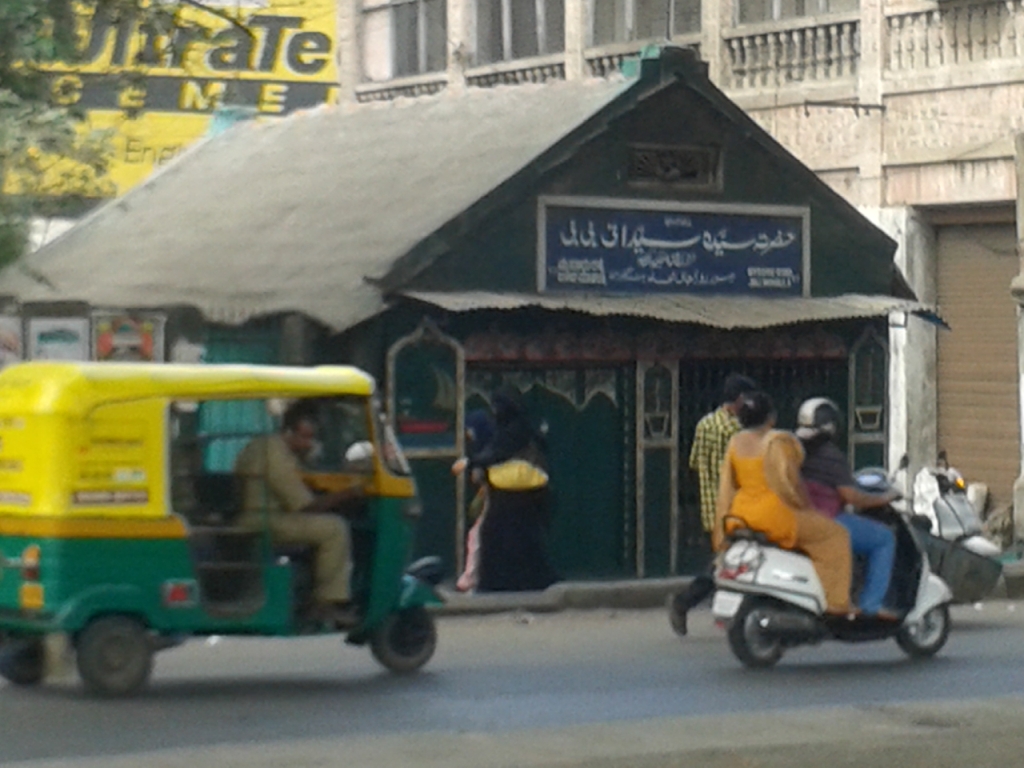 Where is Uncle’s shop? It’s where you are going if you got into an auto-rickshaw with a driver who has volunteered to drive you around for less than the metered rate. It may not be where you want to go, where you think you’re going, or where you’d like to go. But in the driver’s eyes, by taking him up on a reduced fare, you’ve entered into an implicit contract to be taken to a random store and nagged into buying something expensive enough that the shop can happily recoup the driver’s finders fee.
FYI- Bangalore auto-rickshaw fare is currently 25 rupee (Rs) for the first 1.9km, and 13Rs for every kilometer thereafter. If the driver offers to take you around for 10 or 20Rs, you know they have plans. (Although there is a small chance that they are counting on you to be ignorant of the fact that the place they are offering to take you is 50 feet away.) Usually, a driver will offer to take you to a place for 4 to 8 times the metered rate (sometimes more if he has no idea where said place is–a not uncommon condition in Bangalore.) In other words, the driver will normally try to rip you off in the old-fashioned way (which eats at your pocket-book, but not at your time.)
If you find the new-fangled rip-off scheme to be a deplorable con, just remember to save some of your wrath for FaceBook, Google, and the other websites you commonly use. They almost all work on the same model. You get charged little or nothing to use said sites in exchange for agreeing to be shamelessly pitched stuff you don’t want or need.
What does Uncle’s shop sell? I hope you like a good mystery, because there’s no telling whether Uncle’s shop sells anything in which you have the slightest interest. If you are a single male, Uncle’s shop probably sells saris and pashminas. If you have a tiny apartment, Uncle’s shop probably specializes in 14 foot tall bronze statues of Ganesha. It could sell woven goods, knick-knacks, bric-a-brac, widgets, tsotchkes, or relics of a religion you know nothing about so you can engage in some low-grade impiety. (FYI- You may not realize this but for the devoted, it can be a bit offensive for a bunch of non-believers to be wearing “OM” symbols or having Buddha statues who aren’t Hindu/Yogic or Buddhist, respectively. Sort of the way many hardcore Christians feel about how Christmas was shanghai’d by a jolly old elf or Easter was overtaken by a giant bunny.) In some cases, Uncle’s shop will sell all of the aforementioned items and more.
Surely I will get an outstanding deal at Uncle’s shop, right? I mean, Uncle is not going to rip off his nephew’s customer, right? Wrong. First of all, there is an infinitesimally small chance that the driver is biologically related to the store owner in any way, shape, or form. It’s probably more likely that they’ve never formally met.
Second, let’s do some Uncle’s shop mathematics. We will call the wholesale cost of the product “C” and the bloated profit that the store owner would like “W” (for “wishful thinking profit”) and the lowest profit “Uncle” is willing to accept “R” (for “reservation price profit.”) If you just walked into the shop off the street and bought said item you’d pay some amount ≤(C+W) and ≥(C+R).
However, now the driver expects a reward. [Granted, it may be nominal in the scheme of things.] We’ll call the fixed-rate payment to the driver “S” (for “sucker wrangling charge.”) [You may wonder why I’m assuming this is a fixed-rate payment. Fair enough, if the driver is savvy, it will be percentage. However, my finding has been that between 60% and 80% of autorickshaw drivers in Bangalore don’t understand the concept of a map. I’m not saying they don’t know how to use a map. I’m saying that they don’t get that it’s a representation of the streets surrounding them. My point being, auto-rickshaw drivers are–as a group–not savvy. Granted, certain among them are really savvy. However, my point holds as long as we can except that S>0, for all S–whether fixed or a percentage.)
Long story short, now you will pay between (C+W+S) and (C+R+S), where S>0. Long story shorter, going to Uncle’s shop with an auto driver will not save you money (unless you’re looking for something specific, and it will save you the value of time to have a guide to show you where to get what you’re after. Good luck with said guide being an auto driver, the driver doesn’t care what you want, he wants you to buy whatever Uncle’s shop is selling. You can buy what you want on your own time.) It’s true that you may find it worth it to pay the nominal extra amount for many reasons, i.e. convenience, a likable driver, etc. Just be informed.
How come it’s called Uncle’s shop, when nobody involved is the Uncle of anybody else involved? Indians use “auntie” and “uncle” as honorifics for older individuals who are in positions / stature commanding respect–it needn’t be a relative by blood. For auto drivers, this includes random shop owners who’ll pay them 50 rupee for dragging hapless tourists into the store.


