PROMPT: Rewatch

Daily writing prompt
What movies or TV series have you watched more than 5 times?

No TV series. Though there might be episodes of “Seinfeld” that I’ve seen that many times (but others I may have never seen at all.)

Re: Movies: “Kung Fu Hustle,” “The Matrix” (the first one,) and “Kung Fu Panda” (the first one.) Nothing else comes to mind, but there probably are some. (Back from the days when cable ran the same content over and over.)

Five times is a lot of times to watch the same thing. If it’s really good, it will be too mentally / emotionally draining to watch repeatedly. And if it’s too bad, it will be tedious to do so. It needs to be in the sweet spot of light, but incredibly entertaining.
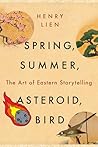
BOOK: “Spring, Summer, Asteroid, Bird” by Henry Lien

Spring, Summer, Asteroid, Bird: The Art of Eastern StorytellingSpring, Summer, Asteroid, Bird: The Art of Eastern Storytelling by Henry Lien

My rating: 4 of 5 stars

Publisher Site

I enjoyed, and was stimulated in thought, by the first half of this book, as well as by sections of the latter half, especially in the fourth chapter. (It’s arranged into four chapters, echoing the book’s central idea of a unique four-act approach to storytelling prevalent in Eastern societies. I’ll get to why I was not so fond of Ch. 3 later.) The book employs exemplary works of literature, film, and even video games to support the claim that there’s not just one approach to sound story crafting — but, rather, that Eastern societies developed distinct modes of storytelling reflecting their values and worldview. (A note on the use of the word “Eastern”: while the book draws heavily on East Asian sources, it tries to make a broader case suggesting not only South Asia but also the Middle East [i.e. everyplace not big-W “Western”] fit this mold. The book might have made a stronger case sticking to East Asia, as – for example – it might be argued that Arabia / Persia of the time of One Thousand and One Nights, being Abrahamic, was closer to Europe than East Asia in values and worldview. To be fair, the author does argue that some parts of that book are believed to have come from farther East (India and, possibly, beyond.))

The book proposes that there are two (arguably three) styles of story construction that are distinctly Eastern. The first is a four-act structure that is far from just a rejiggering of the three and five act forms with which English Literature students will be familiar. Incidentally, the book’s rather unusual title maps to the elements of this four-act structure. The second involves circular and nested story structure. I don’t know that the author succeeds in (or even seeks to) convince the reader that this is a uniquely Eastern approach, but -rather – makes an argument as to why it is prominent in Eastern storytelling.

The author picked an excellent set of works to illustrate his points. Generally, the works are both well-known and well-received among diverse audiences. The films he employs as cases include Parasite, Everything Everywhere All at Once, and Rashomon (the latter also being a literary work.) Lien uses one of my favorite Haruki Murakami novels Hard-Boiled Wonderland and the End of the World as a critical example. I was not at all familiar with the video games he describes (beyond name,) but – given that I’d at least heard of them – I assume they are pretty popular (though I can’t speak to whether they have any discernable stories and will have to take that on faith.) [I’m not sure whether One Thousand and One Nights was a good choice for Eastern literature, though it is an excellent choice as of nested structure.]

As for why I didn’t care for the book’s third part. I should point out that is the most philosophical (and the least explicitly concerned with story) part of the book, and it aims to show how values and worldview vary across cultures such that there are differences in story structure and crafting between different parts of the world. That could be a laudable objective and germane to the book’s point and it’s not why I found this section to be muddled and ineffective. The problem is that the chapter oversimplifies the issue in a way that seems to undercut a broader central argument (that Eastern modes of storytelling are underrepresented outside of the East.) Instead of suggesting that people experience conflicts along continuums (e.g. individual to group identity) and that Easterners tend come to different conclusions than Westerners do based on differing values and cultural perspectives, it engages in an elaboration of the distinctions that seems to suggest there’s some unbridgeable gulf of understanding between cultures (and, quite frankly, kind of feels like it’s shifted from making the aforementioned point to just being a thinly veiled critique of Western culture — which is fine, but probably belongs in a different book — or maybe a manifesto.) But if there were no basis for stories to resonate across this gulf, then not only wouldn’t Parasite and Everything Everywhere All at Once have killed it at both the Oscars and American box office, there’d be no reason for artists to attempt to branch out and tells stories across tribal lines. Without establishing a basis for story resonance, it’s ridiculous to argue that Hollywood should use Eastern modes of storytelling and Eastern worldviews to a greater extent. (A profit pursuing entity is always going to seek the largest possible customer base.) I’m not attempting to negate the argument that there are different approaches to storytelling among different peoples nor that more diversity of approaches shouldn’t be seen across cultures. I’m saying that this chapter doesn’t well support the argument for greater representation of Eastern modes of storytelling outside of Eastern outlets (publishers, film studios, etc.) because it spends so much time arguing the cultural differences that it doesn’t indicate how cross-cultural story resonance is possible.

Overall, I found this to be an interesting and thought-provoking read, though it was – for me – a bit muddled in the middle.

View all my reviews

“A Passage to India” by Walt Whitman [w/ Audio]

Passage O soul to India!
Eclaircise the myths Asiatic, the primitive
fables.

Not you alone, proud truths of the
world,
Nor you alone, ye facts of modern
science,
But myths and fables of eld, Asia's, Africa's
fables,
The far-darting beams of the spirit, the
unloos'd dreams,
The deep diving bibles and legends,
The daring plots of the poets, the elder
religions;
O you temples fairer than lilies, pour'd over
by the rising sun!
O you fables, spurning the known, eluding
the hold of the known, mounting to
heaven!
You lofty and dazzling towers, pinnacled,
red as roses, burnish'd with gold!
Towers of fables immortal, fashion'd from
mortal dreams!
You too I welcome, and fully, the same as
the rest!
You too with joy I sing.

Passage to India!
Lo, soul! seest thou not God's purpose from
the first?
The earth to be spann'd, connected by
network,
The races, neighbors, to marry and be given
in marriage,
The oceans to be cross'd, the distant
brought near,
The lands to be welded together.

A worship new I sing,
You captains, voyagers, explorers,
yours,
You engineers, you architects, machinists,
yours,
You, not for trade or transportation only,
But in God's name, and for thy sake, O
soul.

BOOK REVIEW: Ahiahia the Orphan by Levi Illuitok

Ahiahia the OrphanAhiahia the Orphan by Levi Illuitok
My rating: 4 of 5 stars

Amazon.in Page

Release Date: April 11, 2023

This is a brief and action-packed graphic novelization of a traditional story of the Inuit people of Kugaaruk. That said, it’s probably too brief and action-packed for its own good. The story revolves around a man, Ahiahia, who is orphaned when members of the tribe kill his parents, and then when he comes of age the same contingent have it out for him. While one can imagine any number of internecine conflicts that could lead to the murder of his parents, the fact that we have no clue of the attackers’ motivation makes the whole thing feel gratuitous.

Ahiahia’s grandmother takes the boy in and goes to great lengths to see that he will be safe in the face of whatever familial rivalry led to his parent’s murder. Her actions blend the magical with the practical (e.g. chanting incantations over the bow and arrows she makes for him.) For me, the moral of the story can be seen in this blending. We don’t know how much of Ahiahia’s successes are due to the practical versus the magical, but one feels they worked together and that one without the other would probably not have fared as well.

At the end, there’s a scene that may be disturbing for those who have strong feelings about patriarchal subjugation of women, but it’s hard to argue that it’s not authentic.

This is a very quick read and has sufficient action to keep it engaging. However, it can also feel a bit purposeless.


View all my reviews

BOOK REVIEW: The Art of the Tale by Steven James & Tom Morrisey

The Art of the Tale: Engage Your Audience, Elevate Your Organization, and Share Your Message Through StorytellingThe Art of the Tale: Engage Your Audience, Elevate Your Organization, and Share Your Message Through Storytelling by Steven James
My rating: 4 of 5 stars

Amazon.in Page

This is a fine book on storytelling, storytelling with a focus on business presentations and speeches. That said, this is a topic for which the market is glutted. There are many books available about storytelling, and while this one doesn’t distinguish itself by being exceptionally bad, neither does it distinguish itself as exceptionally good. It’s a decent book on storytelling, and if you’re interested in stories for work presentations or speeches and haven’t read other books on the subject, you might as well try this one. However, if you’ve studied up on the subject, I wouldn’t expect to discover anything profound or novel in this book.

The book does focus on some subjects more than do others. One of my favorite parts was chapter 11, “Warts and All…,” because it addresses an issue that books tend to overlook or gloss over, and that’s how to deal with the skeletons in one’s closet (or in the company’s closet.) It offers an intriguing look at the dark side of Henry Ford.

One of the strengths of this book is that it summarizes key lessons and repeatedly revisits core concepts (e.g. the StoryCube, which is these authors’ outline for presenting the fundamental elements of a story.) The book’s greatest weakness is probably oversimplifications and banal statements, particularly given that the authors critique the simplifying statements of others. For example, they offer a criticism of the common distinction between plot- and character-driven literature that misses that there is something fundamentally different between Joyce’s “Ulysses” and “The Hunger Games” that is worth understanding, and – to the degree their criticism is true – much of this book could be similarly criticized as oversimplification or false dichotomization / categorization.

Reading this book helped me think about the subject of storytelling, particularly the non-written variety of story, but I can’t say there was anything groundbreaking or of unmatched profundity.


View all my reviews

BOOK REVIEW: The Power of Podcasting by Siobhan McHugh

The Power of Podcasting: Telling stories through soundThe Power of Podcasting: Telling stories through sound by Siobhan McHugh
My rating: 5 of 5 stars

Amazon.in Page

This book is in part a how-to guide, and in part a history of podcasting’s rise, though a history that tries to look from within rather than from a distance as much as possible. The two major thrusts of the book are story and sound. Of the many varieties of podcasts that exist today, the focus of this book is on ones that are story-centric, be they non-fiction or fiction. [Of course, there’s an argument that all podcasts should employ story to some degree, even if they aren’t of a format that facilitates an overarching story.] McHugh, herself, uses stories and what I’d call meta-stories (i.e. the stories of how various podcast-delivered stories got told) extensively throughout the book.

With respect to sound, there’s a lot of background sound and music that makes the difference between a professional sounding podcast and one that’s not. This is a particularly difficult subject to grasp because – while one often experiences background sound and music drawing one deeper into the story (or – perhaps more accurately – one feels its absence as a vague sense of detachment,) one tends not to be aware of this background audio on a conscious level. Therefore, discussions that point out the thinking about background audio choices can be profoundly eye-opening for a neophyte, such as myself.

When I say that the book has a podcasting how-to aspect, I should emphasize it doesn’t get into the technical aspects (i.e. what kind of mic to buy and how to use it,) but rather it discusses such topics as scripting, interviewing, editing / reorganizing for effect, and starting out. The book also has chapters at the end about increasing diversity in what has been an extremely Caucasian-centric industry as well as offering insight into potential future directions of audio storytelling. Throughout. there are short interviews with individuals with expertise in the industry, and there’s an extensive appendix, listing podcasts and podcasting resources.

If you’re interested in starting a podcast or learning more about podcasting, I’d highly recommend this book.


View all my reviews

BOOK REVIEW: The Seven Basic Plots by Christopher Booker

The Seven Basic Plots: Why We Tell StoriesThe Seven Basic Plots: Why We Tell Stories by Christopher Booker
My rating: 4 of 5 stars

Amazon.in Page

This tome could’ve been two or more books (or, alternatively, could’ve been heavily edited into one book that stays on task.) The book’s first part contains the book that the reader expects to find. It’s that section that proposes that historically (e.g. pre-20th century) all popular stories fit into one or more of seven plot categories, each of which has a specific purpose. Part I clarifies the nature and purpose of these plot types. The seven plots are: 1.) overcoming the monster, 2.) rags to riches, 3.) quest, 4.) voyage and return, 5.) comedy, 6.) tragedy, and 7.) rebirth. While one might niggle about whether all the various myth, folklore, plays, epic poems, etc. of previous centuries can be categorized by seven plots (or some other number — bigger or smaller,) this first part isn’t particularly controversial. From “Beowulf” (overcoming the monster) to “Hamlet” (tragedy,) most of the stories one might think of probably do lend themselves to such categorization.

Where the book gets controversial, not to mention convoluted, is from Part II onward. Part II delves more deeply into the ideas of Jungian psychology upon which Booker (like Joseph Campbell) hangs his ideas about story. Now for my own controversial views. First, I think Jungian psychology is pseudo-scientific nonsense that should never be used in the treatment or understanding of the mind. While Freudians and Jungians have a big conflict with each other, I think they’re similarly useless. They both start from a laudable view that there is an unconscious mind and we should seek to better understand it. But then, instead of trying to objectively understand the workings of the unconscious mind (granted, it’s a terribly challenging task given our inability to witness the subjective mental experience of others,) each psychiatrist decided to furnish the unconscious mind with his own pet provocative scheme – Freud’s being centered on sexuality [particularly of an infantile nature] and Jung’s being more mystical, but neither man seemed to stop and think about whether said pet scheme could be defective and not universal.

Now, having said that, I don’t find it so objectionable that Booker (and Campbell) use Jung’s ideas for evaluating the fantasy realm of story. Jung’s archetypes may be a perfectly logical way for a writer to think about their characters, about symbolism, and about building nightmare realms. Therefore, I wasn’t that put out by the Jungian focus of the book – despite my lack of belief in the validity of Jungian psychology as a means to understand the mind or to treat mental illness. Still, it does reflect a mindset that is Booker is frozen in, a particular era and approach to psychology that creates many a blindspot in the author. Parts III and IV are about how plot is dead because writers have dared to go off book and abandon the purposes presented them by the titular “seven basic plots.”

Long story short: if you thought that Jung was the bee knees and that mid-20th century views on gender, art, and meaning were the truth, the whole truth, and nothing but the truth, then you may love this book. (At worst, you might find it rambling in places, but it often rambles intriguingly.) If you thought Jung was more a mystic than a psychiatrist, and that the approaches to art from recent decades are as valid as those that came before, you may hate it. I, personally, found a book that contained many interesting ideas, but also found that they were usually deep in the weeds (or maybe – more aptly – encrusted in the ice by which this book’s framework is frozen in time, a time that by no means represented the height of human understanding.)


View all my reviews

BOOK REVIEW: The Storyteller’s Handbook by Elise Hurst

The Storyteller's HandbookThe Storyteller’s Handbook by Elise Hurst
My rating: 5 of 5 stars

Amazon.in Page

Out: June 14, 2022

This is a book, but not one that one reads but rather one that one writes. It contains more than 50 imaginative and fantastical artworks intended to help creative parents build their own stories, while helping their children learn to become storytellers. There is a forward by Neil Gaiman (who has worked with the artist on previous occasions) and an introduction by Hurst, but otherwise there’s almost no text.

The animate subjects of the book are children and animals, but not just any animals. They are mis-sized, misplaced, mythical, imaginary, anthropomorphized, and extinct creatures in search of a clever explanation for their existence and behaviors. The usual suspects of our beloved stories are most well-represented: bears, lions, foxes, rabbits, birds, and fish – for example. But there are also less well-known creatures: mollusks, a mantis, kangaroo, koala, and armadillo. The settings are also designed to fuel the imagination: oceans, hot air balloons, impossibly floating places of all sorts, cities of gothic and fantastical architecture.

If you’re looking for a storybook where you have a graphic prompt to trigger your own story, this is a beautifully illustrated example of such a work.


View all my reviews

POEM: Escaping Isolation [PoMo Day 17 – Ottava Rima]

In isolation, I took to story,
and traipsed through worlds impossible yet true,
living life from infantile thru hoary,
under skies: gunmetal to deepest blue,
in lands where trucks were known to be lorries,
and ancient cities breathed as though brand new.
Where neither time nor bars could imprison,
I found my phoenix had now arisen.

POEM: The Philosopher [Day 16 NaPoMo: Narrative]

Said a man, standing on a crate,
“Thought and comfort are species that cannot mate.”

This philosopher continued:
“An idea unchallenged can’t claim merit. Sacred stories are paper tigers.

“Anything sanctified may lead to murder. For one person’s sacred object will bump into that of another, and it’s only by brute force that such conflicts are resolved. ”

The mayor was captivated by the philosopher’s words, and thought:
The youth are lumps, existing free…
-of challenge
-of thought
-of dignity
-of power

So the mayor invited the philosopher to his town.

The townsfolk were not pleased.

The philosopher’s first act was the erection of a sign that read,

Your god is the wrong God!

One resident said, “How can you make such a statement?”

“I’m not here to offer instruction about how language works, but — rather — about how  a thoughtfully lived life can be achieved.”

The first man kicked the philosopher in his left shin, and stormed off.

The second shouted, “But what gives you the right?”

“The right to what? To write a statement? To expose it to public scrutiny?”

“To make claims about which god is the true God.”

“I make no such claims.”

“But your sign says so.”

“Do you claim the sign is wrong, or that I have no right to make the comment — regardless whether it is true or false?”

“Well, mostly, the first one. The sign is not right,”

“Perhaps the sign IS untrue, and if proven so, I would certainly have to remove it. So tell me, is your counter-claim that your god is truly God?”

“It most certainly is,”

“Then tell me, how can I know that your claim is the correct one?”

“It is written in the scriptures.”

“So anything that is written in a religion’s scripture is true?”

“No. Not just any religion’s scriptures, just ours.” said, the man, thinking he’d anticipated the philosopher’s argument about how mutually exclusive statements can be true.

“And why just yours?”

“Because ours were written by the hand of God,”

“And how could a person such as myself be convinced of the truth of such a statement?”

“Because it is written…”

“So the scriptures of other religions don’t say they are the truth from God?”

“They may say it, but it’s not true.”

“So do you have more of an argument than that you believe something written centuries before your birth must be true and statements contrary to it must be false? If not, I must maintain that the statement on the sign has as much validity as your counterclaim. Both statements may or may not be true and with unassignable probabilities.”

And so the second man punched the philosopher in his right eye, and walked off in a huff.

A third man, a missionary, said, “That man was wrong,”

“I agree,” said the philosopher holding his palm over his eye, “violence is not a winning argument,”

“No,” said the third man, “not about punching you. He was wrong that what matters is the scriptures. I know my god is the God because I feel it’s true.”

“I had vertigo once. It felt like the room was spinning and like I would fall over, but neither was true. So, I can’t say that I put much faith in what I feel as arbiter of truth, but I definitely don’t have any feeling about the existence of your god — one way or the other. Are you saying he might be god to you — who feel this presence — and not to me, and to all those others, who don’t have such a feeling?”

“I’m not saying that…”

“Oh, good, because I was going to ask why you make so much effort to convert people to a subjective god?”

The third man kicked the philosopher in the right shin, shook his head, and walked off.

A fourth man approached and said, “Your sign is wrong because I have no god. I don’t believe in such hokum.”

The philosopher took out a marker and made some editorial changes. He wedged a large “V” in between the word “Your” and the word “god” and wrote “lack of” above it. He then crossed out the words “the” and “God.” The edited sign read:

Your lack of god is wrong!

“Surely, you aren’t going to attempt a proof for the existence of god after what you told your previous conversant?”

“I am not. You watched the previous discussions and should realize that I claim no more than that my statement holds as much validity as yours. Unless, that is, you are more successful at proving the non-existence of a god than the previous individuals did at proving its existence.”

“I cite Occam’s razor,” the fourth man said smugly, adding, “are you familiar with it?”

The philosopher said, “Indeed I am. But I wonder, why is it not called ‘Occam’s Law?’ Is it always the case that the simplest explanation is invariably true? Could we not find in the natural world instances in which the explanation for an observed phenomena was more complicated than an explanation we could theoretically imagine?”

“Not invariably, but a good rule…”

“So you base an absolute conclusion on a ‘good rule of thumb?’ Isn’t there potential for…”

The fourth man socked the philosopher in his left eye.

The philosopher, blinded with two swollen eyes and with a knob under each knee, sat by his sign, awaiting more takers.

The mayor came by and said, “I’m afraid this hasn’t worked out as I’d hoped. I’ve gotten so many complaints. Perhaps, it would be best if you move along.”

So, the philosopher grabbed his meager possessions, and limped one painful step at a time out of town.

***

Two weeks later, a colonizing army invaded.

The officers told the residents that they must convert.

The townsfolk all said that they would never convert.

The generalissimo said, “Convert or die. Those are your options.”

“That’s unfair,” said one man.

“What gives you the right?” said a woman.

The generalissimo then said, “OK. OK. If any of you can give me a sound reason why your religion cannot be supplanted by our own, I will reconsider…”
