
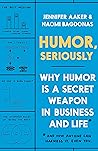
BOOK: “Humor, Seriously” by Jennifer Aaker & Naomi Bagdonas

Humor, Seriously: Why Humor Is a Secret Weapon in Business and Life (And how anyone can harness it. Even you.)Humor, Seriously: Why Humor Is a Secret Weapon in Business and Life by Jennifer Lynn Aaker
My rating: 4 of 5 stars

Book Site

This book aims to bring humor into the workplace — kicking and screaming, if need be. (Or back to the workplace, depending upon to whom one talks.) The authors jointly teach a grad seminar at Stanford’s Graduate School of Business that addresses questions such as: Why is the corporate world so utterly devoid of a sense of humor? What are the benefits of bringing humor into a corporation? And, how can humor be introduced into a corporate setting without undermining other objectives — like taking over with suitable hostility and profitability and decent coffee in the breakroom (or, whatever, corporations are stoked about?)

This book addresses those questions along with more rudimentary questions such as what makes for funny and how can one be funnier than the average internal audit accountant. It also deals with more niche topics, such as the pitfalls of joking around — if you’re the boss — and how to make levity a component of corporate culture.

Like most books about humor that are designed for some other task than tickling the funny bone, one shouldn’t expect a laugh-riot. That said, neither is this a dry text on corporate communications. As I read, I sometimes felt the book tried too hard to throw in a joke and that a number of them didn’t land, but it also occurred to me that one of the book’s intended lessons is that one doesn’t have to be at a Chris Rock or Jim Gaffigan level of funny to engage in (and benefit from) a bit of corporate levity. (Ergo, some of the Dad Joke caliber groaners may have been on purpose and in that spirit.)

I enjoyed this book and felt it was a beneficial read. I’d recommend it for anyone interested in humor, particularly in the workplace.

View all my reviews

BOOK REVIEW: The Art of the Tale by Steven James & Tom Morrisey

The Art of the Tale: Engage Your Audience, Elevate Your Organization, and Share Your Message Through StorytellingThe Art of the Tale: Engage Your Audience, Elevate Your Organization, and Share Your Message Through Storytelling by Steven James
My rating: 4 of 5 stars

Amazon.in Page

This is a fine book on storytelling, storytelling with a focus on business presentations and speeches. That said, this is a topic for which the market is glutted. There are many books available about storytelling, and while this one doesn’t distinguish itself by being exceptionally bad, neither does it distinguish itself as exceptionally good. It’s a decent book on storytelling, and if you’re interested in stories for work presentations or speeches and haven’t read other books on the subject, you might as well try this one. However, if you’ve studied up on the subject, I wouldn’t expect to discover anything profound or novel in this book.

The book does focus on some subjects more than do others. One of my favorite parts was chapter 11, “Warts and All…,” because it addresses an issue that books tend to overlook or gloss over, and that’s how to deal with the skeletons in one’s closet (or in the company’s closet.) It offers an intriguing look at the dark side of Henry Ford.

One of the strengths of this book is that it summarizes key lessons and repeatedly revisits core concepts (e.g. the StoryCube, which is these authors’ outline for presenting the fundamental elements of a story.) The book’s greatest weakness is probably oversimplifications and banal statements, particularly given that the authors critique the simplifying statements of others. For example, they offer a criticism of the common distinction between plot- and character-driven literature that misses that there is something fundamentally different between Joyce’s “Ulysses” and “The Hunger Games” that is worth understanding, and – to the degree their criticism is true – much of this book could be similarly criticized as oversimplification or false dichotomization / categorization.

Reading this book helped me think about the subject of storytelling, particularly the non-written variety of story, but I can’t say there was anything groundbreaking or of unmatched profundity.


View all my reviews