Surrender [Lyric Poem]

Let the flood sweep 
one away — out
of the shallows,
into the deeps.
Don’t ever cry;
Don’t ever weep;
Just feel the speed
Carry one on.

BOOK: “The Jefferson Bible” by Thomas Jefferson

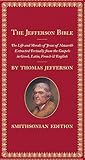
The Jefferson Bible: The Life and Morals of Jesus of NazarethThe Jefferson Bible: The Life and Morals of Jesus of Nazareth by Thomas Jefferson
My rating: 5 of 5 stars

PDF available online [Public Domain]

Thomas Jefferson (yes, the same one who wrote the Declaration of Independence) produced this book by cutting and pasting excerpts from the Gospels so as to produce a distillation of who he believed Jesus was and what Jesus’s essential teachings were. It mixes parables and other New Testament teachings with biographical description.

There is an introduction which offers the reader more specific insight into Jefferson’s thinking than can be gleaned merely from what he includes and what he trims. The Introduction also discusses the similarities and differences between Christian philosophy and that of the Jews, the Greeks, and the Romans.

If you’re looking for a condensed version of the New Testament, I’d highly recommend this book. Jefferson was obviously a sharp guy who looked at the Bible from the perspective of Enlightenment-era thinking.

View all my reviews

PROMPT: Writing

Daily writing prompt
What do you enjoy most about writing?

EPIPHANIES.

But, if you think about it, writing is miraculous. In the scheme of gifts that nature grants, it is way out beyond left field. Encoding ideas and images in simple characters in a way that can evoke emotional or cognitive responses in readers is kind of a superpower. (As is reading.)

PROMPT: Romantic

Daily writing prompt
What’s your definition of romantic?

With a big-R, it’s a philosophical and artistic movement that served as a counterweight to the Enlightenment by advocating for Idealism (versus Materialism) and spirituality (if not necessarily religiosity.)

With a small-R, it’s the skill or proclivity to advance conditions for amorousness.

That’s why capitalization matters.

PROMPT: Decision

Daily writing prompt
Describe a decision you made in the past that helped you learn or grow.

To surrender to my ignorance. If one can never know exactly what game one is playing, it becomes much easier to avoid getting worked up about whether one is playing it right or whether one will “win” or not.

PROMPT: Everyday Things

Daily writing prompt
What are 5 everyday things that bring you happiness?

My wife, movement, new & interesting ideas, play, and epiphanies.

[I’m presuming we’re using the word “thing” in the broadest possible sense — as a stand in for any noun. If it is meant in the narrower common usage of trinkets, gewgaws, baubles, and tchotchkes, then I’ve got nothing.]

PROMPT: More Every Day

Daily writing prompt
What do you wish you could do more every day?

Have epiphanies. They are quite hard come by.

PROMPT: For a Day

Daily writing prompt
If you could be someone else for a day, who would you be, and why?

A Buddha / Bodhisattva (if there’s one about these days.) Why? To feel how his (or her) subjective experience compares to my own.

“I’m Happy to Be a Free Yogi” by Drukpa Kunley [w/ Audio]

I'm happy to be a free Yogi,
growing evermore into inner happiness.

I can have sex with many women
as it helps them find the path of liberation.

Outwardly I'm a fool
and inwardly I live a clear spiritual path.

Outwardly I enjoy wine and women
and inwardly I work for the benefit of all beings.

Outwardly I live for my pleasure
and inwardly I do everything in the right moment.

Outwardly I'm a ragged beggar
and inwardly a blissful Buddha.

BOOK: “Toleration and Other Essays” by Voltaire

A Treatise on Toleration and Other Essays (Great Minds Series)A Treatise on Toleration and Other Essays by Voltaire
My rating: 5 of 5 stars

Project Gutenberg — Free Access

This collection gathers together eight essays and a poem. The theme that interconnects these works is a petition to avoid petty tribalism and irrationality / superstition in the practice of one’s religion. The titular essay, “On Toleration,” sets the collection’s tone, beginning with its detailing of the murder of Jean Calas on religious grounds and its exploration of many more acts of savagery attributable to sectarian forces in alliance with authoritarian governments. The poem, “Poem on the Lisbon Disaster,” echoes the central idea of “Candide” — i.e. the idea that we live in the best of all possible worlds is patently false.

As one would expect of Voltaire, there is plenty of humor and satire throughout these pieces. The arguments are also generally well supported by facts. It is clear that Voltaire possessed a great deal of the knowledge of his day. That said, the reader may well find some factual errors. Most notably, Voltaire tends to attribute a kind of enlightened utopian vision to cultures with which he was likely largely unfamiliar as he builds a case against many within the culture with which he is familiar. This isn’t to say that there isn’t some truth to Eastern traditions being historically more tolerant of other sects than the Abrahamic religions, but the degree to which he extends these idyllic views of those outside of Europe (and the details, thereof) don’t always seem to comport with the historic record.

While some may be inclined to dismiss this book as a collection of anti-religion writings, it is really not anti-belief at all. (Though he does poke holes in many a Biblical myth, so too does he actually provide a deist argument in favor of the existence of a god or gods in the book’s final essay.) Instead, the collection is anti-intolerance, anti-superstition, and anti-authoritarianism. I’d highly recommend this book for all readers. Whatever flaws it may contain are outweighed by the great importance of its message and the cleverness with which Voltaire conveys said message.

View all my reviews