White Space [Free Verse]

I read the space
Around the poem.
It has no meaning,
But says so much.
It betrays a little secret
That no reader ever learned
Who was too concerned
With what was written,
While wholly inattentive
To
What
Was
Not.

PROMPT: 10 Things

List 10 things you know to be absolutely certain.

1.) Nothing is permanent.

2.) The world is not what it seems.

3.) One’s subjective experience is not determined by the state of the world.

4.) Nobody grasps enough truth to be intolerant.

5.) Uncertainty is the root of all fear.

6.) Fear is the root of all hatred.

7.) Hatred is a subjective experience (See #3.) Also, uncertainty is the root of all hatred (by the transitive property,) hence the benefit of travel.

8.) Any who: a.) has suffered a string of hardships; b.) allows themselves to believe that some “other” is wholly responsible for said hardships; and c.) who lacks a sufficient sense of self-empowerment to avoid surrendering entirely to a group identity can (and likely will) become a Nazi (or the equivalent of their day.)

9.) No one can predict the future. [Regardless of how much we all love to try. (See #5.)]

10.) Entropy increases (ultimately, in a closed system.)

NOTE: I remain ready to abandon any certainty in the face of better information.

PROMPT: Teacher

What makes a teacher great?

If students choose the teacher, that is an excellent first indicator. In the typical top-down selection of teachers, it is easy to produce an abundance of shitty teachers. Of course, there is still the danger of charismatic bullshitters and easy people-pleasers, problems ever-present. But among students (as opposed to followers) they usually reveal themselves in time.

PROMPT: Legacy

Daily writing prompt
What is the legacy you want to leave behind?

If “legacy” is defined as something left behind that serves to keep one’s memory alive, then I don’t. I think that goal is futile, illusory, and a bit narcissistic. Even those who are “remembered” long after their deaths are not truly remembered. For example, the Alexander the Great who is remembered to this day likely bears little resemblance to the one who was flesh and blood. What we remember are products of imagination. [Which is fine, but then why tie them to people who lived as opposed to purely fictional ones?]

If I could leave behind some configuration of knowledge of the art of human living that would be helpful to anyone (without it being tied to my identity or memory) that would be a fine thing.

“Without desire everything is sufficient” by Ryōkan Taigu

Without desire everything is sufficient.
With seeking myriad things are impoverished.
Plain vegetables can soothe hunger.
A patched robe is enough to cover this bent old body.
Alone I hike with a deer.
Cheerfully I sing with village children.
The stream under the cliff cleanses my ears.
The pine on the mountain top fits my heart.

Translation by Kazuaki Tanahashi and Daniel Leighton in Essential Zen (1994) HarperSanFrancisco.

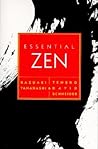
BOOKS: “Essential Zen” ed. by Kazuaki Tanahashi & David Schneider

Essential ZenEssential Zen by Kazuaki Tanahashi
My rating: 5 of 5 stars

Google Books Page

This is a collection of short writings (poems, koans, and prose excerpts) on Zen Buddhism arranged into loosely themed sections. The writings tend toward the artistic, creative, and metaphorical, with relatively few straightforward descriptions of technique or philosophy. The writings range from those of Chinese and Japanese monks who lived hundreds of years ago to present-day poets and Zen practitioners. Among the more frequently drawn from sources are: Hanshan, Ikkyu, Dogen, Ryokan, Hakuin, Gary Snyder, Robert Aitken, Seung Sahn, John Daido Loori, Thich Nhat Hanh, and Peter Levitt. But there are many others, including some who have only a single piece included.

There’s a substantial “Notes” section that gives source, translation, and — in some cases — background information. Most of the translations (both Japanese and Chinese) are by the editors, Kazuaki Tanahashi and David Schneider. There are illustrations, but they are all ensō (circular brush paintings) and related forms.

This is a highly readable and insightful collection of short writings, and I’d highly recommend it for individuals interested in Zen or Eastern Philosophy more generally.

View all my reviews

BOOKS: “The Zen Teaching of Bodhidharma” Translation by Red Pine

The Zen Teaching of Bodhidharma (English and Chinese Edition)The Zen Teaching of Bodhidharma by Bodhidharma
My rating: 5 of 5 stars

Publisher’s Site

Bodhidharma was a Buddhist Monk who is credited with bringing an approach to Buddhism to China that would become Zen. This book presents four of his surviving lectures in their entirety: “Outline of Practice,” “Bloodstream Sermon,” “Wake-up Sermon,” and “Breakthrough Sermon.” It is a bilingual edition, featuring Traditional Chinese script juxtaposed with the English translation.

Bodhidharma was an intriguing and important character in the history of Buddhism, so much so that a legend has grown up around him that is in all likelihood substantially false. The most well-known element of the legend is that he taught monks the martial art that became Shaolin Kung Fu. (Historians refute the likelihood of this because there was no evidence of it in the documentation in the centuries immediately after Bodhidharma’s death. The story came along much later and caught on like gangbusters, so much so that it is routinely repeated today as if established fact. For elaboration, see Meir Shahar’s “The Shaolin Monastery.”) There is simply not a lot known about Bodhidharma (or even the extent which there was a Bodhidharma,) and what is known is not without controversy. Popular accounts put his homeland in Tamil Nadu, India, but dissenting accounts put it as far away as Persia (Iran.)

The reason I mention all this is because some potential readers may expect a kind of fabled story, full of kung fu and magic, and — in point of fact — these teachings offer a clear and straightforward approach to the practice of Buddhism. I’d highly recommend the book for readers interested in Buddhism, Zen, and meditational practices – generally. It is a clear and thought-provoking work. But, if you’re expecting a thrilling recitation of legend and woo-woo, this isn’t it.

View all my reviews

PROMPT: Improvement

What’s one small improvement you can make in your life?

Realize you have no control of what happens in the world, but complete control of your perception of it.

PROMPT: Teacher

Daily writing prompt
Who was your most influential teacher? Why?

By the measure of having taught still useful lessons about HOW to think (those who taught me WHAT to think are largely forgotten along with their lessons,) that would be a tie between my 11th grade Psychology teacher and an undergrad Religious Studies professor. The former, among other ideas, first exposed me to what I would come to believe is the most important lesson of human existence under his label of the “gestalt of expectations.” [I’ve never heard anyone else refer to it as such, but the lesson was sound and I would latter find it in philosophies from Buddhism to Stoicism.] The latter teacher, among other ideas, exposed me to two common opposing modes of fallacious thinking, what he called “the outhouse fallacy” and “the first-est is best-est fallacy” (he was a folksy, if erudite, professor.)

In terms of personal growth and development, generally speaking, there are numerous teachers of martial arts, yoga, and other mind-body practices that are incomparable and thus unrankable. Not to mention, a sound argument can made for the repugnantly unhumble statement that I am my most influential (and most important) teacher. (I state this claim not as though I am unique, but as one that could apply to anyone.)

PROMPT: Tattoo

What tattoo do you want and where would you put it?

I have no interest in tattoos. I’m with the Buddhists on “all is impermanence” and the idea that there is some message that would be poignant for the rest of my days seems silly and unlikely.

Plus I’ve seen so many bad ones: faces that look demented, Chinese characters that make no sense (and/or are upside-down or sideways.) So, no thanks.