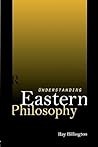
BOOK: “Understanding Eastern Philosophy” by Ray Billington

Understanding Eastern PhilosophyUnderstanding Eastern Philosophy by Ray Billington
My rating: 4 of 5 stars

Publisher Site — Taylor & Francis

This book does a solid job for one that bites off so much in a single go. Eastern Philosophy is a large subject, and to try to outline the major premises of its varied systems and also compare them to Western / Abrahamic notions (when Western schools are sometimes no more different from Eastern schools than each side is within,) and to do so in under two-hundred pages is a daunting undertaking.

For the most part, I felt the book did a fine job of meeting its objective. A fair amount of selection and simplification is required. I will say the part describing karmic doctrine didn’t seem consistent with what I was taught and seems more in line with the early Western scholars who started writing about Eastern Philosophy but could not help but couch the subject in a Western / Abrahamic frame because it was what they knew and was invisible to them. I say this as one who is no big fan of Karmic philosophy, though for another reason (one which is also mentioned in this book.) I’ve always been told that the central idea is to do selfless acts in order to escape the karmic cycle. Billington, like others before him, states it as do “good deeds” and then he puts forth the critique that this won’t help because doing good for one’s own benefit is fraught with peril. My understanding from Sanskrit scholars is: first, Hindu philosophers were aware of this paradox from the beginning and that’s why the emphasis has always been on “selfless” acts; second, the Abrahamic bifurcation of all actions into good and evil is not so much a thing in Hindu thinking (most actions are inherently neither.) I should point out that there is a lot of internal conflict within these philosophies (e.g. differences between Buddhist and Hindu thoughts on Karma) and that Billington does elsewhere reflect on the differences between Eastern and Western thinking about good and evil.

The first two-thirds of the book is organized by schools of thought (beginning with the Indian ones and working toward Chinese / East Asian schools) and the last third deals with a series of fundamental philosophical questions.

If you want a quick outline of Eastern philosophical ideas, this book gives a good look at them, particularly if one is interested in a comparison to Western ideas. The book also spends a fair amount of time in discussion of what a religion is and how one differs from a philosophy.

View all my reviews

PROMPT: Everyone Should Know

Daily writing prompt
What’s something you believe everyone should know.

While any individual’s ability to substantially change the world is minimal, one’s ability to change how one experiences the world is vast. Cultivate the dispassionate witness. #Sakshi Bhava

Also, how to swim, change a tire, and juggle while riding a unicycle.

PROMPT: Principles

What principles define how you live?

Before traveling, empty my cup. Before returning home, empty my cup.

Collect experiences, not geegaws.

Wishing for the world to be some other way is a grand waste of time.

If there is a river flowing toward where I want to be, surrender to it.

See humor everywhere, especially in myself.

Be content with who I am at the moment, while struggling to be a better version in future editions.

Strive to find the non-adversarial path.

Keep looking until I see what is beautiful in all things and creatures.

Don’t attempt to construct anyone else’s list of principles to live by.

Feel the sensations that arise without letting the mind amplify them out of proportion.

Seek only simple pleasures, enjoy them fully, and then move on.

PROMPT: Lesson

Daily writing prompt
Share a lesson you wish you had learned earlier in life.

Few things in life matter as much as they feel they do. Almost nothing is perilous, while many things feel as though they are. Don’t let illusory feelings keep one from living boldly.

Or, as the Epicureans liked to say, “What is painful is easy to endure.”

PROMPT: Ideal Week

Daily writing prompt
Describe your ideal week.

My ideal week would consist of seven days, each day of about twenty-four hours. You could fit four of them in a month with room to spare.

White Space [Free Verse]

I read the space
Around the poem.
It has no meaning,
But says so much.
It betrays a little secret
That no reader ever learned
Who was too concerned
With what was written,
While wholly inattentive
To
What
Was
Not.

PROMPT: 10 Things

List 10 things you know to be absolutely certain.

1.) Nothing is permanent.

2.) The world is not what it seems.

3.) One’s subjective experience is not determined by the state of the world.

4.) Nobody grasps enough truth to be intolerant.

5.) Uncertainty is the root of all fear.

6.) Fear is the root of all hatred.

7.) Hatred is a subjective experience (See #3.) Also, uncertainty is the root of all hatred (by the transitive property,) hence the benefit of travel.

8.) Any who: a.) has suffered a string of hardships; b.) allows themselves to believe that some “other” is wholly responsible for said hardships; and c.) who lacks a sufficient sense of self-empowerment to avoid surrendering entirely to a group identity can (and likely will) become a Nazi (or the equivalent of their day.)

9.) No one can predict the future. [Regardless of how much we all love to try. (See #5.)]

10.) Entropy increases (ultimately, in a closed system.)

NOTE: I remain ready to abandon any certainty in the face of better information.

PROMPT: Teacher

What makes a teacher great?

If students choose the teacher, that is an excellent first indicator. In the typical top-down selection of teachers, it is easy to produce an abundance of shitty teachers. Of course, there is still the danger of charismatic bullshitters and easy people-pleasers, problems ever-present. But among students (as opposed to followers) they usually reveal themselves in time.

PROMPT: Legacy

Daily writing prompt
What is the legacy you want to leave behind?

If “legacy” is defined as something left behind that serves to keep one’s memory alive, then I don’t. I think that goal is futile, illusory, and a bit narcissistic. Even those who are “remembered” long after their deaths are not truly remembered. For example, the Alexander the Great who is remembered to this day likely bears little resemblance to the one who was flesh and blood. What we remember are products of imagination. [Which is fine, but then why tie them to people who lived as opposed to purely fictional ones?]

If I could leave behind some configuration of knowledge of the art of human living that would be helpful to anyone (without it being tied to my identity or memory) that would be a fine thing.

“Without desire everything is sufficient” by Ryōkan Taigu

Without desire everything is sufficient.
With seeking myriad things are impoverished.
Plain vegetables can soothe hunger.
A patched robe is enough to cover this bent old body.
Alone I hike with a deer.
Cheerfully I sing with village children.
The stream under the cliff cleanses my ears.
The pine on the mountain top fits my heart.

Translation by Kazuaki Tanahashi and Daniel Leighton in Essential Zen (1994) HarperSanFrancisco.