What colleges have you attended?
Indiana University, Georgia Tech, and Georgia State University. Also, technically, University of Maryland and City Colleges of Chicago (through the military.)
What colleges have you attended?
Indiana University, Georgia Tech, and Georgia State University. Also, technically, University of Maryland and City Colleges of Chicago (through the military.)
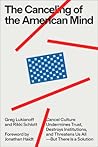
The Canceling of the American Mind: Cancel Culture Undermines Trust and Threatens Us All―But There Is a Solution by Greg LukianoffWhat was your favorite subject in school?
Depends on the year. In twelfth grade, I remember enjoying Physics the most. In Eleventh, Psychology was the best class I attended. There was a year when I got the most out of an English class that focused on Creative Writing. I guess my most longstanding preference was for classes like Geography and Social Studies, wherein we learned about the world outside our world.
What makes a teacher great?
If a student (or students) voluntarily and enthusiastically come to learn from an individual, that individual is a great teacher.
The emphasis is on “to learn” because some people confuse great charisma with great pedagogy, but such people go to the charismatic person to take comfort from being in that person’s presence, not to learn — despite whatever truisms or clever-sounding parallel grammatical structures the charismatic individual might spout.
So, if one would go to an individual seeking knowledge, knowing the experience will be challenging and not merely comforting, one has found a great teacher.
Describe something you learned in high school.
A Psych teacher told us a story of what he called “a gestalt of expectations.” A man from a city in the East is driving out West, and he passes a gas station – despite being low on fuel. (He’s used to gas stations being everywhere.) Anyhow, he runs out of fuel. He can’t see anything around except desolate desert bisected by a line of asphalt. He decides to walk back to the gas station he passed ten miles back. There is no one traveling on this remote stretch of desert road. As he’s walking in the intense heat, it comes to his mind that the employee at the service station is really going to gouge him on the price of gas and a jerry can. As he walks and walks, skin prickling with the heat, he keeps thinking about how he’s going to get screwed by the gas station attendant and also how he’ll be chided and ridiculed for running out of gas in the middle of the desert. He imagines it in great detail. Finally, bedraggled and with heaving breaths, he arrives at the station. The gas station attendant rushes out to help this poor man, and the man punches the attendant square in the nose (for all the offenses taking place solely in the man’s mind.)
In a broader formulation, I think this is the most important lesson any human can learn. Our personal perception of what we experience is not equal to what it is that we experience (the exterior world.) This is why some people dealt a crappy hand can turn it into a wonderful life, and also why some people who seem to have it all commit suicide in the prime of life.
I could be angered or dismayed that the single most important lesson I learned in secondary school was via off-curriculum ramblings during an elective class, but I choose not to. Instead, I’ve been trying all my life to make that bit of knowledge into wisdom.
Genius: A Very Short Introduction by Andrew RobinsonWords memorized rote are a meal wholly undigested, That's why memorization is utterly detested. Rote learning is, somehow, bloating and yet never filling. One takes it all in by way of monotonous drilling, but while you're still filling your cup you're already spilling. You pass your test and purge it all. It's so unfulfilling. If I may, please let me suggest that here's what you should do: get the gist, play with it, and find out what it means to you.
Children’s Literature: A Very Short Introduction by Kimberley Reynolds
Up the Down Staircase by Bel Kaufman
My rating: 5 of 5 stars
This is a humorous novel about a rookie teacher’s first year in a New York City public school with all the frustrations and victories that experience entails. It’s an epistolary novel – meaning it’s conveyed through a series of documents. Some of the humor is of a “kids say the darndest things” nature – though these are high school students, so the humor isn’t so much born of naiveté as it is a combination of teenage snarkiness and a maddening ignorance of concepts that students should have grasped by that age (i.e. laugh so you don’t cry style humor.) The humor from kids is largely conveyed by students’ comments in the teacher’s comment box as well as via homework assignments.
There’s a second kind of humor in the form of bureaucratic absurdism. Bureaucratic wrangling and lack of resources cause most of the protagonist’s frustrations. This humor is largely conveyed through memos – some school-wide and some specifically to the protagonist, Sylvia Barrett. Barrett also commiserates with her co-workers, and we see some of her frustration playing out through the post-it note equivalent of water-cooler conversations.
The epistolary form offers a challenging format for both character development and story presentation. However, the novel is strong on character development. It achieves this in large part by mixing long-form letters to a close friend with the short memos and comment box entries. The reader gets to see events unfold and responses by way of different documents. The longer letters give us some depth of feeling. There is even a point where Barrett is being swamped by correspondence and we hear nothing back from her, and in this we can feel the degree to which she is overwhelmed.
The book isn’t story-centric. However, there is a narrative arc that revolves around the question of whether Barrett will stay on at the public high school or move on to teach at a liberal arts college. She is torn because she feels she can do good at the public high school and that would be satisfying, but at the same time she is bureaucratically frustrated and demoralized by perceived failures. There are dramatic events here and there to elevate the tension from the run-of-the-mill school events, but not so much that the book ever moves away from feeling like the real experience of a rookie teacher.
The book uses drawings here and there, usually presented as student doodles, to add to the humor.
I enjoyed this book, finding it to be both humorous and illuminating. I would highly recommend it for those interested in the challenges of secondary education or who can appreciate the [bittersweet] humor of it.
TED Talks Storytelling: 23 Storytelling Techniques from the Best TED Talks by Akash Karia
My rating: 4 of 5 stars
This is a brief guide to storytelling and story building, particularly as it pertains to public speaking. Its emphasis on TED Talks is just to capitalize on the popularity of that forum as well as to draw widely known examples. There are no novel insights offered in this book. It’s the same information one could find from many other sources. However, it’s concise, well-organized, and uses examples pulled from popular TED Talks, and so readers may get some synergies from familiarity with a given speaker’s delivery.
The book is organized into nine chapters. The first introduces the topic by explaining why stories are so much more effective than other approaches to public speaking. The second chapter is about hooks and conflict. The third chapter is about the twist or element that makes the story interesting—as opposed to a straightforward accounting of events. Chapters four through six are all related in that they deal with providing the sensory and other details necessary to make the story come alive for the audience member. Chapter seven is about the effectiveness of stories with a positive message. Chapter eight steps back and examines the overall flow of the story with key way-points of consideration. Chapter 9 is a summation of key points. It’s mostly a list of the 23 bullet points that were made throughout the book, each of which is also located at the end of its respective chapter.
I’d recommend this book for anyone preparing for a public speaking engagement. However, I should point out that the price seems to be higher at the moment than when I bought it. I wouldn’t recommend spending a lot on the book because the information is so widely available.