PROMPT: 30 Things

Daily writing prompt
List 30 things that make you happy.

1.) love; 2.) a glorious turn of phrase; 3.) discovery; 4.) walking; 5.) swimming; 6.) stumbling upon an interesting and / or novel idea; 7.) movement; 8.) travel; 9.) street food; 10.) quiet; 11.) health; 12.) recognition that when things are at their very worst, they must get better — because everything is impermanent; 13.) an intense stretch; 14.) Whitman’s “Leaves of Grass;” 15.) undiscovered country; 16.) the hanging moment; 17.) a mystery-laden world; 18.) a moment of flow; 19.) a mountain path; 20.) a clear stream; 21.) the way of non-adversariality; 22.) a thing stripped to its simplest form; 23.) the moment breath turns the tide; 24.) animals being animals; 25.) a brief instant of free fall; 26.) the recognition that something that used to cause me angst or fear no longer does; 27.) when body, movement, and the world fall into alignment; 28.) first contact with someplace / something new; 29.) connection; 30.) the first sign that the struggle is paying off.
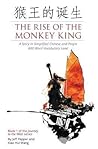
BOOKS: “Rise of the Monkey King” ed. / trans. Jeff Pepper & Xiao Hui Wang

The Rise of the Monkey King: A Story in Simplified Chinese and Pinyin, 600 Word Vocabulary Level (Chinese Edition)The Rise of the Monkey King: A Story in Simplified Chinese and Pinyin, 600 Word Vocabulary Level by Jeff Pepper
My rating: 5 of 5 stars

Publisher Site – Imagin8

This is an abridged and linguistically simplified telling of the first two chapters of Journey to the West. It contains the birth story of Sun Wukong (i.e. the Monkey King) and describes his studies with a sage in an attempt to become immortal.

As someone learning Chinese but at a point where I can only read grammatically and lexically simple content, it’s not easy to find reading material that is both fun to read and readable. The discovery of this series was a godsend. It’s hard to get more thrilling than the story of the Monkey King, and it helps that I’ve already read translations – and so have a bit of context to piece together challenging sentences and to avoid the misunderstandings that can arise when reading a new language. It’s much easier to be a disciplined reader when reading something that is neither a children’s book nor the life story of a preternaturally typical person [which is the usual adult equivalent of a beginner level reader.]

I was pleased by how this book was laid out. Often reading material for learners puts the Chinese characters (hanzi,) the Romanized phonetics (pinyin,) and the English translation all in adjacent rows. While this has its advantages, it also makes it too easy to cheat by eye saccade and not be reading as well as one thinks one is. This book does have all three elements, but it alternates paragraphs of hanzi and pinyin but then puts the translation in an unbroken format after the Mandarin. The book also has a glossary of the book’s vocabulary.

Whether you’ve already read Journey to the West or not, if you’re just learning to read Simplified Chinese, I’d highly recommend this book.

View all my reviews

PROMPT: Bed

Daily writing prompt
What time do you go to bed and wake up currently?

When I can’t read two sentences without drifting off, I sleep. When the sun comes up, I awaken.

PROMPT: Before the Internet

Daily writing prompt
Do you remember life before the internet?

Yes, yes. We read these things called books. They hurt much worse when you dropped one on your toe (but much less than the stone tablets of the preceding generation,) but at least you wouldn’t be out $1,200 (USD) if they took a bad bounce.

PROMPT: Unwind

Daily writing prompt
How do you unwind after a demanding day?

Reading is best for me. It’s low energy and as long as I don’t do it on the phone I’m not subjected to the blue light that they use in phone screens (specifically to keep one from unwinding.) Reading eases me to sleep, especially if I don’t pick writing that’s too stimulating.

PROMPT: Reread

Daily writing prompt
What book could you read over and over again?

If plays count as books, then most of Shakespeare’s plays. I’ve already reread a number of them (e.g. Hamlet, Macbeth, Merchant of Venice, and A Midsummer Night’s Dream.)

I’ve read Whitman’s Leaves of Grass, a couple times in full (and segments of it many times over) and expect to get to it again. I’ve read Voltaire’s Candide a couple times.

I could definitely see rereading Journey to the West, Water Margin, and Romance of the Three Kingdoms, but at this point I’m hoping my Mandarin will get good enough to read them in Simplified Chinese.

I’ve read a number of nonfiction texts multiple times — e.g. Sunzi’s Art of War, Miyamoto Musashi’s Book of Five Rings, Laozi’s Dao De Jing, and Emerson’s Selected Essays.

I’m generally not a fan of rereading books because there is so much awesome stuff out there to be read a first time. For all the reading I’ve done, there is still a massive number of classics that I have yet to touch. Usually there has to be a good reason for a reread, e.g. a new translation that promises to be improved / simplified, the book is just so potent as to still have lessons packed in after the first read, it’s a challenging read and the first go leaves a lot on the table, or — like The Little Prince — its enjoyment-to-time investment ratio is high.

BOOK: “The Short Story: A Very Short Introduction” by Andrew Kahn

The Short Story: A Very Short Introduction (Very Short Introductions)The Short Story: A Very Short Introduction by Andrew Kahn
My rating: 4 of 5 stars

Publisher Site – OUP

This guide provides an overview of the short story, particularly literary short stories (though it’s not without mention of genre fiction.) The book is well organized and offers some fascinating food for thought, particularly regarding the psychology of character and the distinctions between short stories and novels. (The former are not to be thought of as pared down versions of the latter.)

I will say that, for a concise introduction, the book does occasionally get into the weeds on specific issues, potentially losing the non-specialist reader who this series is ostensibly geared toward.

I found the book’s organization to be logical and productive to its task. After an introduction that explores the advent and history of the short story, most of the chapters deal with structural or compositional aspects of story, including: openings, voice, setting, plot, irony / reversal, and endings. One chapter (Ch. 6) stands out as a bit different in that it zooms in on Chekhov and his influence on the short story as we’ve come to know it. While this could be said to demonstrate the author’s tendency to zoom in the specificity more than is usual for such a guide, I did find the chapter interesting and enlightening.

If one is interested in the short story (as a reader, writer, or both) one will find this guide worth one’s attention.

View all my reviews

PROMPT: Screentime

How do you manage screen time for yourself?

Many ways, really: e.g. Go for a walk or otherwise move. Forget it exists. When the WiFi goes down, take it as a sign from the universe. Juggle. Do something productive.

PROMPT: Hobby or Pastime

Daily writing prompt
What is your favorite hobby or pastime?

I don’t collect favorites. I like reading, hiking, writing, swimming, playing, exercise, traveling, cooking… each in its due time for its due time.