“Religion” by Paul Laurence Dunbar [w/ Audio]

I am no priest of crooks nor creeds, 
For human wants and human needs
Are more to me than prophets' deeds;
And human tears and human cares
Affect me more than human prayers.

Go, cease your wail, lugubrious saint!
You fret high Heaven with your plaint.
Is this the "Christian's joy" you paint?
Is this the Christian's boasted bliss?
Avails your faith no more than this?

Take up your arms, come out with me,
Let Heav'n alone; humanity
Needs more and Heaven less from thee.
With pity for mankind look 'round;
Help them to rise -- and Heaven is found.

“O sweet spontaneous” by E.E. Cummings [w/ Audio]

O sweet spontaneous
earth how often have
the
doting
   
    fingers of
prurient philosophers pinched
and
poked

thee
, has the naughty thumb
of science prodded
thy

  beauty  how
often have religions taken
thee upon their scraggy knees
squeezing and

buffeting thee that thou mightest conceive
gods

  (but

true

to the incomparable
couch of death thy
rhythmic
lover

  thou answerest

them only with

  spring)

Preacher Limerick

There once was an evangelical preacher
 who made each sermon a double-feature:
   first, the evils that tempt;
   then, why he was exempt:
 "One must know math's pitfalls to be a math teacher..."

The Second Coming by W. B. Yeats [w/ Audio]

Turning and turning in the widening gyre
   The falcon cannot hear the falconer;
 Things fall apart; the centre cannot hold;
   Mere anarchy is loosed upon the world,
 The blood-dimmed tide is loosed, and everywhere
   The ceremony of innocence is drowned;
 The best lack all conviction, while the worst
   Are full of passionate intensity.

Surely some revelation is at hand;
   Surely the Second Coming is at hand.
 The Second Coming! Hardly are those words out
   When a vast image out of Spiritus Mundi
 Troubles my sight: somewhere in sands of the desert
   A shape with lion body and the head of a man,
 A gaze blank and pitiless as the sun,
   Is moving its slow thighs, while all about it
 Reel shadows of the indignant desert birds.
   The darkness drops again; but now I know
 That twenty centuries of stony sleep
   Were vexed to nightmare by a rocking cradle,
 And what rough beast, its hour come round at last,
   Slouches toward Bethlehem to be born?

PROMPT: Changed Mind

Daily writing prompt
What’s a topic or issue about which you’ve changed your mind?

Oh so many things. My epistemological stance is that one should be ready to drop any belief like a hot rock in the face of better information or better means to understanding.

One of the most fundamental changes is that I used to take for granted that there was a god. Now I’m agnostic about whether there is one, and am virtually certain that – in the unlikely event there is a god – it (she? they? he?) bears no resemblance to any of the tribally derived deities of the various world religions.

I used to think introversion was something that could be, and should be, overcome. Now, I believe the healthy approach is in accepting it and managing one’s life so that it’s not a problem. Truth be told, in my youth, I had a lot of grandiose ideas about what was possible with regards to the mind, ideas which I have jettisoned in favor of one’s that better match the empirical evidence.

PROMPT: Traditions

Daily writing prompt
What traditions have you not kept that your parents had?

Religion and activities related thereto.

BOOKS: The Mind of Adi Shankaracharya by Y. Keshava Menon

The Mind of Adi ShankaracharyaThe Mind of Adi Shankaracharya by Y. Keshava Menon
My rating: 4 of 5 stars

Amazon.in Page

This book does a good job of that at which the title hints, offering the reader insight into the philosophy of Adi Shankaracharya. Along the way, Menon presents clear descriptions of Indian philosophical concepts such as Maya, Avidya, Antahkarana, etc., and also compares and contrasts Shankaracharya’s philosophy with those of other philosophers (from both the East and West) as a means to clarify ideas that can be subtle and complex.

That said, what the book isn’t is an unbiased and objective look at Shankaracharya’s ideas. While Menon doesn’t go as far as to support the supernatural myths of Shankaracharya’s life (which are only discussed in the Appendix,) and he skirts that 800-pound gorilla of Hindu philosophic controversy, caste, he does present the philosophy as an advocate for Shankaracharya rather than as an indifferent scholar who merely wishes to deliver arguments and ideas while inviting thought among his readers.

While the book deals with epistemology, ethics, and various aspects of metaphysics, the biggest single subject is Self. I found the explanation of this topic to be fascinating. I had previously understood that among the major differences between Shankaracharya and Buddha was on this question. While I still find the Buddhist approach to Self (or, more properly, lack of Self — i.e. Anatta) to be the more compelling and parsimonious explanation, I feel that I was provided with about as clear an explanation of the Hindu (generally) and Shankaracharyan (specifically) views on Self as one could wish for.

I’d recommend this book. If you’ve come away from reading about subjects like “Maya” (Is it illusion? Is it NOT illusion?) this book can definitely help offer clarification, and (as books on philosophy go) it’s readable and not too jargon-laden. That said, if one is looking for a book that is not advocating a philosophy but, rather, objectively providing ideas and contrasting explanations, this book may bias your views.

View all my reviews

DAILY PHOTO: Religious Buildings in Beijing

St. Joseph’s Church on Wanfujing Street (a.k.a. Wanfujing Church / Dongtang); Roman Catholic

Lama Temple (a.k.a. Yonghe Temple); Tibetan Buddhist (i.e. Vajrayana Buddhist)

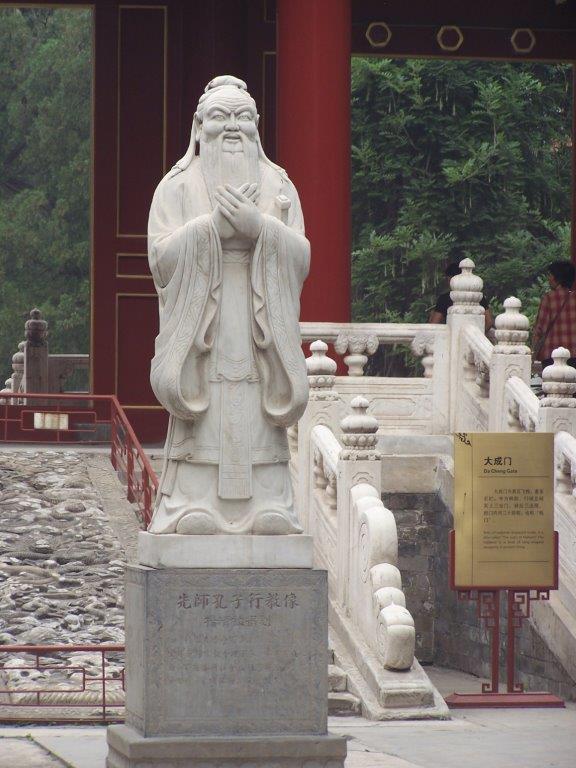
Beijing Temple of Confucius; Confucian

BOOK REVIEW: The Pocket Chögyam Trungpa by Chögyam Trungpa

The Pocket Chogyam TrungpaThe Pocket Chogyam Trungpa by Chögyam Trungpa
My rating: 5 of 5 stars

Amazon.in Page

This pocket-sized guide consists of 108 excerpts drawn from the writings of Chögyam Trungpa, a prolific — if controversial — teacher of Tibetan Buddhism. Chögyam Trungpa may have been most famous in the West for coining the English term “Crazy Wisdom,” and for founding Naropa University in Boulder, Colorado. [Note: while he coined the term “Crazy Wisdom,” he didn’t originate the concept, which existed already – arguably in multiple forms — in Vajrayana Buddhism from olden times.] Beyond basic Buddhist philosophy, he wrote extensively on Buddhist Psychology, Tantric Buddhism, and the Buddhist conception of warriorship.

The book is designed to be picked up at any point. There isn’t a formal grouping of concepts, but rather the book meanders around, revisiting ideas such as Enlightenment, Emptiness, emotional intelligence in multiple locations throughout the book. The entries are between a paragraph and a page long in most cases.

I found a great deal of food-for-thought in this book and would highly recommend it for those wishing to dip a toe into the teachings of Chögyam Trungpa.


View all my reviews

Spanish Inquisition Limerick

There once was a Grand Inquisitor --
a most unpopular visitor.
His knock at your door
meant you were done for.
He could paint even a saint sinister.