BOOKS: “Be Funny or Die” by Joel Morris

Be Funny or Die: How Comedy Works and Why It MattersBe Funny or Die: How Comedy Works and Why It Matters by Joel Morris
My rating: 5 of 5 stars

Author Site

Release date: Sept 4, 2025 [paperback, hardcover is already out]

This is a comedy writer’s guide to how humor is crafted. It’s a bit popular psychology and a bit of a how-to guide. If one is expecting, because it’s on comedy and humor, a book that is a laugh riot on every page, this isn’t the book for you. That’s not so say Morris doesn’t pepper the book with witty commentary and humorous examples, but it’s ultimately a book about how the sausage gets made and is, thus, somewhat analytic — if in a readable style.

At the core of Morris’s theory of comedy is a three-component structure: construct, confirm, and confound. Other major ideas are the fundamental tribalism of comedy and the connections between comedy and music. It wouldn’t be a present-day book on comedy if there wasn’t some discussion of the idea of offense and the “limits” of what can be said.

I can’t say all of Morris’s ideas found immediate resonance with me, but even when I didn’t fully buy the argument, I did find the presentation thought-provoking. For example, I don’t know that I buy Morris’s argument about the importance of tribality to comedy. I do agree that one needs a common language and some overlap of experience, but all of humanity has a domain of overlap of experience. Yes, one may have an easier time the more extensive that overlap is, but ease doesn’t necessarily mean one can’t get big laughs from an audience whose worldviews and experience are radically different from one’s own. [Of course, I may just be being overly sensitive as a traveler in a tribal world.]

For writers, the end of the book has a few chapters that are more about story than comedy – per se, and – while these chapters compare and contrast comedy and drama writing – they provide information useful to any writer engaged in storytelling.

I’d highly recommend this book for any readers interested in comedy writing, be it of standup material, scripts, or other content.

View all my reviews

PROMPT: Technology

Daily writing prompt
How has technology changed your job?

Technology has changed everything, for good and for ill. It’s the source of our vast growth in productivity, but also at the heart of our modern crises (e.g. I’m almost certain that no caveman ever experienced “imposter syndrome.” But like other crises of modernity, I suspect that technological dependence and an ever-continuing trend toward ultra-specialization are its cause.)

I count myself fortunate to be of an age to (probably) miss the (rapidly approaching) day when machines and artificial intelligence do all “productive tasks” better, faster, and with far less energy consumption than a human being. I don’t think most of humanity will be prepared for that day, and it will – in all likelihood – go down catastrophically. [I think we’re seeing the cracks in the dam already.]

I spend more and more time with the only technology-proof sector of which I’m aware: building a more capable human being.

I believe if every person spent some time learning skills like primitive living (sustainable wilderness survival skills) or unarmed martial arts (that train against armed opponents) society would be much better off. I pick these two as examples of skill sets that give practitioners a deep confidence in themselves [not in themselves + technologies that they can’t build, can’t fix, and which they don’t really understand.] I suspect that the core self-empowerment that would result would ease away much of the general shittiness of character we are increasingly prone to see in the world, shittiness that — like all shittiness — is ultimately rooted in fear.

PROMPT: Secret Skill

Daily writing prompt
What’s a secret skill or ability you have or wish you had?

Mind control. I can control my mind with my mind.

[NOTE: I’m not sure what “secret” has to do with it. Anything one blabs across the internet is — by definition — not a secret. Though the skill I mention takes place in a purely subjective realm, so — in that sense — might remain unknown to the general public.]

PROMPT: Confident

Daily writing prompt
Who is the most confident person you know?

I don’t think that’s a question I can meaningfully answer. I think each person has more confidence and courage in some dimensions of life than in others. A given observer tends to see the person who is the most confident in the areas in which that observer is least confident and think of that person as the most confident — when that person might be quite lacking in confidence in areas to which the observer isn’t being attentive.

It was eye opening to read about Audie Murphy, a man who won the Congressional Medal of Honor for single-handedly taking on a unit of Nazis, a man who had a successful career in film, but also a man who was said to have been tremendously shy and awkward around strangers. It would be all in the context in which one saw Murphy that might make one think he was the most or least confident person around.

Quite frankly, the person who appears the most confident in all aspects of life is probably also the most full of shit.

PROMPT: Negative Feelings

Daily writing prompt
What strategies do you use to cope with negative feelings?

Feel them, but don’t feed them. By that I mean take time to be aware of the feelings, but do not let the mind go into its default mode of fixation upon the object informing these sensations and worst-case scenario building. Give the feelings your attention but recognize that you influence your experience of the world and don’t give the mind free reign to build an illusory scenario that it accepts as its reality. (i.e. Remember what Mark Twain said, “I’ve had a lot of worries in my life, most of which never happened.”)

The biggest problem with negative feelings is that the go-to modern strategy is attempted distraction (by vice, by entertainment, by activity, etc.) this leads the body to turn up the heat. If you give the sensations your attention without adding value judgements, it becomes impossible to obsess. For yoga practitioners who’ve done Yoga Nidra (Yogic sleep) the experience will be familiar. One often begins by being attentive to sounds, by giving the sounds attention without judgement, your mind starts to lose interest and it becomes harder for those sounds to distract you throughout the practice. This approach to negative feelings is much the same.

Also, breathwork that extends the exhalation component of breath will shift the balance toward rest and digest activity.

Ultimately, realize that these feelings are just sensations your body and brain use to turn your attention in certain directions. They have no more power than that, other than what one grants them. They are not identical to — or inextricably linked with — the events of the world that triggered them, and — therefore — you get to be the master of, and not the slave to, your feelings.

The next time you find yourself getting bogged down by a negative feeling, give the feeling a minute or two of pure undivided attention, and then think, “This is a wonderful opportunity to learn how my body and mind work.” See what happens.

PROMPT: Superstitious

Daily writing prompt
Are you superstitious?

No. I’ve trained myself to recognize factors, such as selection bias, that contribute to superstitions. And I try to hold all beliefs only so tightly as they can be shaken away by better understanding, particularly beliefs that aren’t strongly supported by experience and reason.

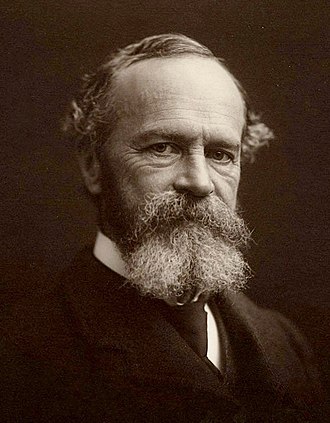
FIVE WISE LINES FROM WILLIAM JAMES [Feb. 2025]

Our view of the world is truly shaped
by what we decide to hear.

The greatest weapon against stress
is our ability to choose
one thought over another.

The art of being wise is
the art of knowing what to overlook.

We have grown literally afraid to be poor.
We despise anyone who elects to be poor
in order to simplify and save his inner life.

Whenever two people meet,
there are really six people present.
There is each man as he sees himself,
each man as the other person sees him,
and each man as he really is.

NOTABLE MENTIONS:

We may be in the Universe as dogs and cats
are in our libraries, seeing the books
and hearing the conversation,
but having no inkling of the meaning of it all.

My experience is what I agree to attend to.

BOOKS: “The Varieties of Religious Experience” by William James

The Varieties of Religious Experience: A Study in Human NatureThe Varieties of Religious Experience: A Study in Human Nature by Dr. William James
My rating: 5 of 5 stars

Project Gutenberg — Free Online

This book is now more than 120 years old and yet is still widely read and is still provoking thought about the nature of religious experiences and how they should be considered by academia. The book is a write-up of a series of twenty lectures that the famous American Philosopher-Psychologist, William James, delivered at the University of Edinburgh in 1901-02.

There are a few things that impressed me about this book. First, James was skilled with language and clever in conveying ideas, resulting in a good bit of quotable material and stimulating ideas.

Second, James’s writings about Eastern practices and philosophies were impressively clear and faithful. In those days, there wasn’t a lot translated from Sanskrit, Pali, etc. and what had been translated was frequently done by outside academicians with no firsthand experience with Eastern systems — e.g. Hinduism or Buddhism. This meant that the writings about Eastern Philosophy and practices from those days were often contorted by a Western / Abrahamic frame in a way that distorted the true nature of those traditions. James seems to have gained at least some of his understanding from someone with enough practical experience to produce accurate descriptions. Furthermore, James avoids spewing myths and misapprehensions by being humble in stating what is merely his understanding. It should be noted that James does write much more about Abrahamic traditions (as one would expect given his direct experience,) but it’s hard to plumb the depths of mysticism without looking to the East where such practices reached such advanced states.

Finally, I was impressed with James’s ability to walk the line of believer and scholar in a way that was fair both to religion and the religious but also to the scientifically-minded rational sceptic. So much of what I read on the subject takes a vitriolic tone of strict opposition and often unfairly depicts the positions of the other side (to be fair, usually this seems to be because the critic doesn’t understand the views of the other side and so produces an interpretation of the opposing ideas conforming to their own worldview, rather than just lying to win.) [As was attributed to James as well as others, “…people think they are thinking when they are merely rearranging their prejudices.”]

I’d highly recommend this book for readers interested in philosophy of religion and the psychology of religious experience.

View all my reviews

PROMPT: Perspective

Daily writing prompt
How do significant life events or the passage of time influence your perspective on life?

I’m getting more at ease with Death by the day. In a broader sense, it’s progressively easier to not get worked up over the everchanging and unpredictable nature of the world.

BOOKS: “Moonwalking with Einstein” by Joshua Foer

Moonwalking with Einstein: The Art and Science of Remembering EverythingMoonwalking with Einstein: The Art and Science of Remembering Everything by Joshua Foer
My rating: 5 of 5 stars

Author’s Book Site

This fascinating work of immersion journalism offers insight into the human memory at its best (and worst,) and throughout the book one follows the author’s experience in preparing for and competing in the American and World Memory Championships. A central theme of the book is how humanity’s attitudes toward (and approach to) memory have changed over time. The tactics that allow competitive mnemonists to perform astounding feats of memorization were well-known in the ancient world and Middle Ages but began becoming less practiced from the dawn of the printing press, becoming almost unheard of by the general population in this, the internet age. Questions such as whether education’s shunning of memorization is, indeed, a sound move are explored. (The mnemonists argue that memorization is done poorly by our educational system, but — if it was done correctly — it would offer tremendous value.)

I found this book to be quite compelling. Foer pulls no punches when presenting individuals who are (or appear to be) charlatans — though in a way that is fair and doesn’t deny things are not always straightforward. (Most of the mnemonists he talks to are clear that they do not have particularly good memories but rather are well-practiced in a set of techniques — e.g. the “memory palace” — that allow even mediocre memories to memorize stacks of cards, chains of random numbers, or even poems at lightening speeds.) Hence the author, with no such background, can learn the skills well enough to be competitive in the US national competition after practicing about a year.

The author speaks to semi-celebrities such as Kim Peek (whom Dustin Hoffman’s character in “Rain Man” is very loosely based upon,) and self-help guru Tony Buzan. But he also interviews a man who has no long-term memory (except from his childhood) and speaks to experts in optimal human performance.

I’d highly recommend this book. It is intensely readable. The stories are riveting and sometimes humorous and the throughline of Foer’s preparation and competition just add icing to the cake.

View all my reviews