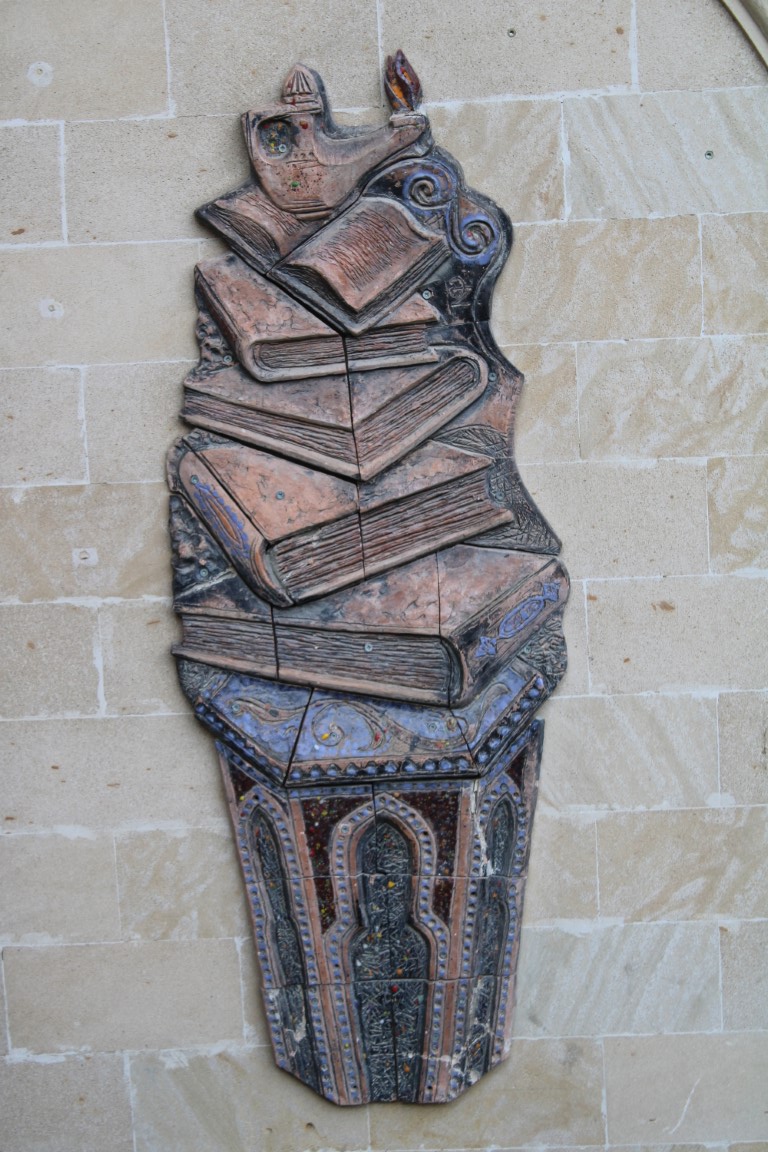
BOOKS: “A Child’s Garden of Verses” by Robert Louis Stevenson

A Child's Garden Of VersesA Child’s Garden Of Verses by Robert Louis Stevenson
My rating: 5 of 5 stars

Amazon.in Page

Until recently, I was only acquainted with Stevenson as a novelist, but I had a powerful experience with his poem “The Hayloft” (included in this collection.) I was intrigued by how a poem written by a nineteenth century Scot could prove so nostalgia-inducing for me, having been a 20th century American farm-boy. So, I read the collection, and found that “The Hayloft” was only one of many examples that had such an effect. Others include: “Land of Counterpane,” “Block City,” and “Land of Nod.” The nostalgic power of the poems derives from the fact that Stevenson does a phenomenal job of capturing a child’s enthusiasm for play, and in that regard I’m sure the collection will resonate more broadly than just I, or even than just farm kids.

Afterall, there’s a lot of Stevenson’s experience that is dissimilar to mine. Besides his era and his nationality, his mentions of nurses, gardeners, and cooks is surely much different from my own upbringing, being devoid of household staff. But the book only needs to draw upon that love of play and imagination to take one back.

For a work from the nineteenth century, this collection of 50+ lyric poems has aged well. There is the occasional word like “gabies” or “whin” to send one to a dictionary, but those archaic or obsolete terms are rarities. Furthermore, the lyricism of the poems makes them easily read or sung.

I’d highly recommend this collection for poetry readers, particularly children or those looking to reexperience childhood.

View all my reviews

The Circle of Play [Lyric Poem]

Sometime not too distant,
There will come a day
When you will return to
A frequent state of play.

When that day comes around,
You'll have lost all concern
For the adults' belief that
Frivolity must be spurned.

You'll take to tossing balls
And climbing up the walls,
Just like you used to do
When you were one or two --
Before that human zoo
Got its hooks in you.

“Tomorrow and Tomorrow and Tomorrow” [Soliloquy from MACBETH] by William Shakespeare [w/ Audio]

Tomorrow, and tomorrow, and tomorrow,
Creeps in this petty pace from day to day,
To the last syllable of recorded time;
And all our yesterdays have lighted fools
The way to dusty death. Out, out, brief candle!
Life's but a walking shadow, a poor player,
That struts and frets his hour upon the stage,
And then is heard no more. It is a tale
Told by an idiot, full of sound and fury,
Signifying nothing.

PROMPT: Every Day

Daily writing prompt
What do you wish you could do more every day?

Move playfully.

BOOKS: “Imagination: A Very Short Introduction” by Jennifer Anna Gosetti-Ferencei

Imagination: A Very Short Introduction (Very Short Introductions)Imagination: A Very Short Introduction by Jennifer Anna Gosetti-Ferencei
My rating: 5 of 5 stars

Amazon.in Page

This is a concise guide to the subject of imagination, the capacity to conceptualize that which does not exist in reality. Philosophy is the primary dimension through which the subject is investigated, though the insights of poets (particularly Romantics,) authors, and artists are frequently presented — in several cases, in detail. Also, the author does discuss ideas from other disciplines as relevant (e.g. psychology, anthropology, science.) This is notable, for example, in Chapter 2, which looks at early signs of imagination in the human record and the evolution of this capacity.

Philosophical views on imagination have varied to the greatest possible extent, from Plato’s belief that imagination represents untruths and is therefore dangerous to various views suggesting that imagination is a good thing, is fundamental to what it means to be human (e.g. to empathy,) and is inescapable for humans. This Plato against the world dispute is revisited in several places throughout the book. Besides those of Plato, the views of Kant, Nietzsche, Wittgenstein, and Sartre are particularly extensively examined.

Creative types will find the final chapter (Ch.6 “Creativity from invention to wonder”) the most engaging part of the book as it deals with what makes for creativity. The chapter discusses topics such as whether constraints help or hinder creativity? Take, for example, poetry: does free verse poetry produce more imaginative material, or — on the contrary — is rhymed and metered verse more innovative and novel. If you think you know the answer, you might be surprised by the arguments that have been put forth.

I enjoyed reading this book and found it thought-provoking and worthy of the time.

View all my reviews

PROMPT: Outgrown

Are there any activities or hobbies you’ve outgrown or lost interest in over time?

Well, having an imaginary friend is adorable at nine, but at ten they institutionalize you. So I would say, yeah.

PROMPT: Playtime

Do you play in your daily life? What says “playtime” to you?

All the time. Free movement & free writing.

BOOKS: Travels with Epicurus by Daniel Klein

Travels with Epicurus: A Journey to a Greek Island in Search of a Fulfilled LifeTravels with Epicurus: A Journey to a Greek Island in Search of a Fulfilled Life by Daniel Klein
My rating: 5 of 5 stars

Amazon.in Page

With the wave of renewed interest in Philosophies of Life lately, it’s nice to see a book that puts Epicurus at the fore. In a number of ways, I believe Epicurus was the most advanced of Ancient Greek philosophers, and yet he doesn’t get much attention compared to Plato, Aristotle, and the Stoics. (In part this is because the vast majority of Epicurus’s writings were lost, and in part it’s because little-“e” epicureanism [i.e. being culinarily hedonistic] has become much more familiar to people than big-“E” Epicureanism [i.e. a materialist philosophy that values pleasure, but not in so hedonistic way as to lose sight of virtue and the countervailing costs of pursing pleasure.] While adjectival forms have done a number on Cynicism and Stoicism as well, the former is – for all intents and purposes – dead and the latter has become much more well-known to present-day people from a pile of podcasts, books, and vlogs.)

I should point out that Klein doesn’t solely focus on the philosophy of Epicurus, he also tells readers what other schools of philosophy teach us about how to age well (and to not turn into a curmudgeon) — most notably: Buddhism, Stoicism, and Existentialism. That said, it’s fair to call Epicureanism the backbone of this book.

One who reads the title might wonder whether this is a pop philosophy book on aging or a travelogue. It’s definitely both, but the philosophy part dominates. I would call it 70/30 pop philosophy to travelogue (maybe 65/35.) The book uses the individuals Klein interacts with on Hydra (and elsewhere in Greece) as examples of how people age well, and in the process shows the reader [textually] a beautiful part of the world. But the core of the book is about philosophy as it pertains to such topics as play, perception of time, idleness, and changing views of spirituality.

I will warn the reader that, while the book offers many great thoughts for a philosophy of aging well, I didn’t agree with everything in the book. Klein contrasts his philosophy for living well into old age and for adapting one’s life to changing roles to the people he calls the “forever young” crowd. I wouldn’t put myself in the “forever young” category as I don’t believe I’m grasping at youth and all its blessings and pains. However, I suspect Klein would put me in that group because I work out intensely, watch what I eat / manage my vices, and am trying to work things so that my heart explodes while I’m still physically and mentally capable — i.e. before I become decrepit or senile. My point is, I’m not sure Klein’s dichotomy is that useful or reflective of reality, and that being health-conscious should necessarily be contrasted with enjoying the pleasures of age. [Truth be told, I’d say the biggest driver for people being more health-conscious into old age is seeing earlier generations live longer, but with a decreased quality of life through that period of increased longevity — See: Being Mortal by Atul Gawande.]

Still, overall, the book is quite readable and offers much excellent food for thought, and I’d recommend it for anyone who is interested in moving into advanced age in a way that isn’t misery filled.

View all my reviews

BOOK REVIEW: Iphigenia in Aulis Adapted by Edward Einhorn [from Euripides]

Iphigenia in Aulis: The Age of Bronze EditionIphigenia in Aulis: The Age of Bronze Edition by Edward Einhorn
My rating: 5 of 5 stars

Amazon.in Page

This illustrated play is an adaptation of Euripides’ drama of the same name. The title character, Iphigenia, is the daughter of King Agememnon and she’s lured to Aulis by her father to be a human sacrifice, but under the fraudulent claim that she’s to be married to Achilles. [Because, you know, people tend to not show up if you invite them to be murdered, but they’re much more amenable if you invite them to marry a hunky half-god.]

It’s a simple and straightforward story, but one that is never-the-less evocative and dramatic. Agememnon’s will to kill his daughter falters for a time and when his wife, Klytemnestra, scores Achilles’ support for the cause of saving her daughter, it’s unclear how things will unfold. It’s a story that encourages one to reflect upon fate and the virtue of sacrifice, while showing that different chains of causality applied to the same event can radically alter the perception of justness. When Iphigenia’s death is seen as the means to get back Helen (who eloped with Paris to Troy,) it’s vile and despicable. However, when it is viewed as the means to get the fleet moving in order to restore the honor of those assembled nations pledged to fight, that’s a different matter.

I found this play to be compelling and well worth reading.


View all my reviews

Shakespeare’s Tragedies, Condensed: Part, The Last

I
King Lear too much loved being praised,
and too little recognized love.
He shunned the daughter he should’ve kept,
and held tightly those in need of a shove.

II
Timon of Athens spent lavishly,
but then - in his time of great need -
no one would return the favor, so
he gave his last coin to watch Athens bleed.

III
Antony is a love-struck boy,
and plots are afoot he can't grasp.
He ends in slow suicide by sword,
while Cleopatra goes out with an Asp.

IV
Coriolanus was kind of a jerk,
and that's why he was exiled.
But he could vanquish all of Rome.
Death to the reciprocally reviled!