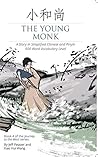
BOOK: “The Young Monk” [Vol. 4 of the “Journey to the West” Series] ed. by Jeff Pepper / trans. by Xiao Hui Wang

The Young Monk: A Story in Simplified Chinese and Pinyin, 600 Word Vocabulary (Journey to the West Book 4)The Young Monk: A Story in Simplified Chinese and Pinyin, 600 Word Vocabulary by Jeff Pepper
My rating: 5 of 5 stars

Publisher Site — Imagin8

This book, Volume 4 of the Journey to the West series, takes a turn from the books thus far. While the first three volumes (Ch. 1-7) focus on Sun Wukong, the Monkey King, this volume leaves him under the mountain where the last volume left him, and — instead — focuses on the origin story of Xuanzang — the monk who is sent by the Buddha to India to get scriptures in the original book — based on the real-world monk who did travel to India to complete the selection of Buddhist scriptures available to Chinese Buddhists.

The monk’s story might not sound like it would be as thrilling as that of the superpowered immortal monkey, but it’s a gripping tale. The story begins before Xuanzang is born and ends in his eighteenth year. So, before he is assigned to travel West to get scriptures.

As I’ve said in earlier reviews, I really like the approach of this series. It has Simplified Chinese script, pinyin, an English translation, and a full glossary of terms used, and it’s organized so as to facilitate reading by a language learner.

I continue to recommend this series for language learners who need a linguistically simplified text to be able to read.

View all my reviews

Worldly Concerns [Kyōka]

Buddha's lap,
a pigeon lands:
a monk shoos
the bird away,
but Buddha didn't mind.

Fēnggān [Senryū]

the monk rode in
on a bright-eyed tiger, and
started hulling rice.

Monk’s Limerick

There once was a virtuous, old monk
Who never, ever had sex or got drunk.
He lived in silence,
And practiced non-violence...
Till one day, in a funk, he kicked a young monk
In the junk.

An Echo of Monks [Haiku]

walking past 
an echo of monks,
i seek distinction.

Four Seasonal Haiku of Ryōkan [w/ Audio]

Spring

rainy days
make the monk Ryōkan
feel sad.

Summer

the moon in my window
is all the thief left behind.

Autumn

an autumn wind
chills the dangling persimmons,
and my testicles.

Winter

little birds have
gathered in the brushwood
on a snowy morn.

Footprints [Haiku]

footprints in stone --
 outside the temple; how do
  Buddhists step so hard?

Ikkyū’s Poetry: The John Steven’s Wild Ways Selection / Translation

Wild Ways: Zen Poems of IkkyuWild Ways: Zen Poems of Ikkyu by Ikkyu
My rating: 5 of 5 stars

This is the John Stevens selection and translation of poetry from Ikkyū’s Crazy Cloud Anthology. Ikkyū was what might be called a mad sage of the Rinzai sect of Zen Buddhism. He once showed up at a temple in his vagabond rags and was turned away, when he came back the next day in the ceremonial robes that revealed him as a preeminent monk and was subsequently treated like royalty, he took the robes off and told the abbot that it was apparently the robes that were honored and deserving of a meal. Ikkyū was known not only for his rejection of dogmatic and highfalutin approaches to Buddhism, but also for his love of sex, brothels, meat eating, and poetry. Much of the poetry touches on those two subjects (disdain for dogma and pretension and love of pleasure,) though there are also poems that explore nature and the kind of imagery one might be more likely to expect in Japanese poetry.

Ikkyū mostly wrote in quatrains, using a Chinese style of verse. Though Ikkyū was no more dogmatic about following poetic protocols than he was following monastic precepts, and often went with the flow.

I read the Stephen Berg translation, Crow with No Mouth several years ago. I would put this one on par with that one. There are actually several translated selections from the Crazy Cloud Anthology poems that are available. If you are interested in Ikkyū’s poetry, this is as good a place to start as any. It should be noted that while some of the poetry is around sexuality, it’s not particularly graphic but more suggestive.

View all my reviews

Prayer Flag Impermanence [Free Verse]

prayer flags languidly roll
in the courtyard
of the monastery

one monk
has seen the flags
every day since
they were erected

&

before that
saw their predecessors --
sun-bleached and tattered

that monk
 looks upon the flags
as if he's never seen them before
and will never see them again

each monk was taught to think this way,
but he's the only one who sees this way

Teaching Tree [Haiku]

robe-wrapped tree,
standing like an old monk
teaching stillness