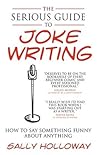
BOOK: “The Serious Guide to Joke Writing” by Sally Holloway

The Serious Guide to Joke Writing: How to Say Something Funny about AnythingThe Serious Guide to Joke Writing: How to Say Something Funny about Anything by Sally Holloway
My rating: 4 of 5 stars

Google Books Page

This book presents a textual version of the author’s joke writing seminar. It offers a few techniques for joke writing that are informed by the premises that: 1.) jokes exist out in the world for one to find — rather than to create; 2.) Anyone who is funny with his or her friends can be a funny joke writer, BUT not without effort. That effort comes in the form of training oneself to look at words and phrases in unconventional ways and in applying (largely mechanical) processes to coax or wheedle the jokes out of the ether. I say “largely mechanical” because there is a chapter on stream-of-consciousness joke writing, but the heart of the book is a process called joke-web building that is a step-by-step approach to finding humor wherever it may hide.

The book alternates practical and “theoretical” chapters. The “theoretical” chapters are mostly about the psychology that gets in one’s way as a joke writer and the ways around it. That is, those parts deal with the value of breaks and the need to manage anxiety. The practical chapters explain the procedures and have Q&A style troubleshooting sections in addition to a description of the process.

I found the book to be interesting and a quick read. Some of the procedures seem a bit tedious, but they do produce results. It may be possible to streamline them to one’s own situation.

View all my reviews

PROMPT: Writing

Daily writing prompt
What do you enjoy most about writing?

EPIPHANIES.

But, if you think about it, writing is miraculous. In the scheme of gifts that nature grants, it is way out beyond left field. Encoding ideas and images in simple characters in a way that can evoke emotional or cognitive responses in readers is kind of a superpower. (As is reading.)

PROMPT: 30 Things

Daily writing prompt
List 30 things that make you happy.

1.) love; 2.) a glorious turn of phrase; 3.) discovery; 4.) walking; 5.) swimming; 6.) stumbling upon an interesting and / or novel idea; 7.) movement; 8.) travel; 9.) street food; 10.) quiet; 11.) health; 12.) recognition that when things are at their very worst, they must get better — because everything is impermanent; 13.) an intense stretch; 14.) Whitman’s “Leaves of Grass;” 15.) undiscovered country; 16.) the hanging moment; 17.) a mystery-laden world; 18.) a moment of flow; 19.) a mountain path; 20.) a clear stream; 21.) the way of non-adversariality; 22.) a thing stripped to its simplest form; 23.) the moment breath turns the tide; 24.) animals being animals; 25.) a brief instant of free fall; 26.) the recognition that something that used to cause me angst or fear no longer does; 27.) when body, movement, and the world fall into alignment; 28.) first contact with someplace / something new; 29.) connection; 30.) the first sign that the struggle is paying off.

Wen Fu 10 “Originality” [文赋十] by Lu Ji [陆机] [w/Audio]

Splendid thoughts arise from joined words --
Lucidity is awakened:
Luminous like adorned brocade,
Doleful as a string serenade.
But if crib suspicions aren't killed,
It'll be just one more pulp piece.
Though you may be these word's weaver--
Some ancestor, the prime conceiver.
You must be just and rise above,
Though it kills words you've grown to love.

The original lines in Simplified Chinese:

或藻思绮合,清丽千眠。
炳若缛绣,凄若繁弦。
必所拟之不殊,乃暗合乎曩篇。
虽杼轴于予怀,怵佗人之我先。
苟伤廉而愆义,亦虽爱而必捐。

Wen Fu 8 [文赋 八] “Edits” by Lu Ji [陆机] [w/ Audio]

Maybe the first lines constrain the last;
Maybe ends insist on openings;
Maybe some truths escape all words;
Maybe dulcet lines tell no truths.
One may need to keep separated --
Beauty and truth -- to avoid wounds.
Inspect and haggle over each word --
Distinctions maybe finer than a hair;
Weigh each edit upon a scale;
Ensure each cut serves its purpose.

Original poem in Simplified Chinese:

或仰逼于先条,或俯侵于后章。
或辞害而理比,或言顺而义妨。
离之则双美, 合之则两伤。
考殿最于锱铢,定去留于毫芒。
苟铨衡之所裁,固应绳其必当。

Wen Fu 6 [文赋六] “Modes of Writing” by Lu Ji [陆机]

Poetry is poignant and ornate;
Essays are deep and content-centric.
Stele entries are true to the essence;
Paeans, moving and melancholic.
Inscriptions are concise and kindly;
Telltales have a logic and cadence.
Odes show great grace and refinement;
Op-eds are unrepressed and intense.
Music 's penetrating and stately;
Speeches must sparkle with cleverness.
Though there ever so many forms,
All thwart evil and allow release:
Expression, sans pride overweening,
With no waste of words or lost meaning.

Original in Simplified Chinese:

诗缘情而绮靡,赋体物而浏亮。
碑披文以相质,诔缠绵而凄怆。
铭博约而温润,箴顿挫而清壮。
颂优游以彬蔚,论精微而朗畅。
奏平彻以闲雅,说炜晔而谲诳。
虽区分之在兹,亦禁邪而制放。
要辞达而理举,故无取乎冗长。

Wen Fu 5: “Writing Styles” [文赋五] by Lu Ji [陆机] [w/ Audio]

Among ten thousand writing styles,
There's no one standard or measure.
The styles: many, muddled, and free --
Form, the unattainable treasure.
Talent in word-wrangling shows skill.
Idea conveyance shows craft.
Writers strive 'twixt have and have not --
Unyielding in shallow or deep draught.
An escape artist of fine lines --
Yet time and space consume in kind.
Intricacy excites the eye,
But frugality soothes the mind.
One of few words is not confined.
Verbose writers drift the Undefined.

The original in Simplified Chinese:

体有万殊,物无一量。
纷纭挥霍,形难为状。
辞程才以效伎,意司契而为匠。
在有无而黾勉,当浅深而不让。
虽离方而遯员,期穷形而尽相。
故夫夸目者尚奢,惬心者贵当。
言穷者无隘,论达者唯旷。

“Poetry Is a Destructive Force” by Wallace Stevens [w/ Audio]

That's what misery is,
Nothing to have at heart.
It is to have or nothing.

It is a thing to have,
A lion, an ox in his breast,
To feel it breathing there.

Corazón, stout dog,
Young ox, bow-legged bear,
He tastes its blood, not spit.

He is like a man
In the body of a violent beast.
Its muscles are his own. . .

The lion sleeps in the sun.
Its nose is on its paws.
It can kill a man.

Wen Fu 4: “Ekstasis” [文赋四] by Lu Ji [陆机]

It's all the amusing matters
That sages admire without bounds.
Writers find their way through the void --
Knock on silence to find its sound.
Silk scroll messages from afar,
The bard's words surge forth from the heart.
Words and ash grow to overflow --
Thoughts transcend depths to become art.
Flowery fragrance pungently sprawls;
Plants shoot forth verdant greenery.
The brush winds swirl to whirlwinds
Clouds climb above the academy.

Note: I previously posted other translators’ (Barnstone and Chou) version of this poem as The Joy of Words @ https://berniegourley.com/2024/12/31/the-joy-of-words-by-lu-ji-w-audio/

Original poem in Simplified Chinese:

伊兹事之可乐,固圣贤之所钦。
课虚无以责有,叩寂寞而求音。
函绵邈于尺素,吐滂沛乎寸心。
言恢之而弥广,思按之而逾深。
播芳蕤之馥馥,发青条之森森。
粲风飞而猋竖,郁云起乎翰林。

BOOKS: “Be Funny or Die” by Joel Morris

Be Funny or Die: How Comedy Works and Why It MattersBe Funny or Die: How Comedy Works and Why It Matters by Joel Morris
My rating: 5 of 5 stars

Author Site

Release date: Sept 4, 2025 [paperback, hardcover is already out]

This is a comedy writer’s guide to how humor is crafted. It’s a bit popular psychology and a bit of a how-to guide. If one is expecting, because it’s on comedy and humor, a book that is a laugh riot on every page, this isn’t the book for you. That’s not so say Morris doesn’t pepper the book with witty commentary and humorous examples, but it’s ultimately a book about how the sausage gets made and is, thus, somewhat analytic — if in a readable style.

At the core of Morris’s theory of comedy is a three-component structure: construct, confirm, and confound. Other major ideas are the fundamental tribalism of comedy and the connections between comedy and music. It wouldn’t be a present-day book on comedy if there wasn’t some discussion of the idea of offense and the “limits” of what can be said.

I can’t say all of Morris’s ideas found immediate resonance with me, but even when I didn’t fully buy the argument, I did find the presentation thought-provoking. For example, I don’t know that I buy Morris’s argument about the importance of tribality to comedy. I do agree that one needs a common language and some overlap of experience, but all of humanity has a domain of overlap of experience. Yes, one may have an easier time the more extensive that overlap is, but ease doesn’t necessarily mean one can’t get big laughs from an audience whose worldviews and experience are radically different from one’s own. [Of course, I may just be being overly sensitive as a traveler in a tribal world.]

For writers, the end of the book has a few chapters that are more about story than comedy – per se, and – while these chapters compare and contrast comedy and drama writing – they provide information useful to any writer engaged in storytelling.

I’d highly recommend this book for any readers interested in comedy writing, be it of standup material, scripts, or other content.

View all my reviews