BOOK REVIEW: The Miracle of Mindfulness by Thich Nhat Hanh

The Miracle of Mindfulness: An Introduction to the Practice of MeditationThe Miracle of Mindfulness: An Introduction to the Practice of Meditation by Thích Nhất Hạnh

My rating: 4 of 5 stars

Amazon page

This book by the renowned Vietnamese Buddhist monk, activist, and poet, Thich Nhat Hanh, offers pointers on how to live a life of mindfulness. Like most of Hanh’s works, this one is brief, concise, and the front and back matter account for about as much verbiage as the chapters themselves.

The seven chapters that make up the book proper examine mindfulness from various angles, with various approaches, and have a loose organization. The most readable of these chapters–owing to its narrative format–is the last, which retells a Tolstoy story about an Emperor who receives three questions and–unable to find suitable answers by offering a reward to his subjects–dons a disguise and visits a hermit sage. Needless to say, the sage (and life events) enlighten the Emperor, and the answers revolve around the theme of mindfulness. Among the most thought-provoking of the chapters is one that proposes that one take one day of the week to focus on mindfulness. Hanh offers advice on how to best select and structure such a day.

While the appended matter of some of Thich Hhat Hanh’s books can read like filler (intended to reach a page quota), that isn’t so much the case with this book. The most valuable of the appendices gives 32 exercises for building mindfulness. Many of these exercises are variations on a theme, and some are much more extensive than others, but it’s a crucial section and might even be called the heart of the book. Likewise, there are five sutra translations that will be appreciated by readers who are actually Buddhist. (Non-Buddhists may find the sutras to be a less colorful and more repetitive restatement of what Hahn has told them in the chapters. If one pays attention to the chapters and does the exercises, reading the sutra’s isn’t necessary for those who are not students of the religion.)

There is an odd postscript by one of Hanh’s students that is like those I’ve seen in other Hanh books. It’s an odd little testimonial. I put it in the filler category as anyone buying the book knows who Thich Nhat Hanh is and about the accolades he has received and, therefore, they don’t need a prologue telling them how awesome he is. It actually detracts from his persona as a wise man, because it makes one wonder who inspired the little ego trip. I suspect this is more a publisher desired addenda than an author inspired one, but, at any rate, it’s not useful. It can be interesting to hear about the war days, but there’s an outlet for that. Furthermore, I would think the place to tell us how awesome the author is would be at the beginning of the book–not the end. If one gets to the back matter, he must have done something to impress one.

I’d recommend this book for meditators, would-be meditators, and anyone who thinks that life is slipping through his or her fingers because of constant stress and a runaway mind.

View all my reviews

BOOK REVIEW: The Tao of Jeet Kune Do by Bruce Lee

Tao of Jeet Kune DoTao of Jeet Kune Do by Bruce Lee

My rating: 4 of 5 stars

Amazon page

Jeet Kune Dō (henceforth, JKD) is Bruce Lee’s “styleless style” of martial arts. Its literal meaning is “the way of the intercepting fist.” However, Lee cautions one against attaching too much significance to that name (or any name) in the book’s final chapter. Long before “Mixed Martial Arts” became a household word, Lee was constructing this fighting system that borrowed heavily from the Western traditions of boxing, fencing (conceptually speaking), and wrestling as well as from Kung-fu, Savate, and Judō/Jujutsu. While JKD employs techniques and concepts from these systems, Lee remained adamant that no good came of organized styles built on fixed forms. In fact, that might be said to be the central theme of the book. That is, each fighter should begin with sound fundamentals and build an approach that is ultimately his or her own.

The Tao of Jeet Kune Do is an outline of the martial art. In many ways, it looks like and reads like Lee’s personal notebook. It’s illustrated with crude (but effective) hand drawings of the type one would see in a personal journal, and they are annotated with hand-written notes. (My biggest criticism is that on the Kindle version the graphics are largely unreadable. I’d recommend you get the print edition if you can, which is large-format paperback as I recall.) The book combines a philosophy of martial arts with nitty-gritty discussion of the technical aspects of combat. The philosophical chapters bookend the technical ones.

As others have pointed out, there’s not much that is new in either the philosophical discussions or the technical ones. Lee’s value-added is in how he states these concepts, how he selects the concepts of value (informed largely by a love of simplicity and a hatred of dogma), and the weight lent to the lessons by Lee’s great success story—albeit in a life far too short. Lee was a man of charisma, and one who approached endeavors with gravitas.

Now, I can imagine some readers saying, “Why are you recommending a book on real fighting by a movie martial artist? Would you recommend a book on how to conduct gall bladder surgery from someone because they were on the first two seasons of ER? Would you take martial arts lessons from Keanu Reeves because his moves looked pretty nifty in The Matrix?”

I’ll admit that there is nothing about making kung-fu movies that makes one particularly competent to give advice on close-quarters combat. However, as I said, Lee seemed to devote himself entirely to everything he did. Consider the Bruce Lee physique, which seems so common place among actors today (no doubt in part chemical and in part owing to live-in Pilates coaches) was virtually unseen in the 70’s. Yeah, he probably had good genes, but he must have trained like a maniac as well. Lee’s constant mantra of “simplicity” lends him a great deal of credibility. (It should be noted that pragmatism is not a virtue in the movie-making industry.) Lee demonstrates that he’s given a lot of thought to the subject and done the training when he discusses technical concepts. For example, while he gives high praise to Western boxing and emulates boxing moves in some regards, he also notes that boxers are insufficiently cautious owing to the rules/equipment of their sport (a comment—it should be noted–that can be leveled against any sport martial art.)

The technical material is organized in four chapters. The chapter on “tools” deals with the techniques of striking, kicking, and grappling. A chapter on preparations explains Lee’s thoughts on faints, parries and manipulations. There is a chapter on mobility that discusses footwork and various types of evasions. The last technical chapter discusses the approaches to attack, focusing heavily on JKD’s five types of attack.

The Tao of Jeet Kune Do is undeniably repetitive, but that repetition has value in hammering home key concepts. It’s also consistent with the JKD philosophy of not getting into a great deal of complexity, but rather drilling home the basics. There’s an old martial arts adage that says, “One should not fear the man who knows 10,000 techniques as much as the one that has done one technique 10,000 times.” This seems apropos here. Besides, the concepts that are repeated are often worth memorizing. e.g. Simplify. Eliminate ego. Avoid fixed forms. Be natural. Don’t think about building up as much paring away.

I’d recommend this book for martial artists of any style. Non-martial artists may find the philosophical chapters interesting, but may not get much out of the list-intensive technical chapters.

View all my reviews

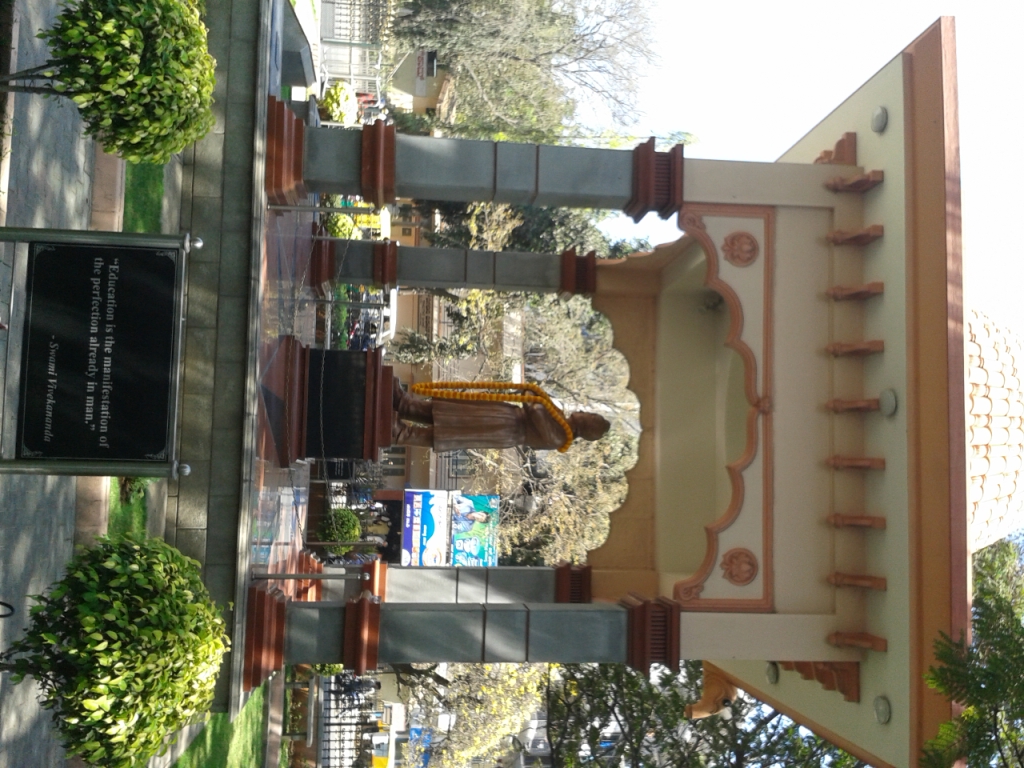
DAILY PHOTO: Swami Vivekananda

Taken February 25, 2014 in Bangalore

Taken February 25, 2014 in Bangalore

This little park devoted to Swami Vivekananda is located on Bull Temple Road in Bangalore. Swami Vivekananda was a 19th century yogi and Hindu holy man. He was the chief disciple of Swami Ramakrishna, and is often credited with introducing yoga to the West.  This statue is located across the street from the Ramakrishna Math near Gandhi Bazaar (there is another Ramakrishna Math closer to Ulsoor Lake.)

The park has a series of quotes from the Swami in English and Kannada. The one above says, “Education is the manifestation of the perfection already in man.”

BOOK REVIEW: The Novice by Thich Nhat Hanh

The Novice: A Story of True LoveThe Novice: A Story of True Love by Thích Nhất Hạnh

My rating: 5 of 5 stars

Amazon page

The Novice is the retelling of a Vietnamese folk tale about a young monk who is repeatedly wronged, but who always does the virtuous thing. As I read this book, I thought the story seemed familiar, and I realized that I read the same story as The Martyr by Ryūnosuke Akutagawa. Akutagawa does a much better job of story building. The Japanese writer doesn’t reveal to the reader that Lorenzo (his novice and the equivalent of Thich Nhat Hanh’s Kihn Tâm) is a female until the end—thus definitely resolving the claim that the young monk fathered a child out-of-wedlock and in contravention of vows f0r the reader at the same time as the characters in the story learn it.

Thich Nhat Hanh tells us that the novice is a female at the beginning, and he does so via backstory that serves both to give justification for why Kihn Tâm chooses to disguise herself and become a monk and to pile onto the injustice. We learn that Kihn Tâm’s female alter ego had been married, but the marriage ended with a false accusation of attempted murder of her husband. This backstory probably isn’t worth the drag for either of the aforementioned purposes—but the former is more justifiable than the latter.

What Thich Nhat Hanh lacks in gripping narrative structure, he gains in provoking thought. The Zen monk and poet gives the reader insight into how Kinh Tâm manages to be preternaturally virtuous. In The Martyr this is a black box affair. Hanh also encourages the reader to see Kihn Tâm’s accusers as the novice does, i.e. with compassion. Akutagawa does what any writer would do; he vilifies the accusers so as to make the story resonate with the average, petty, martyr-complex prone reader—as opposed to the enlightenment-aspiring reader. Hanh leaves the other monks in Kinh Tâm’s corner, i.e. when everyone else is condemning the novice, they still believe in her. In Akutagawa’s story, monastics are not inherently so perfect.

The book offers some interesting back matter. The most substantial of the appendices is an account by Sister Chan Khong of the works of Thich Nhat Hanh and his followers both during the war and afterword when they tried to establish a monastery in Communist Vietnam. The essay echoes the themes of loving-kindness and compassion that form the core of the novella, as does the essay by Hanh that brings the book to a conclusion. While this back matter is filler to make up for the fact that the story is not novel length, it nevertheless makes for interesting reading.

I’d recommend this book for those with an interested in Zen. If you’re looking for a good story, read Akutagawa’s The Martyr, but if you want to be inspired to compassion, read Thich Nhat Hanh.

View all my reviews

BOOK REVIEW: The Equanimous Mind by Manish Chopra

The Equanimous MindThe Equanimous Mind by Manish Chopra

My rating: 4 of 5 stars

Amazon page

Imagine going to a meditation center and living by the following rules:

1. You may not have access to any reading materials.

2. You may not have access to any writing materials.

3. You must leave behind cell phones, tablets, laptops, watches, radios, and other portable electronic devices.

4. While there will be other people around, you are only allowed to talk to your instructor/mentor, and mustn’t acknowledge or interact with others. You will scarcely hear a voice unless you are in meeting with your teacher or listening to the taped lessons in the evening.

5. You will be segregated from the other sex. They will have separate living and meditation spaces.

6. You will eat only the vegetarian meals provided by the center.

7. You will spend your days mostly in meditation—meditation of a rigorously prescribed nature.

8. You have to live by these rules for ten straight days. You are strongly discouraged from attending if you don’t believe yourself capable completing of all ten days.

Could you do it? If your response is, “Sure I can, piece of cake,” you are either an exceptional person or a little deluded. And it’s probably more likely you are like the person who imagines they will be a hero in a bank robbery or mugging, but who ends up catatonically cowering in a puddle of their own piddle. Maybe it shouldn’t be a tough proposition, but it is.

The ten days described are the basic course offered at Vipassana meditation centers around the globe. Except your travel costs, there’s no cost to attend, and you aren’t even allowed to tip the staff–though you can make a donation at the end of the course to assist others. If you happen to be near a center, there’s nothing but will and 10 consecutive days of freedom to keep one from taking the course.

The Equanimous Mind charts Manish Chopra’s personal experience with the course. I bought the book because I intend to attend the course myself, and I craved insight into what the experience is like.

For those who are unfamiliar with Vipassana meditation, it’s nominally a Buddhist method, but practitioners are quick to point out that it’s actually areligious. One need not be Buddhist to attend. One could be a Hindu, a Methodist, or an atheist and get the same value from attendance. Adherents believe that this is the meditation method that Buddha himself taught. For those who thought this sounded awfully cult-like when I described it above, in many ways it’s the antithesis of a cult. There is no central guru to worship. The closest thing to the overarching guru, S.N. Goenka, passed away last year. You don’t have to join a group or swear allegiance. And not only don’t you surrender your life-savings, you don’t have to surrender one, thin dime to have the experience.

Chopra doesn’t write at all about the background of Vipassana, nor much about its philosophy or method. Instead, this book is a retelling of Chopra’s personal experience with the camp. There are many books that deal with those aforementioned topics, and so it’s no loss that this book doesn’t. It does give the reader a first-hand look at what it’s like to live in the camp and what prolonged meditation is like, and thus meets a valuable niche in lending comfort to those who are considering the course–but who are leery of what they will go through.

It’s remarkable that the author had the detailed recollections necessary to construct an entire book. The organization of the book chapters is by day, and so there are ten core chapters. (This is a good way to arrange it as there is apparently some universality to experience day-by-day. Not only are people being taught the same methods, but it seems most people who quit do so on days two or six—indicating many people hit “walls” at the same point.) One will remember that notebooks and writing utensils are prohibited. The last chapter informs the reader that Chopra began frantically outlining the book on his way home. It’s surprising that an entire book sprang from memory. The author does claim that the clarity gained through the course improved his memory.

One can’t help but wonder what the book would have read like if it had been compiled day-by-day as a journal. In other words, how much was the book was framed by the euphoria of just having completed the course? Chopra does mention some low points of the course, but, overall, the picture he paints is rosy. It may be that his experience was just overwhelmingly positive, or he could have been on a high from completing something quite difficult.

Chopra suggests that by the end he had greater mental clarity, decreased vice, increased mental capacity, and was living an idyllic life. I don’t want to sound like I’m treating the account as suspect, and I certainly wouldn’t suggest that Chopra is being blatantly dishonest. However, I worry that Chopra might have oversold the course. It almost reads like he’s been imbued with superpowers (mental, not physical–think Professor Xavier, not superman) at the end of the book. (He doesn’t suggest anything magical, but the claims are pretty impressive.) Maybe this is genuinely his experience, but it sounds a little too good to be true.

I’d definitely recommend this book for people who are considering taking the course. I’m not sure it would be of much interest to a more general reader. As I indicated, one isn’t going to learn a lot about the philosophy or history of Vipassana. One does learn a little about the methods from Chopra’s description, but it is fairly cursory. There is a fair amount of mundane information that people interested in the course will love to know (e.g. what kind of food was served and what it’s like to have to sit through one’s body aches), but which will be less than thrilling for someone who has no interest in taking the course.

View all my reviews

BOOK REVIEW: The Way of Chuang Tzu by Thomas Merton

The Way of Chuang TzuThe Way of Chuang Tzu by Thomas Merton

My rating: 5 of 5 stars

Amazon page

The Way of Chuang Tzu is Thomas Merton’s take on Chuang Tzu’s lessons of Taoism. One might ask why a person should learn about Taoism from a Trappist monk any more than one would learn the teachings of St. Francis of Assisi from a Zen monk. Maybe you should and maybe you shouldn’t, but I think Merton did a remarkable job in putting this book together and that there’s a lot to be learned from it. Some may find a fresh fusion in Merton’s approach to Chuang Tzu.

What I like most about this version of Chuang Tzu’s teachings is that Merton doesn’t foul it up with a bunch of analysis. Because the lessons are short and—admittedly, in some cases—arcane, there’s a temptation to write in a bunch of explanation and analysis—both to hit a page quota and to prove how smart the translator is. Ironically, some don’t seem to see the irony of rambling on in explication of Taoism—a philosophy that advocates simplicity and rebukes the wordy for their arrogance. Merton doesn’t fall into this trap. He offers a few pages of introduction as context for the reader, and then moves straight into 62 lessons of Chuang Tzu.

I’d say the introduction is useful, particularly for individuals without a great deal of background in Taoism. In it, Merton gives insight into potentially confusing topics like wu-wei (actionlessness), the yin/yang dichotomy, and the divergence of Taoists from Confucian scholars on the four-fold Ju philosophy of virtue. However, the intro can also be skipped if you do know a about Chinese philosophy, and don’t care to read a commentary on Taoism inflected with Trappist worldview. (Taoists may want to skip the intro if they’re prone to becoming infuriated by an outsider proposing that their life philosophy took a wrong turn along the way. Merton suggests that one shouldn’t confuse Chuang Tzu’s Taoism with what the system has become, the implication being that it was a sound philosophy and became voodoo hokum in modern times.) Merton does inevitably project some of his own worldview as a Christian monk into Chuang Tzu’s teachings. Some might find this to make for a refreshing commentary on it, and others may find it a bit off the mark on occasion.

Merton’s poetic background serves him well here as many of the lessons are in poetic form—partially or totally. Translating poetry is one of the most difficult linguistic tasks imaginable. Merton has the added challenge of never having read the original. He doesn’t read any Chinese languages. He did, however, consult four different translations in three different languages (English, French, and German.) This, of course, means that besides Merton being in the text, there’s a further seepage of Western framing into these Eastern teachings. I’ll leave it to the reader to decide whether this is a good or bad thing, and arguments could be made either way.

One of the strengths of Chuang Tzu’s lessons is his use of the narrative form. That is, the Taoist sage liked to use stories to impart his wisdom, like the wheelwright who insults the Emperor but then ends up teaching him a valued lesson. One of my favorites is the story about the Prince of Chu sending out high-ranking emissaries to appoint Chuang Tzu to a ministerial post. Chuang Tzu explains why he is turning down the offer by way of an allegory about a turtle.

Chuang Tzu also uses dialogue to get his point across in a way that is easy to follow and clear. A prime example of this is the discussion between Chuang Tzu and Hui Tzu about the happiness of fishes, which has an almost Socratic ring to it. The combination of story and dialogue makes Chuang Tzu’s lessons sometimes easier to follow than the Tao Te Ching of Lao Tzu. Lao Tzu tends to be more arcane by way of his use of short, declarative statements that are more vague and abstract (that could be a good thing, but given vast loss of cultural context it might be confusing as well.)

I’d recommend this book for anyone interested in Taoism. I enjoyed the Merton’s sparse approach, and think that he does a good job conveying Chuang Tzu’s lessons.

View all my reviews

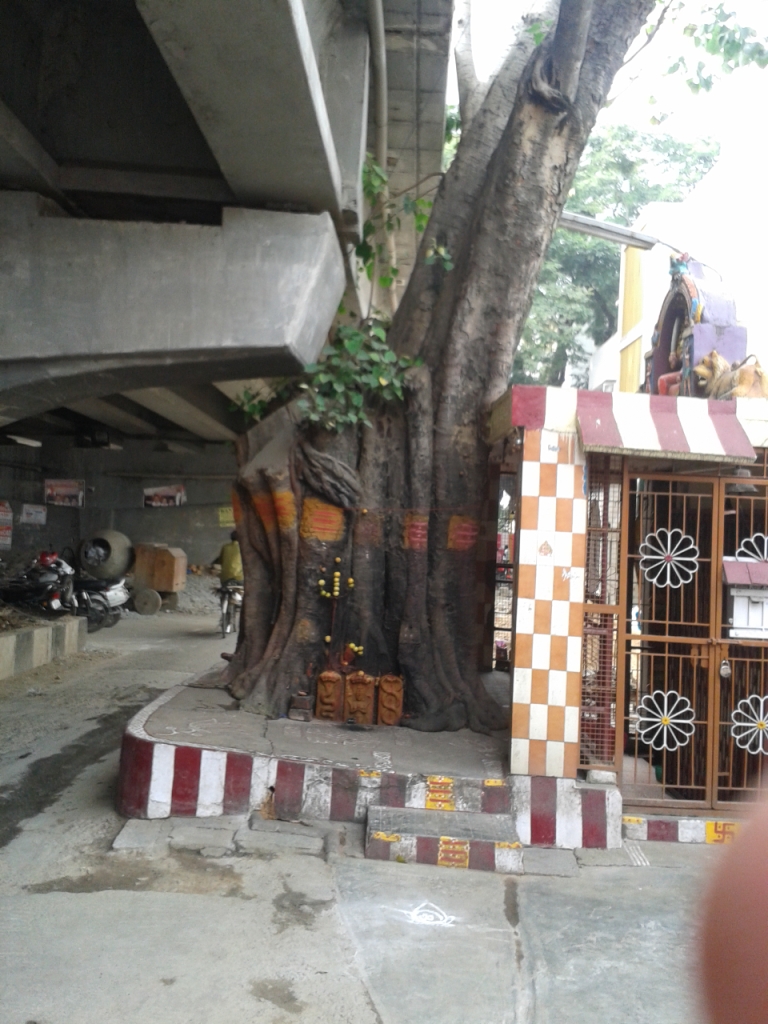
DAILY PHOTO: Half a Tree is Better than None

Taken December 7, 2013 in Cox Town.

Taken December 7, 2013 in Cox Town.

I took this photo yesterday in Cox Town as we were walking over to the United Charities Bazaar (a great and highly recommended event.) It’s a tree that juts out into the road next to a small Hindu temple. When they put in a flyover, they cut away quite a bit of the tree, but the part that remains seems to be thriving.

When one moves to a new country, one experiences a wide variety of cultural insights. All of a sudden, this invisible thing called culture becomes visible. There are, of course, many norms that grate on one’s nerves with respect to the culture one has been transplanted into. In the vast majority of cases, there isn’t anything inherently wrong with the new culture–they are just differences, just shocks to one’s system. There are a few cultural proclivities that one can fairly say are objectively inferior, and it’s a testament to India that they are trying to fix these problems (e.g. by outlawing the caste, by trying to prevent killing off of girl children, etc.)

However, if one is honest with oneself, one also gains insight into one’s native culture, and its particular inferiorities.  As I said, we take culture so for granted that we don’t necessarily even see the peculiarities of our own culture. One of the Indian  norms that I find most laudable is the preservation of living things to the extent possible. Put alternatively, one of the norms of my own culture that I’ve come to find most dismaying is the belief that anything that causes a person the least inconvenience must die immediately.

I imagine that some Westerners in India find it to be a pain to have to step out into the street when walking down the sidewalk because there are occasionally ten-foot diameter trees hogging the whole sidewalk. In the US, they’d just cut down the big tree and replace it with a dwarf tree of some sort that would never give them a problem–and if it did, just get out the saw.

RANT: There’s nothing worse than hyperbole!

There's nothing worse than a dictator with an angry army of warcocks!

There’s nothing worse than a dictator with an angry army of warcocks!

I’m taking a stand against the phrase, “There’s nothing worse than…”

OK, feel free to continue using it for saying, “There’s nothing worse than…

-Nazis.”

-nuclear Armageddon.”

-cancer.”

-catching on fire.”

-shrapnel in the face.”

-losing one’s job to a machine that isn’t even artificially intelligent.”

I’ll accept a bit of hyperbole because there’s no objective and universally-accepted way to determine who was worse, Hitler or Pol Pot. And it’s legitimate to exaggerate one’s personal crises–provided that crisis isn’t something like having the seat warmer go on the fritz in your SUV.

My problem is hearing,  “There’s nothing worse than…

-spotty cell phone reception.”

-when it takes 30 minutes to get your oil changed.”

-when a pay-per-view bout ends in the first round.”

-an empty Nutella jar.”

-when the elevator is broken and I have to walk all the way to the second floor.”

-getting in the line behind someone who still writes checks.”

Clearly, there are many things worse than any one of those things, or even all six of them happening on the same day. If you can’t think of one, you should get out more. I’m not saying one should be constantly comparing one’s problems with the biggest disasters in the world. Nor am I saying that, in the scheme of things, your  piddly-ass problems don’t matter. I’m just calling for perspective. It’s hard to take someone seriously who can’t imagine a fate worse than a cracked lid on a Starbucks half-caf latte.

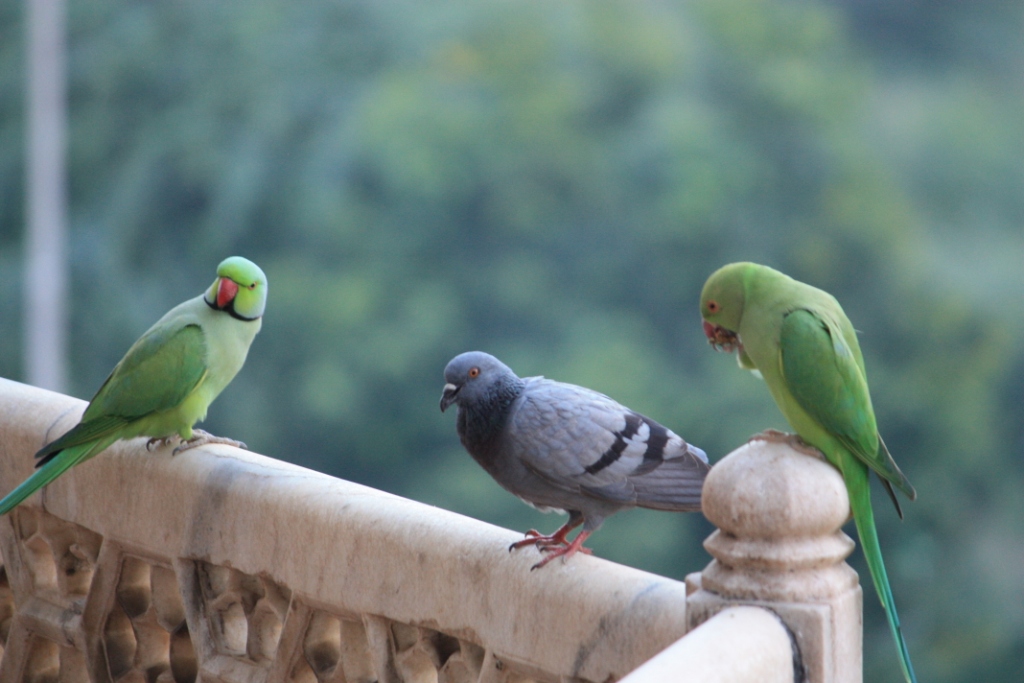
POEM: Awkward Bird Conversation

AgraFort17Three little birdies sat on a rail.

Two little birdies spoke of no avail.

“Sam, you’re just not one of us.”

“I’m not a bird, like you or Gus?”

“No. Some birds just don’t go together.”

“You mean the ones without any feathers.”

“No. Some birds are just kind of unique.”

“Yeah, I once saw one without any beak.

“Some birds are from very different type eggs.”

“We all have two legs, so what’s wrong–I begs.”

“It’s not that there’s anything wrong, per se–

It’s just that–well–we’re green, and you’re grey.”

“So you won’t sit on a rail, preen, or be seen

with any bird, unless its color is green?”

“Well, it just sounds silly when you put it that way.”

BOOK REVIEW: The Book of Tea by Kakuzo Okakura

The Book of TeaThe Book of Tea by Kakuzō Okakura

My rating: 4 of 5 stars

Amazon page

This book is neither about tea the drink nor tea the plant; it’s about tea the experience. It’s about what the author refers to as “Teaism,” which is akin to Taoism and Zen and which extols the virtues of simplicity, purity, and humility. Teaism is a philosophy that exists around–and in conjunction with–so many familiar philosophies, but is not subsumed by any of them.

The book is divided into seven parts: I.) The Cup of Humanity; II.) Schools of Tea; III.) Taoism and Zennism; IV.) The Tea Room; V.) The Art of Appreciation; VI.) Flowers; and VII.) Tea Masters.

Part I gives us an overview of what Teaism is. One may get a better feel for the author’s view of Teaism through a few choice quotes than from my rambling description. (I’ll take advantage of the book’s 1906 birth date–and, hence, public domain status–to quote heavily from it.)

“Those who cannot feel the littleness of great things in themselves are apt to overlook the greatness of little things in others.”

“It’s [The Tea cult’s] very spirit of politeness exacts that you say what you are expected to say, and no more.”

“For Teaism is the art of concealing beauty that you may discover it, of suggesting what you dare not reveal.”

“Let us dream evanescence, and linger in the beautiful foolishness of things.”

The first part also devotes considerable space to contrasting East and West. The author defends the Eastern ways, which include an exacting and meticulous approach to tea, as not being backwards–as suggested by some in the West.

It should be noted that her commentary, while sometimes sharp in tone, isn’t an attack on the West so much as a defense of the East. It’s interesting to me that there was such conflict as Teaism sprang from Taoism, which is the individualistic strain of Southern China. There is much in common between the values of Taoism and Western liberal thinking. Both share irreverence for tyranny and authoritarianism, and a dislike of that which is forced on one by dictate.

The second part gives a mini-history of the development of tea, but soon sows more of the philosophy of tea in what becomes a lead-in to the following chapter. A couple more choice quotes:

“Perhaps we reveal ourselves too much in small things because we have so little of the great to conceal.”

“Teaism was Taoism in disguise.”

The third part is the core chapter. It discusses the like mind of Taoism and Zen, and how these systems made fertile soil for the growth of Teaism. It is the heart of the book, as it reveals most vividly what Teaism is by explaining the concepts of nothingness and duality.

“One who could make himself a vacuum into which others might freely enter would become a master of all situations.”

“In jujutsu one seeks to draw out and exhaust the enemy’s strength by non-resistance, while conserving one’s own strength for victory in the final struggle.”

“Truth can be revealed only through the comprehension of opposites.”

“The followers of Zen aimed at direct communion with the inner nature of things, regarding their outward accessories only as impediments to a clear perception of truth.”

Part IV describes the place in which the tea ceremony takes place. The key points are: The tea room should be small and simple, and emulate a Zen monastery. The entryway should be less than three feet high, so that all–Shogun or shepherd alike–can be reminded of the need for humility. The first requisite of being a tea master is the ability to sweep and clean. Earlier, Okakura mentions how the most senior monks in a Zen monastery do the most arduous tasks, rather than the novices. This point translates to Teaism. By becoming a master, one doesn’t escape the requisites of modest tasks, but must carry them out all the more skillfully.

Part V, on the art of appreciation, was summed up for me by the quote, “We classify too much and enjoy too little.”

Part VI is where the author goes a little astray in my opinion. She seeks to address the co-development of flower arranging with tea ceremony. She begins by bemoaning the waste of so many flowers–even more-so in the West than the East. “Why were the flowers born so beautiful and yet so hapless.”

Interestingly, she never bemoans the plucking of tea. She anthropomorphizes flowers–not, apparently, because they are living–but because they are beautiful. She imagines that they must feel the excruciating pain of being wrenched from a stem in a way that a rather lackluster looking tea-bud cannot. It’s her deference to the consensus of beauty as represented by the flower as opposed to the simple tea-bud in which she performs the greatest sin against her own philosophy.

Furthermore, she says, “The man of the pot is far more humane than the man of the scissors.” Failing to recognize that the flower planter and the flower harvester are, in most cases, one in the same person.

She eventually explains how those whose philosophy so despised the destruction of life and beauty came to engage in flower arranging. “We shall atone for the deed by consecrating ourselves to purity and simplicity.”

The final part tells us about the nature of the tea master–a monk of leaf and beverage, if you will.

“The tea-masters held that real appreciation of art is only possible to those who make of it a living influence.”

“He only who has lived with the beautiful can die beautifully.”

I recommend giving this thin book a read. I packs a lot of food for thought into a small package. The language is excellent. (The book was originally written in English, and directed toward a Western audience. Hence the extensive defense of Eastern thinking up front.Therefore, there is no worry about getting a particular translation.)

View all my reviews