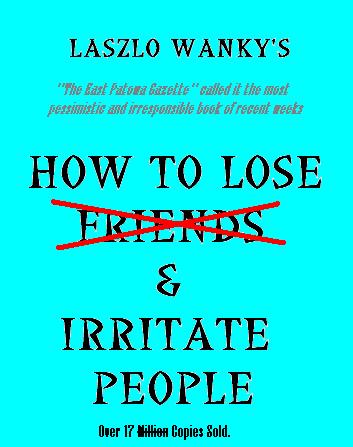
Wanky pays an homage to Dale Carnegie’s seminal self-help book by calling it, “a book for its time–that time being one in which people were lonely, pathetic, and didn’t understand social networking.” The author’s central premise is that we live in very different times, and today people are inundated by Facebook friends they neither like nor find interesting. Furthermore, Wanky goes on to argue, gone are the days when likable people are liked. We live in an era in which douche-bags and drug-addled celebrities are gods among men. The book offers many headline examples, such as how Miley Cyrus’s career crashed as the sweet and admirable Hannah Montana, but then she caught her second wind by adopting the persona of a meth-addicted prostitute.
Roughly half of the book is dedicated to how to find success in defriending unwanted virtual amigos. Wanky suggests that the usual tactic of subtly “un-adding” people almost always fails because people are too “wussified” to make it stick. The only effective strategy, according to the author, is to trick others into removing you from their list of pseudo-friends. Be forewarned, however, being uninteresting and annoying is not enough–one must be spectacularly despicable. This is hard for most people–whom Wanky calls “the sychophantic masses”–because they slobber over being liked. Wanky devotes three chapters to helping people get over their love of being liked. The most cogent of these chapters is, “Kim Jong Un or Gandhi: Who Ya Wanna Party With?”
The aforementioned chapters also help set up Part II of the book, which explains how one can put a skyrocket on one’s career by borrowing the techniques of the likes of Howard Stern, Rush Limbaugh, and Piers Morgan. Wanky shows how, like these individuals, one can be thoroughly unlikable while having people hang on your every word. Again, three chapters form the core of this part of the book. They are: “Loud = True”, “Bombastic Fact Picking for Beginners”, and “Your Hairstyle Makes You Sound Stupid.”
I’m not going to pretend that Mr. Wanky’s language is fluid or graceful. The author’s prose is colloquial… at best. A typical sentence–seen in chapter 8–is, “If ya wanna get with the boom-chiggy-booms, you gotta shout those fart-monkeys down, cause if they hear ’em they’ll all be like, ‘who’s the fart-monkey now, bitch, who’s the fart-monkey now?'”
The book’s strengths include its incredible brevity. Weighing in at only 26 pages, four chapters consist entirely of 27-syllable haiku. It also features fine graphics such as a picture of a “fart-monkey” that any grandmother would be proud to stick on their refrigerator. (The color choices were bit odd, but Wanky was clearly limited to the 16-color box of Crayolas.)
I’d recommend this book for anyone who doesn’t like friends and who really despises people’s indifference toward them. I have no doubt that by following Mr. Wanky’s recommendations, one can become a thoroughly loathsome individual in a matter of days.
I brought a great deal of interest and enthusiasm towards this subject as I began reading this book. As I proceeded to read, my feelings about The Science of Yoga became much more mixed. At its best, the book shows the state of scientific research on yoga and crushes myths that are deeply ingrained, and it points out risks of which yogis and yoginis should take notice. At its worst, it is sensationalism run-amok–suggesting hugely expensive solutions to issues that are either relatively small problems or that the author fails to prove are really problems at all. Put more simply, at its best it’s outstanding, but at its worst it’s tripe. What I will say about this book is the same thing that its author says about yoga, which is that—on balance—it does more good than harm.
The book is arranged into seven chapters, each of which discusses the scientific research on a different dimension of controversial beliefs about yoga. These include the historic claims of supernatural yogic abilities, the issue of whether yoga increases cardiovascular health, the role of yoga in mental health and well-being, the safety of practicing yoga, the role of yoga in healing, the sexual claims of yogis, and whether yoga enhances creativity. It is written in a scholarly format, heavily end-noted and with bibliographic citations. There is front matter giving information about key people, time lines, and yoga styles in outline form.
In an afterword, Broad points out that this has been his most controversial book to date. I can see why, but, to be fair, I’m sure much of the criticism is unfairly based on a failure to read the book or a desire for the author to treat many of yoga’s mythical aspects as science (as many of its practitioners do.) The former problem was exacerbated by the fact that a single chapter excerpt was published in the New York Times as a teaser for the book. Designed to spark controversy (always good for readership), it was one of the most negative of chapters—the one dealing with yoga injuries. Some who took umbrage probably didn’t realize that Broad is a yoga practitioner, and that there are chapters that are overwhelmingly positive on yoga (e.g. the chapter on “mood” which deals with yoga’s influence on psychology has mostly great things to say about the discipline.) While all of the chapters combine a mix of good and bad news, one comes away from some of them seeing a positive picture of yoga and others with a negative one. In the first half of the book it seems as though chapters may have been arranged to alternate positive and negative dimensions.
Of course, there will also be people who are outraged because of the discussions of the debunking of the con games of their beloved yogis, or for a failure to discuss the critical importance of things like Chakra fluffing. It should be noted that Broad doesn’t deride or mock such spiritual beliefs, he more or less ignores them beyond the occasional off-hand mention—as one would expect in a book about science.
My primary criticism with The Science of Yoga is a common one consideration of problem-solving utilizing public policy (not just with respect to yoga), which is to become so impassioned about a problem that you lose all sight of cost-benefit considerations or the negative feedback effects incentivized by your “solutions.” The problems about which Broad gets so exercised as to suggest an overhaul of yoga as we know it, largely fall into two categories. First, there are problems that are exceedingly rare but catastrophic for in individual involved. This is exemplified by the apparent heightened incidence of strokes among individuals engaged in certain inversions (e.g. a shoulder stand in which the neck is under compression.)
In an interesting turn away from science, Broad makes assumptions in the face of lack of evidence about the incidence of stroke in yoga practitioners. He assumes that yogis have at least the same incidence of stroke due to vertebral artery injury as the general population because of inversions and other yogic activities that put pressure on blood vessels in the neck. He does make clear that it’s just a guess, but one could equally well speculate that those who practice yoga suffer a diminished rate of such strokes because of greater flexibility and strength in the neck. (For the most part the human body is an anti-fragile system, i.e. it grows stronger when subjected to stresses—up to a point—than when shielded from stresses.) While he does call for increased study of the issue, he’s also simultaneously calling for expensive reforms. In essence, he’s calling for a solution before awaiting the evidence that there’s actually a real problem. Stroke is the 800 pound gorilla of the risks the Broad writes about in terms of damage, and so it’s not surprising that he paints the risk in ominous terms. He criticizes the Yoga Journal for dismissing it as a “minuscule number of cases”, but even taking his estimate of 300 (and realizing it could be much lower and is compared to 800,000 cases of stroke per year in the US according to the CDC) “minuscule” does not sound that out of line in a country of 314 million people.
Second, there is the issue of bad information being spread by yoga teachers and authors either because they don’t know any better or because they have an incentive to deceive. This is exemplified by the widespread notion that yoga (and particularly pranayama— breathing exercises) increases one’s cardiovascular fitness. Is it wrong? Yes, but it’s not clear that this propagation of bad information has hurt anybody. That may sound harsh, but—think about it–many people lead long and fruitful lives believing things that aren’t true. Now you may say, “Yes, but people who believe the Earth is flat can’t get hurt believing that, but yoga practitioners can be hurt by wrong information.” I would agree that some wrong information could be damaging, but consider the example given, which–I might add–is one of the main thrusts of Broad’s book. If it were the case that many people got fat because they thought yoga would help their cardio when instead it decreased their metabolism (as the evidence suggests it does), then no one would believe the myth. The idea wouldn’t have the strong hold that it does. What happens more often is that people either lose weight because they stress and eat less or they stay the same—either way they haven’t been hurt any more by bad information. Even if someone came to yoga to lose weight and gained some, they will abandon yoga and go to Zumba or Taebo with greater flexibility and probably a diminished risk of injury for having done yoga.
By spreading information about the risks and the state of scientific understanding of them Broad is doing good work. However, he goes on to suggest that we need lots of bureaucrats to monitor and license yoga and that we need much more rigorous requirements for yoga teachers than the 200 or 500 hour Yoga Alliance certifications that currently exist (or the teaching certificates issued by the gurus or teacher trainers of various styles of yoga), and herein lies two problems. It’s not clear that a problem exists to merit such an expensive solution.
First of all, many of the worst cases that he points out were people engaged in questionable practices on their own. I’m sorry for my frankness, but you can’t regulate stupid out of existence. There was one kid who sat for hours in Vajrasana (sitting on haunches), one who fell asleep in a forward bend, and another who had a stroke after holding a shoulder stand on a hard surface for hours. Now, my experience may not be as extensive as others, but I’ve attended yoga classes in the US, India, and Thailand. I’ve had teachers tell me to hold a pose for 5 deep breaths. I’ve even had teachers tell me to hold a pose for 10 deep breaths. No teacher has ever said to me, “Hold that pose for four hours or until you have a stroke, whichever comes first.” Even teachers with a couple hundred hours of instruction and a couple hundred more of experience don’t—as a rule—give patently stupid advice. (To the degree that there are rare exceptions, thinking that no teacher would ever again give a piece of bad advice if they just all had PhDs is a little presumptuous.)
The major problem with Broad’s suggestion of a need to overhaul the system and install bureaucratic gatekeepers and overseers and to make teachers jump through vastly more educational hoops is that it increases the cost of doing yoga with a teacher. Now, I know that yoga is associated with relatively affluent people, but—believe it or not–there are yoga practitioners who aren’t SUV-driving, Abercrombie&Fitch-wearing, maid-hiring suburbanites. If the monthly cost of attending yoga class goes from tens of dollars to hundreds of dollars because every yoga teacher has to have a PhD in Kinesiology and every studio has to comply with the extensive regulations and licensing fees of the newly formed Department of Yoga Management, then many people who are happy with the level of instruction they are currently getting are going to be emulating books and videos and injury rates could actually go up.
Another example of a “problem” that is not definitively shown to be a problem is Broad’s extensive criticism of an author of a popular book on yoga (i.e. Larry Payne) for using a Ph.D. designation that was from a southern Californian diploma-mill. While there is something objectionable about putting a PhD behind one’s name that wasn’t justly earned, it’s not at all clear that this was a problem. One expects to hear how Larry Payne left a pile of wrecked souls in his wake. However, while Broad devotes pages to ridiculing Payne for putting PhD after his name, the few mentions of the Payne’s interactions with others suggest that he helped them get healthier (e.g. Dr. Ursatine) and that he furthered the state of his professional field. The implication being that the credential matters vastly more than the individual’s experience and diligence. Interestingly, Dr. Fishman (for whom Broad has nothing but kind words—presumably because he holds an MD) is quoted as speaking glowingly about Payne and his contributions to the field.
Another example of sensationalism can be seen in the chapter on sexuality. While we would expect this chapter to be entirely about the claims of yoga being able to enhance one’s sex life, a fair amount of it is devoted to pointing out instances of lecherousness among yogis. I’m not saying that it’s bad to point out bad behavior of gurus in terms of harassing or molesting their female students, but unless there’s some evidence that this inclination is tied the sexual practices of yoga, this would seem to be the wrong venue for the discussion. In other words, if yogis are no more lecherous on the whole than other teachers or coaches, then it would seem that mention of this issue is just to titillate. If yogis are uncontrollable horn-dogs because of yogic practices, then fine, but you’ve got to establish that there’s evidence for that somehow.
Overall, I’d recommend that individuals interested in the scientific literature on yoga read this book. It provides a good overview of the literature, and is well-cited. The books weakness comes from insisting that a large number of mole hills are really the Himalayas. These mole hills can be addressed with education, but can never be eliminated. Suggesting we upend the apple cart to produce “solutions” to marginal problems is ridiculous. We may think a world in which there was never another fatal traffic accident would be nice, but I assure you we would not want to live in the world in which all the actions were taken necessary to achieve said goal. If one compares the extrapolated estimates of hospital visits for yoga injuries, they are really quite few and we have no reason to believe that the vast majority aren’t life-threatening or permanently disabling.
For me it would have been a great book if it laid out the risks and rewards, and suggested caution. Of course, then it probably wouldn’t have gotten any more attention than the many books that already exist on the subject of yoga injuries, so maybe some good can come of Broad’s implication that going to the yoga studio is akin to storming the beaches at Normandy and that we need to stop the horrors or yoga practice.
This book by the renowned Vietnamese Buddhist monk, activist, and poet, Thich Nhat Hanh, offers pointers on how to live a life of mindfulness. Like most of Hanh’s works, this one is brief, concise, and the front and back matter account for about as much verbiage as the chapters themselves.
The seven chapters that make up the book proper examine mindfulness from various angles, with various approaches, and have a loose organization. The most readable of these chapters–owing to its narrative format–is the last, which retells a Tolstoy story about an Emperor who receives three questions and–unable to find suitable answers by offering a reward to his subjects–dons a disguise and visits a hermit sage. Needless to say, the sage (and life events) enlighten the Emperor, and the answers revolve around the theme of mindfulness. Among the most thought-provoking of the chapters is one that proposes that one take one day of the week to focus on mindfulness. Hanh offers advice on how to best select and structure such a day.
While the appended matter of some of Thich Hhat Hanh’s books can read like filler (intended to reach a page quota), that isn’t so much the case with this book. The most valuable of the appendices gives 32 exercises for building mindfulness. Many of these exercises are variations on a theme, and some are much more extensive than others, but it’s a crucial section and might even be called the heart of the book. Likewise, there are five sutra translations that will be appreciated by readers who are actually Buddhist. (Non-Buddhists may find the sutras to be a less colorful and more repetitive restatement of what Hahn has told them in the chapters. If one pays attention to the chapters and does the exercises, reading the sutra’s isn’t necessary for those who are not students of the religion.)
There is an odd postscript by one of Hanh’s students that is like those I’ve seen in other Hanh books. It’s an odd little testimonial. I put it in the filler category as anyone buying the book knows who Thich Nhat Hanh is and about the accolades he has received and, therefore, they don’t need a prologue telling them how awesome he is. It actually detracts from his persona as a wise man, because it makes one wonder who inspired the little ego trip. I suspect this is more a publisher desired addenda than an author inspired one, but, at any rate, it’s not useful. It can be interesting to hear about the war days, but there’s an outlet for that. Furthermore, I would think the place to tell us how awesome the author is would be at the beginning of the book–not the end. If one gets to the back matter, he must have done something to impress one.
I’d recommend this book for meditators, would-be meditators, and anyone who thinks that life is slipping through his or her fingers because of constant stress and a runaway mind.
Amazon recently put out a list of 100 Books to Read in a Lifetime. I appreciate the mega-bookseller taking a less doctrinaire approach than, say, The Guardian’s 1000 Novels Everyone Must Read. Also, props to Amazon for including a number of contemporary works—though I guess that is self-serving of them (i.e. $10 versus $0 sales price)—so never mind.
Whenever I see one of these lists—and there are so many of them—I always feel a bit inadequate. I suspect I’m not alone, given a recent generic list posted by The Millions, entitled 28 Books You Should Read If You Want To. That author’s approach is laudable. She doesn’t hand out exact titles as if we all need the same books, but rather suggests the kind of books one should consider reading (but only if you want to.)
I read like a fiend. While I usually don’t read rapidly (I can; I learned how in grad school, but I prefer savoring to injecting words), I’m constantly reading. So it’s a little disappointing to see how I stack up in the grand scheme of list-makers.
So this brings me to the point of this post, which is to boost my self-esteem by building a list of books, all of which, I’ve read. As I considered the books I’ve read that I would be so bold as to recommend “everyone” read, I saw trends. First, I read a lot of thin books, or, perhaps, they stick with me more. Don’t get me wrong, I’ve read some monsters Moby Dick (on everybody’s list—I don’t know why), Atlas Shrugged (on the Libertarian Book-of-the-Month Club list, and not much else), and 1Q84 (given a few years, it’ll be on all the lists.) However, it’s the thin books that have stuck with me, and they often get kicked aside by the [other] pretentious list makers. Also, shorter forms (e.g. essays, short stories, poems, and novellas) often don’t get properly recognized because everyone wants to talk about novels and tomes.
Second, while I like to consider myself an international reader (e.g. I’ve read a fair number of translated Japanese and Chinese classics), the fact of the matter is that I’ve had a skewed reading history. I’m an American, and have disproportionately read books that are either by Americans or that speak to the American worldview / mindset (my list will be both.) This isn’t so much an issue for most of the list makers as they simply propose that every Nigerian, Thai, and Peruvian should read a canon devoid of any Nigerian, Thai, and Peruvian authors (but instead that is 50% British, 30% American, and 20% all others.) While the list may be targeted toward U.S. audience, these books are good for everybody, and everybody should read outside the familiar.
Without further ado, my list, 30 Thin Books That Every [Attention-Challenged] American Should Read:
Because poetry is good for the soul. Yes, this anthology is skewed toward dead poets, but it’s not only thin, it’s cheap. It’s got Whitman, Dickinson, Frost, Sandburg, and Hughes.
Because, screw totalitarianism, that’s why. This is like 1984, but without the villainy clubbing one over the skull. Therefore, you can introduce the kids to commie-hating early and without giving them nightmares—well not bad ones. Plus, it’s thinner than 1984.
Because virtue is good for the soul. This is Plato’s account of Socrates’ defense at his own trial and his subsequent explanation of why he was going to drink the hemlock. Yes, it’s technically three books, but they are often bundled together as one book. Even with all three, it’s pretty thin.
Because Orwellian dystopia isn’t the only dystopia. In Huxley’s book, tyranny wasn’t a matter of force, but manipulation. This book shows how dystopia can be disguised as utopia by keeping the population adequately drugged and well-sexed.
Because satire is good for the soul. No sacred cows escape roasting in this thin volume. A naïve young man travels out into the world to find that evil is ubiquitous.
Because how often does a book coin a common phrase. (FYI- “A Clockwork Orange” was a phrase Burgess borrowed for the book that was common in some parts, but Heller invented the term “Catch-22.”) The story revolves around the notion that one can’t get out of the war by reason of insanity, because if one is trying to get out of the war one is sane by definition, and if you are insane, you don’t try to get out.
Because if you’re going to break the law, you should know how to do it do it virtuously and not like a dirtbag. (Hint: It’s more painful than you think.) This essay tells of Thoreau’s imprisonment because he refused to pay taxes that would fund the war with Mexico. It’s usually bundled with other essays.
Because books are good. The title comes from the temperature at which books burn, and it’s set in a dystopian future in which the protagonist, “Fireman” Guy Montag, goes around collecting and burning books.
Because you should know how to turn someone down (e.g. I would not eat them on a boat, I would not eat them with a goat.) Or, because learning to be playful with words may serve one well. Or, because you should try new things. In the story, an unnamed narrator is subjected endlessly to green eggs and ham, which he steadfastly, refuses until the end.
Because you think you’ve got a weird family. Hamlet exacts revenge when he finds out that his uncle killed his father to marry his mother and usurp the throne.
Because you don’t want to underestimate Mother Nature when you strike out to build your indomitable American spirit. This is the true story of a college graduate who gives away his bank account, burns his pocket-money, cuts ties with his upper-middle class family, and sets off to become self-made. Ultimately, he ends up in Alaska, and it does not end well.
Because, stop being such a gloomy-Gus. Admittedly, this is an unconventional choice– both because it’s not particularly skillfully written and a few of its conclusions may not be as true as they once were. However, it does inject a dose of reality for those who view the world through shit-colored glasses. As the title suggests, the authors argue that life in America is getting better year after year. We are getting healthier and richer. Being economists, they present much of their findings as graphic representations of statistical data.
Because sometimes the world actually looks better through shit-colored glasses, Seriously, because you need to know how to get on with it when life is at its toughest. Viktor Frankl was a psychiatrist and Holocaust survivor who writes about what kept people going at places like Auschwitz.
Because, just get on with it. This was actually a kind of “Notes to Self,” written by the Roman Emperor to remind himself to be virtuous, to live, and to not fear death.
Because you don’t get enough of the word “rickety” these days. But seriously, you get to “see” a lot of America through Kerouac’s poetic language. It follows the road trips of a beat generation protagonist through America.
Because Faulkner’s language rocks, and this is a gripping and gritty tale. It’s the story of an upper class co-ed who’s dragged down into the underworld and some desperate times by a couple bad decisions, not the least of which was going for a ride with a stupid drunk.
Because you need a pep talk to think for yourself. Emerson proposed that one stand as an individual and stop letting political parties, religions, or other organizations decide what one believes. Emerson and Twain both saw a sad trend brewing in which people were starting define their beliefs by identifying with a party and then letting that party’s opinion leaders tell them what to think. Sadly, this trend only grew since there day to the point that many people have extremely strong beliefs that they can’t begin explain in a logically and factually consistent way.
Because one day China is going to collect on our debts, and well need some grasp of their culture. Seriously, you should read outside your culture. In the process, you’ll find that the Taoist stream of thought isn’t all that far off our own—“f#@k authority and pretentiousness and all the bureaucratic formalities.”
Because, screw Melville, this is the great American novel. Yes, I realize that it’s not particularly thin, but compared to Moby Dick it is—and it reads more quickly because there aren’t long drawn out sections on the minutiae of whale pineal glands and what not. This book follows the adventures of that rapscallion, Huck, as he flees a drunk father and a lady who wants to make him civilized, and takes to rafting on the Mississippi with an escaped slave. Yes, it has the n-word like a billion times, but if you read all the words (and not just that one) you’ll see there’s a positive message about the development of mutual friendship and respect between Huck and Jim.
Because you need to get outside more. It’s the story of a dog who is taken from the good life as a pet in California to the wilds of Alaska, and what said dog must do to survive.
Because you need to be concise AND coherent. In the age of Twitter, people are mastering the former while losing the latter. This is a thin books that tells you most of what you need to know to write intelligibly in English.
Because America has a dark side, and nobody writes it better than Poe. Any of the many collections of Poe’s short stories (some including poems and/or long-form works) will do. One definitely wants “The Pit and the Pendulum,” “Tell-tale Heart,” “The Murders in the Rue Morgue,” “A Descent into the Maelstrom,” and, of course, the title poem.
Because we need an injection of Stoicism to counteract the prevailing trend toward whining and moaning. Epictetus was a slave who became one of the most famous Greek sages. His sayings are mostly about not crying over spilt milk, but to be careful not to be the one who spills the milk. In other words, don’t whine about what the world gives you, devote your energies to being virtuous and conscientious.
Because you should understand your place in the ecosystem, and Lewis Thomas describes it artfully and concisely. This is a series of essays that covers a lot of ground with respect to the subjects of biology and physiology.
Because you may just want to take over the word someday. This is advice about how to rule. It may not make one popular as a middle manager, but there are bits of wisdom throughout.
Because someday it’s all going to come to an end, and it will probably end badly. This is the story of a father and son wandering through a post-apocalyptic wasteland. I realize I’ve put a lot of dystopianism on this short list, but I’m going to say that’s part of the American condition. America has had it good for long enough to realize that all things come to an end.
Because we should not give the short story short shrift, and Hemingway—like Poe—did them well. Besides the title story, this collection includes “The Killers”, “The Gambler, The Nun, and the Radio”, and “A Clean, Well-lighted Place.”
Because you need to get out of the country and experience some of the rest of the world. This is about the travels from Paris to Pamplona of a group of men who’ve all fallen for the same woman with that woman—of course—along for the ride.
Because you need to get out of the house, away from your cubicle, and out into nature. This is an essay extolling the virtues of putting one foot in front of the other like you mean it.
This is the story of a little boy’s dreamtime journey to a world inhabited by “monsters” and his interaction with them. Like Green Eggs and Ham, you should have read this as a kid. If you didn’t, I’m sorry about your defective parents, but get over it. Since you probably don’t want to read this as an adult on the Metro going to work, you can get Christopher Walken to read it for you on YouTube.
So that is it. That is my list of 30 Thin Books that Every [Attention-Challenged] American Should Read.
A number of books have come out about introversion in recent years. Most of these books seek to dispel common myths about being introverted, such as:
a.) Introverts can and should change teams to the extroverted
“light side” as soon as possible.
b.) There’s something psychologically wrong (re: neurotic or even psychotic) with being introverted.
c.) “Introverted” is synonymous with:
1.) Shy (i.e. having social anxiety disorder)
2.) Schizoid
3.) Anti-social
4.) Self-centered (in the pejorative sense–a more neutral meaning could be said to be true by definition.)
This isn’t to say that one can’t be both introverted and any of the above, but one can also be extroverted and any of the above (including, believe it or not, shy—i.e. it’s possible to be an extrovert with social anxiety disorder.)
Where Dr. Olsen Laney’s book tries to carve a niche is in teaching introverts how they can conduct their lives in an extrovert-centric world so as to maximize their effectiveness and minimize their exhaustion. One will note that her advice doesn’t advocate attempting to become extroverted. In fact, one of the most interesting and informative sections of the book is chapter 3, which explains the differences in brain chemistry that result in introversion or extroversion. While some of the conditions mistaken for introversion–such as shyness–can be overcome or trained away, introversion is hardwired into the brain.
The book’s ten chapters are organized into three parts. The first part explains just what defines an introvert, what traits commonly mistaken for introversion aren’t introversion, and the physiological roots of introversion. The second part consists of four chapters that delve into problems faced by introverts in four critical domains: relationships, parenting, socializing, and work. The final three chapters present the prescription for modifying one’s behavior to keep one’s energy up in the face of the demands of modern life. It’s really all about energy—how we use it and replenish it differently. The external world—most notably interaction with other people but also anything of a chaotic environment—drains the energy of introverts faster than that of extroverts.
As one reads through the book, there are many tips for mitigating the negative effects of common introvert characteristics seen as problematic in an extrovert’s world. It should be noted that some of these are genuine problems (i.e. how one metabolizes food) and others are a matter of perspective (i.e. lack of conviction v. open-mindedness.) These “problems” include: difficulty making quick decisions, difficulty with word retrieval, lack of investment in one’s own ideas (“wishy-washy” in extrovert lexicon, but arguably open-minded), tendency toward over-stimulation, lack of inclination to engage in [prolonged] eye contact, proclivity to metabolize food quickly with resultant blood sugar drops, proclivity towards sedentariness, and a tendency to fail to delegate work and reward job completion—if one happens to be the boss.
I found this book to be enlightening. There were many ideas I found myself agreeing with (e.g. using hobbies and activities as a means of controlled interaction.) There were only a few pieces of advice that I thought poor (i.e. picking a weekend day to lay in bed or on the couch all day—reading or otherwise.) While it may seem logical that movement would drain energy in contradiction of the goal of restoring energy, I find being sedentary beyond a certain number of hours to be a huge energy drainer and that periodic movement is necessary and restorative to keep my energy level robust. (And I’m about as introverted as one gets by the criteria established in the book, most of which apply to me.) Of course, there are variations among introverts–just as among extroverts—not only with respect to the degree of introversion but also with respect to specific characteristics experienced. (e.g. Some introverts may not find that all of the criteria in the preceding paragraph apply to them.)
I’d recommend this book not only for introverts, but for those who interact with introverts in key ways (e.g. familial relations, significant others, bosses, employees, etc.) Non-introverts may find some sections are more helpful and necessary than others, and may not find they need to read from cover to cover.
If anything sells a book more effectively than sex, it’s being banned. One knows that a book contains powerful ideas when someone goes to the effort to try to have it banned. Granted, the powerful ideas may or may not be good ideas–or true ideas, but thinking minds will demand to see for themselves. (I for one will be stopping by my local bookstore to see if they have a copy they’ll sell me for less than 1,000 rupee [$16USD], because I’ve got to know what has the thought Nazis up in arms.)
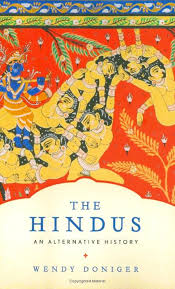
But does a self-imposed ban have the same effect? Penguin India settled a suit by agreeing to stop printing the book The Hindus: An Alternative History, and to burn outstanding copies. This, after a protracted legal battle against a Hindu nationalist group called Shiksha Bachao Andolan. However, there may be more to it than simply trying to build sales on the four+ year old book (that likely would have been long forgotten in an environment of free speech.) Indian law makes it a criminal offense to offend Hindu sensibilities, and thus puts the publishers in physical as well as fiscal jeopardy. Of course, it’s already come and gone as a best-seller in India, so it couldn’t hurt to restoke global interest.
It should be noted that there isn’t overwhelming support for banning the book in India. There has been outrage against Penguin’s fold by Indians who read, who believe in freedom of speech, and who are terrified of the idea of a crime of hurting someone’s feelings by discussing their religion’s history. (The latter being a direct route to tyranny if ever there was one. )
As I said, sex sells and bans sell double; the book in question has both. One might be inclined to think that it’s some sort of porn novel churned out on pulp. Actually, the author is a Professor of Religious History at the University of Chicago, Wendy Doniger. The book does apparently focuses heavily on the role of sexuality in Hindu mythology. What some readers might not know–and might be surprised to learn–is that hardcore Hindu nationalists are two steps to the right of Jerry Faldwell on issues of sex.
Traveling to an archaeological site as grand as Angkor, it’s natural to wonder what the city must have been like in its heyday. Angkor’s population was estimated to be as much as 1 million people, making it one of the world’s biggest urban centers in its day. One can get a feel for how vast and impressive Angkor was by way of the restorations, its artwork, and even the lay of its rubble fields. However, today’s Angkor is in large part a testament to the power of Mother Nature to swallow once proud temples and palaces with strangler figs and to shatter stout walls with white silk cotton trees. It’s hard to fathom what it was like when it was occupied by kings and concubines, slaves and shamans.
A Record of Cambodia offers a rare glimpse into life at Angkor at the tail end of the 13th century—near the city’s peak. It was written by Zhou Daguan, a Chinese diplomat sent by Yuan China [Mongolian era] as part of a delegation. Zhou spent almost a year at Angkor during 1296-1297. His report was translated into French during the 19th century, and all the English translations in existence had been based on the French not the original Chinese (i.e. twice translated.) This 2007 edition, however, was translated directly from Classical Chinese by Peter Harris.
The thin volume weighs in at only about 150 pages, but fewer than 40 pages are Zhou Daguan’s report. The other 110 pages include front matter, graphics, appendices, and notes. The Introduction, at 30 pages, is almost as long as Zhou’s document. However, this should not be taken as criticism. There’s a lot of useful expansion upon, and explication of, the information in Zhou’s report in both the Introduction and the end-notes. While it’s written by the translator, Peter Harris, it’s probably best to think of the Introduction as an Editor’s Introduction rather than a Translator’s Introduction–the latter creating an impression of a discussion of the minutiae of ancient grammars. (There is a little of that in a separate “Notes on the Translation.”) Harris’s introduction sets the background, elaborates on certain mistakes that Zhou seems to have made, and contrasts Zhou’s report with the accounts of other famous travelers such as Marco Polo, Ibn Buttata, and Xuanzang
Zhou’s report is divided into 40 chapters; though the word “chapter” seems more fitting for some than others, as many are no more than a single short paragraph. Each chapter is themed by some element of Khmeri life during the era. They include coverage of how people dressed, the nature of slavery at Angkor, what the buildings looked like in their glory days, sexual practices, agriculture, trade, local flora and fauna, and eating practices.
While short, Zhou’s book gives us a great deal of information that we wouldn’t have had otherwise. I learned a number of intriguing facts such as that fireworks displays were a regular event, runaway slaves had their faces tattooed blue, and the only ones not all allowed in Angkor Thom were those who were missing a toe(s) (removal of digits was a punishment back in the day.) Zhou has a great curiosity with the sexuality of the Khmeris, which was a great deal more liberal than that of China. Even the practice of toplessness among both men and women of all classes drew Zhou’s attention.
As when one reads the accounts of European explorers and adventurers, there’s a certain bigotry and conceit that comes across in Zhou’s writing—though it doesn’t come across as jarringly as in the works of, say, Francis Galton. Zhou does report on matters where the Khmeris looked down on Chinese practices as uncivilized (e.g. using human waste as fertilizer or using toilet paper / not reserving their right hand for sanitary endeavors.) On some cultural differences, Zhou comes across as mocking the Khmeri ways (e.g. communal bathing practices), and he goes as far as to refer to them as “Barbarians.”
If you’ve been to (or plan on going to) Angkor, I’d highly recommend giving this thin volume a read. It won’t take much time, and it’ll allow you to see the ruins in a new light.
There are some nonfiction books that one reads because one wants the objective, unvarnished truth about events. This is NOT that book. Some books you read knowing they are going to contain a mix of truth and falsehood–fact and fiction–and you read them believing you can gain insight from both the truth and the falsehood–if you consider the words analytically in light of known facts. This is that kind of book.
Don’t Kill Him is an autobiographical account of Ma Anand Sheela’s (a.k.a. Sheela Ambalal Patel’s) life as the secretary / spokeswoman / project manager / Pepper Potts for Bhagwan Rajneesh (a.k.a. Osho.) As such, while it is about the life of Sheela, the central character is the Bhagwan Rajneesh. This is indicative of the narcissistic but charismatic cult leader—who must be the center of attention—and the infatuated cult member for whom the “guru” is everything. What one really gets in this book is insight into the mind of a person prone to join a cult.
Chances are you know of the Bhagwan Rajneesh in one of two very different ways. As Osho, he’s an enlightened guru who penned over 600 books on spiritual topics from Taoism to Tantric sex, who attracted a vast following of wisdom seekers, and who to this day has a centers globally in his name—despite having died in 1990. As the Bhagwan Rajneesh you may know of him as a petty narcissist who built a stunningly successful cult of personality, and who in all likelihood green-lighted a salmonella attack on a rural populace in Oregon in an attempt to sway a local election so that certain dodgy practices could be carried out at his commune.
Sheela comes across as quite reasonable in the book. Gone are the days when she made replies to questions such as “tough titties” or a horrifying Holocaust joke. She claims that her former outlandishness was part of a role that she played on behalf and at the behest of the Bhagwan, but playing the victim in the face of entire world that conspired against her in her selfless virtuousness is a prevailing theme throughout the book.
Read carefully, there is plenty of evidence that all is not right with the author’s mind. She barely addresses criminal charges for which she was given sentences in total of 64 years (though, because they were to be served concurrently, the most she would have served would have been 20—and in reality she served less than two-and-a-half.) She talks more about the least of the charges–visa fraud then the attempted murder and assault convictions. She merely asserts that there was a vast conspiracy involving the German government (who extradited her), the U.S. criminal system (which indicted her), and at least two different factions of the Rajneeshee cult (one being exemplified by the Bhagwan, himself, and the other by David Berry Knapp, the mayor of Rajneeshpuram (the incorporation of the cult compound) who not only dropped a dime on Sheela but also implicated the Bhagwan)
While it’s fair to say mistakes are made in the American criminal justice system now and again, the scale of conspiracy that would have to be involved in Sheela’s case strains credulity. Her suggestion that a criminal justice system that protects defendants as much as anywhere in world is completely corrupt comes off as a bit sad and pathetic. Here and there she points out that there were one or two good people in the jail or justice system, but one soon suspects that these are just other deluded cult-prone individuals ready to drink the Kool-Aid themselves. Interestingly, while she claims there was not a shred of evidence against her, she made an Alford plea. (You’ll be forgiven for not knowing what an Alford Plea is, as it’s something only the mind of a lawyer could come up with. One pleads guilty while asserting one’s innocence. In essence, one says, “I’m really not guilty, but there’s enough evidence to convict me so I want to make a deal to get less prison time.” Of course, she makes paranoid-sounding claims that the American criminal justice system as justification for not standing up for her own innocence.
The only bad decision of any note that the author ever admits to making is slapping one of the followers, an act for which she claims both Bhagwan Rajneesh and the commune forgave her. These repeated claims that while her life was falling apart it was because almost everyone else was wicked while she was a victim wear a little thin. She claims that all the accusations against her resulted from her decision to leave because of her guru’s latest decision to bilk wealthy followers to pay for more Rolls-Royces. There may be a seed of truth in this. The Bhagwan also claimed that she embezzled money, a charge that was not covered in the charges for which Sheela was convicted. It’s as likely as not that any shortage of funds resulted from the Bhagwan’s own materialistic addictions. Whether his accusations about the bioterror attack were spurred by being spurned by this assistant cannot be known. Of course, it could also be that he wanted to separate himself from the felony indictments that were becoming increasingly inevitable.
The title, Don’t Kill Him, comes from Sheela’s repeated suggestion that, while the Bhagwan was a madman, one shouldn’t destroy the legacy. It’s this back and forth between deifying and castigating the Bhagwan that gives one insight into the mind of a cultist—but also leaves one scratching one’s head at what the author’s point is. When she suggests that he was a petty, narcissistic, greedy drug addict who should be exalted, it’s a bit dumbfounding for the average individual. It seems to be a textbook case of infatuation with the charisma of an otherwise deplorable human being. There is this widespread confusion of charisma with enlightenment that is intriguing. Early in Chapter 4 and later in Chapter 5, the author suggests that the Bhagwan set up her imprisonment as part of her education. That level of delusion is astounding.
There are those who’ll say that Sheela is right and others who’ll tell you that she is just trying to bash the Bhagwan—albeit in a very ambivalent way. I’m here to tell you that this book leaves the reader with one logical conclusion, and that’s that both Sheela and the Bhagwan were coo-coo for Coco-Puffs.
If you’re at all familiar with Dr. Moshe Feldenkrais, most likely it’s for the system of bodily awareness and efficient movement that bears his name (i.e. the Feldenkrais Method.) You may be completely unaware that Feldenkrais was a first-rate judōka who trained under judō’s founder Jigoro Kano, and that his experience with judō played a major role in his understanding of the principles of natural and efficient movement. (It should be noted that Feldenkrais was neither a medical doctor nor a doctor in a medical / biological field, but was a physicist by training.)
Higher Judō was originally published in 1952, and was out of print for many years until a new addition was brought out in 2010 (with three new forwards and some additional back matter.) It’s not hard to imagine why the book made a comeback after such a hiatus–and 26 years after the death of Dr. Feldenkrais. The book explains the ground fighting techniques of judō, which are the basis of Brazilian Jujutsu (BJJ), and BJJ is a dominant form of ground and submission work within Mixed Martial Arts (MMA.) Given the immense popularity of MMA, and the desire of fighters to hone their technique to the utmost, it’s a good time to bring this half-century old book back to the fore.
The book consists of twelve chapters. The first half of these chapters deals with preliminaries such as principles of movement, philosophy, and basic movement exercises. The second half gets into the tactics of ground work. The arrangement for the latter chapters is largely by position of the competitors relative to each other (e.g. the mount, 12 o’clock, side control, in the guard, etc.)
The first half has few graphics, but the last half is packed with line drawings that are based on photographs (ostensibly it was cheaper or easier to reproduced the line drawings back in the day.) The line drawings offer sufficient detail so that one can see what is being done (to the degree one would be able to see it in a photo or even in person—i.e. some of the techniques are subtle and the written description becomes essential.)
The book is a good overview of the basics of ground work with a few unusual and rare techniques thrown in. Feldenkrais points out that some techniques are more important than others, and that one should drill a few of the most critical ones rather than focusing a lot of time on the more eccentric techniques. As I’ve written many times before, I don’t believe that one can learn a martial art from a book. However, if you’ve been taught these types of techniques, you’re sure to find this book an interesting reference with some ideas for approaching ground work training.
Some of the characteristics of the book could be taken as positive or negative, and I’ll leave it to the reader to decide. First, Feldenkrais avoids using names for techniques. He uses neither the common Japanese names for the techniques (e.g. there’s no reference to juji gatame, tomoe nage, or hadaka jime) nor the common English names. He goes by figure number attached to the aforementioned line drawings. Second, he has thoroughly cross-referenced the book such that you might be on the page containing figures 228 and 229, and he’ll make reference to figure 52. So the book involves a lot of turning back (I wrote in the page numbers where off-page figures were referenced so I wouldn’t have to find what page the figure was on each time.) Third, Feldenkrais is a scholar by training and is not averse getting a bit wordy and verging on abstruse. Of course, the flip-side of this is that he provides a great deal of precision in his language. That being said, I found this book readable and much less ponderous than one of his Feldenkrais Method books that I read.
I’d recommend this book for anyone interesting in gaining a better understanding of ground fighting. In the early sections of the book he provides excellent food for thought about the judō approach to movement, and in the latter half he catalogs the basics in a thorough and logical fashion.
This book is one of many that challenge the conventional approach to medical care in which a patient is a passive character who just goes to the doctor and does (or ingests) whatever the doc tells them to. In the vein of works by Deepak Chopra and Bernie Siegal, this book is written by medical doctor who has different beliefs on healing. So what’s the niche of Mind Over Medicine, given that there are already a number of prominent medical doctors preaching the same message? That message is that your body is a healing machine and will do MOST (not ALL, none of these individuals advocates abandoning modern medical science) of the heavy lifting of healing, if you create the right conditions. Rankin presents results from scientific studies as the thrust of her book. I’m not really that familiar with Siegal, but you’ll find Rankin’s work a great deal less spiritual and more scientific than the works of Deepak Chopra.
There’s a lot of scientific interest in understanding why some people experience spontaneous remissions from the most lethal of ailments while others succumb to diseases that most people weather with ease. While many people will chalk it up to divine will or chakra nudging or having one’s demons expunged, these aren’t satisfying answers for the scientifically minded individual. However, neither is the extreme skeptic’s suggestion that these are just randomly distributed flukes of nature—and it’s a waste of time to try to explain the outliers. The latter being unsatisfying because phenomena like the placebo effect are well documented.
So what conclusion does Rankin draw from the scientific literature. As suggested earlier, the conclusion is that the body is extremely good at healing what ails it, but it has to be in the right mode to have this healing take place. What’s the right mode? It has to be in relaxed mode, or, in scientific parlance, the parasympathetic system must be engaged. The problem is that when a person is under stress, the body switches into a fight or flight mode. Humanity hasn’t really come to grips with the fact that work deadlines, fears about ailments, or fears that our spouse may be cheating aren’t really the same as our ancestor’s experience of being chased by a saber-tooth tiger. When that ancestor was being chased by a tiger, his or her body shut down everything that wasn’t germane to immediate survival (e.g. digestion is interrupted, blood isn’t evenly distributed but goes to lungs and skeletal muscles, etc.) The tiger chase is over shortly, and the body returns doing its regular at-rest functions (e.g. digesting, healing, etc.) However, if we let our stressors kick us into that immediate survival mode–and just having a disease can be stressing enough in itself–then our healing can be severely or completely curtailed.
Can faith healing, karma cleansing, chakra fluffing, or sugar pills contribute to healing? Sure, but not in the way that the faithful thinks. These systems–each of which has proponents who’ll swear they witnessed first-hand the power of faith or magic or invisible energy (and they are probably not lying)–work because the person who firmly believes in these therapies is able to relax and let their bodies can do what they do.
Does this mean that those who don’t believe in religion or cosmic energy manipulation are out of luck? No. You just skip the middleman and engage in activities such as meditation, yoga, tai chi, or breathing exercises that allow you to put the body in a relaxed state. Secular meditation works just fine if practiced consistently, and particularly if one confronts, addresses, and eliminates the long-terms stressors in one’s life.
At the heart of the book is a discussion about how to go about performing one’s own diagnosis and writing one’s own prescription. As I mentioned earlier, this isn’t about cutting the doctor out. In this case one is diagnosing one’s stressors and prescribing activities to eliminate them. This doesn’t mean one should pass up medical treatment or doctor’s advice. However, it may entail switching doctors if you have a doctor that firmly believes you are incapable of getting better—you don’t need any doubts about your body’s ability to do its thing being foist upon you.
I’d highly recommend this book for scientifically-minded individuals interested in learning how they can help their bodies get into a state conducive to healing.