“Goose Chant” by Luo Binwang [w/ Audio]

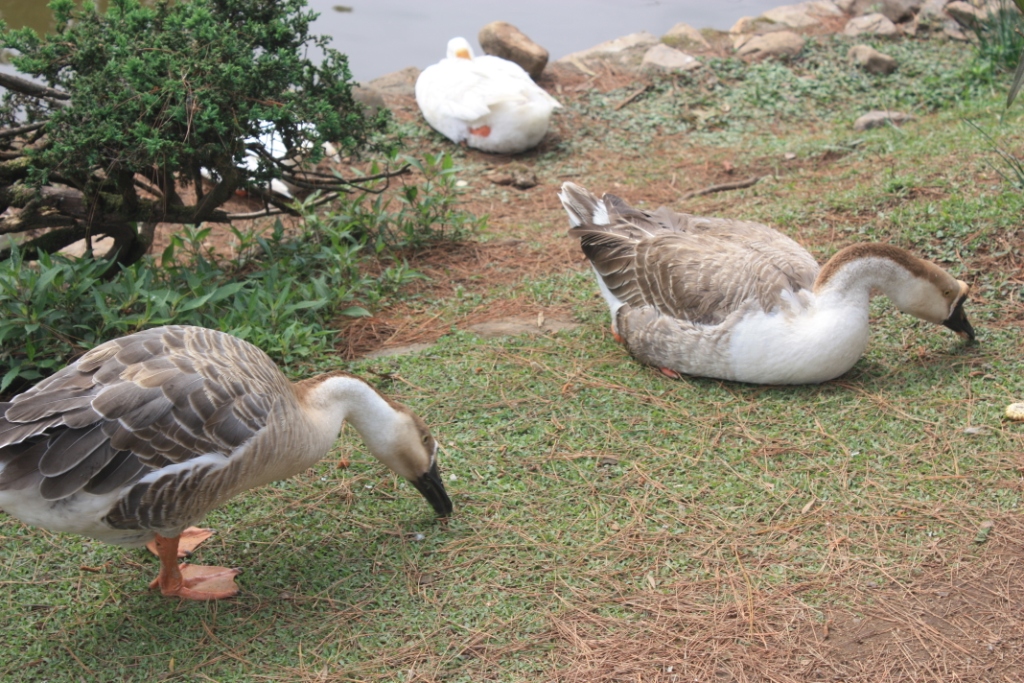
Goose, Goose, Goose,
Look skyward and let your song loose.
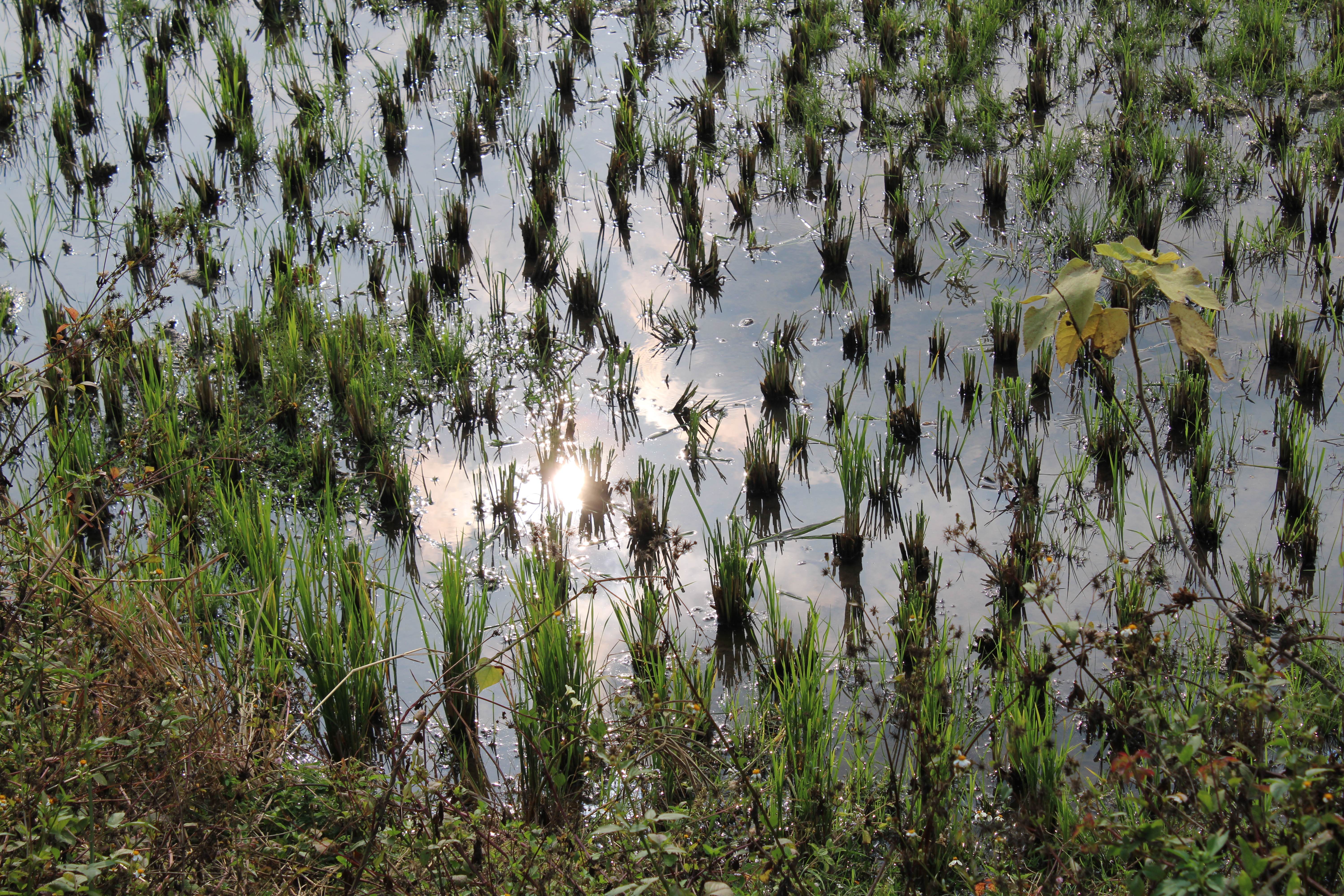
White feathers float on the green lake
As red feet paddle through clear waves.

NOTE: This poem’s title is often translated as “An Ode to the Goose” but the Chinese title 咏鹅 (Yǒng é) is “Chant[ing] Goose.”

“A Burnt Ship” by John Donne [w/ Audio]

Out of a fired ship, which by no way
But drowning could be rescued from the flame,
Some men leap'd forth, and ever as they came
Near the foes' ships, did by their shot decay;
So all were lost, which in the ship were found,
They in the sea being burnt,
They in the burnt ship drown'd.

BOOKS: “Chinese Folktales for Language Learners” by Vivian Ling and Peng Wang

Chinese Folktales for Language Learners: Famous Folk Stories in Chinese and English (Free online Audio Recordings)Chinese Folktales for Language Learners: Famous Folk Stories in Chinese and English by Vivian Ling
My rating: 5 of 5 stars

Publisher Website

As the title suggests, this is a collection of fifteen Chinese folktales presented bilingually in a manner optimized to language learners. To clarify the “optimized for language learners” comment, these stories are paced differently than they would be if the central objective was to entertain. That old writerly chestnut of “show don’t tell” is often violated and the stories are kept short and sweet in a way that can feel like they sprint through critical moments. This is not criticism. I think it is the best way to give individuals learning Mandarin (or presumably Mandarin speakers learning English) a user-friendly book that doesn’t feature dense blocks of text and overly complicated language. (Note: it’s also not bad for those who just want the quick and dirty version of these tales.)

Each of the stories includes a section with some background information on the history and cultural elements behind the stories (stories which display a range of realism and are from distant times,) a list of terms and phrases in English and Chinese, and a brief set of questions to help the reader develop deeper insight into the stories. These ancillary features are all quite useful to the student of language.

As stories, some of these folktales are more compelling than others. A number of them are dry, but what they lack in intrigue they make up for in insight into the history and culture of China. And some of the stories, e.g. “Judge Bao Takes on the Emperor’s Son-in-Law,” are fascinating.

I’d highly recommend this book for those who are trying to learn Mandarin, but it would also serve those who wish to learn some Chinese folklore in a condensed and readable format.

View all my reviews

“Feeling for the Farmers” by Li Shen [w/ Audio]

Hoeing farmer, as heat haze roils,
His flowing sweat waters the soil.
All those who know food on a plate
Should feel each grain comes of that toil.

NOTE: The title of this poem (悯农, or Mǐn Nóng) is often translated as “Toiling Farmers,” though “Compassion for Farmers” or “Pity Farmers” would be closer to the literal translation.

“Abstract” [Poetry Style #22] by Sikong Tu [w/ Audio]

Lonely and longing to travel;
All alone and lacking a tribe.
Like the crane up on the mountain,
Or the cloud that enshrouds its peak.
Like the portraits painted by past
Masters, of souls you couldn't have known.
Like a leaf drifting on swift winds,
Bounding through the boundless spaces.
You'll never be able to hold it,
But can hear the song it dances to,
Those who accept this can tune in,
And the signal will only get stronger.

NOTE: The late Tang Dynasty poet, Sikong Tu (a.k.a. Ssŭ-k‘ung T‘u,) wrote an ars poetica entitled Twenty-Four Styles of Poetry. It presents twenty-four poems that are each in a different tone, reflecting varied concepts from Taoist philosophy and aesthetics. Above is a translation of the twenty-second of the twenty-four poems. This poem has been alternately titled “Abstraction,” “Elegance,” and “Drifting Aloof” by varied translators, but its original title is 飘逸.

“Gitanjali 7” by Rabindranath Tagore [w/ Audio]

My song has put off her adornments.
She has no pride of dress and decoration.
Ornaments would mar our union;
they would come between thee and me;
their jingling would drown thy whispers.

My poet's vanity dies in shame before thy sight.
O master poet, I have sat down at thy feet.
Only let me make my life simple and straight,
like a flute of reed for thee to fill with music.

NOTE: This poem is sometimes titled, “My song has put off her adornments,” or – simply – Song VII.

“Acquainted with the Night” by Robert Frost [w/ Audio]

I have been one acquainted with the night.
I have walked out in rain -- and back in rain.
I have outwalked the furthest city light.

I have looked down the saddest city lane.
I have passed by the watchman on his beat
And dropped my eyes, unwilling to explain.

I have stood still and stopped the sound of feet
When far away an interrupted cry
Came over houses from another street,

But not to call me back or say good-bye;
And further still at an unearthly height,
One luminary clock against the sky

Proclaimed the time was neither wrong nor right.
I have been one acquainted with the night.

“Ascending Happiness Plateau” by Li Shangyin [w/ Audio]

At day's end, feeling ill-at-ease,
Riding a cart to the plateau.
The setting sun fires glorious skies,
But a yellow dusk is coming.

“There was an Old Man with a beard” by Edward Lear [w/ Audio]

There was an Old Man with a beard,
Who said, "It is just as I feared! --
Two Owls and a Hen,
Four Larks and a Wren,
Have all built their nests in my beard!"

NOTE: This poem no. 1 of Lear’s The Book of Nonsense.

“The Snow Storm” by Edna St. Vincent Millay [w/ Audio]

No hawk hangs over in this air:
The urgent snow is everywhere.
The wing adroiter than a sail
Must lean away from such a gale,
Abandoning its straight intent,
Or else expose tough ligament
And tender flesh to what before
Meant dampened feathers, nothing more.

Forceless upon our backs there fall
Infrequent flakes hexagonal,
Devised in many a curious style
To charm our safety for a while,
Where close to earth like mice we go
Under the horizontal snow.