BOOKS: “Rise of the Monkey King” ed. / trans. Jeff Pepper & Xiao Hui Wang

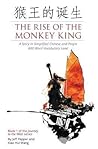
The Rise of the Monkey King: A Story in Simplified Chinese and Pinyin, 600 Word Vocabulary Level (Chinese Edition)The Rise of the Monkey King: A Story in Simplified Chinese and Pinyin, 600 Word Vocabulary Level by Jeff Pepper
My rating: 5 of 5 stars

Publisher Site – Imagin8

This is an abridged and linguistically simplified telling of the first two chapters of Journey to the West. It contains the birth story of Sun Wukong (i.e. the Monkey King) and describes his studies with a sage in an attempt to become immortal.

As someone learning Chinese but at a point where I can only read grammatically and lexically simple content, it’s not easy to find reading material that is both fun to read and readable. The discovery of this series was a godsend. It’s hard to get more thrilling than the story of the Monkey King, and it helps that I’ve already read translations – and so have a bit of context to piece together challenging sentences and to avoid the misunderstandings that can arise when reading a new language. It’s much easier to be a disciplined reader when reading something that is neither a children’s book nor the life story of a preternaturally typical person [which is the usual adult equivalent of a beginner level reader.]

I was pleased by how this book was laid out. Often reading material for learners puts the Chinese characters (hanzi,) the Romanized phonetics (pinyin,) and the English translation all in adjacent rows. While this has its advantages, it also makes it too easy to cheat by eye saccade and not be reading as well as one thinks one is. This book does have all three elements, but it alternates paragraphs of hanzi and pinyin but then puts the translation in an unbroken format after the Mandarin. The book also has a glossary of the book’s vocabulary.

Whether you’ve already read Journey to the West or not, if you’re just learning to read Simplified Chinese, I’d highly recommend this book.

View all my reviews

“Weichuan Farmers” [渭川田家] by Wang Wei [王维] [w/ Audio]

Low, warm light lands on the village.
Cattle and sheep trapsing farmward.
Farmer mulls a missing shepherd,
Leaning on his staff, still on guard.
Pheasants cluck, wheat heads are heavy,
Silkworms dormant, mulberry leaves few.
Farmers stand, hoes on their shoulders,
Telling old tales, as if they were new.
How I envy the idle time --
To chat about mankind's decline.

This is poem #16 of the 300 Tang Poems [唐诗三百首.] The original poem in Simplified Chinese is:

斜光照墟落, 穷巷牛羊归。 
野老念牧童, 倚杖候荆扉。
雉雊麦苗秀, 蚕眠桑叶稀。
田夫荷锄立, 相见语依依。
即此羡闲逸, 怅然吟式微。

“Autumn Moon” [秋月] by Cheng Hao [程颢] [w/ Audio]

A clear stream passes by the
mountain clad in green;
The clear sky and clear water
melt in autumn hue.
Far far away from the tumultuous
world unclean,
Long long will white clouds and
red leaves be friend to you.

Note: This is the joint translation of Xu Yuanchong and Xu Ming found in the edition of Golden Treasury of Quatrains and Octaves on which they collaborated (i.e. China Publishing Group: Beijing (2008) p. 64.)

Wen Fu 10 “Originality” [文赋十] by Lu Ji [陆机] [w/Audio]

Splendid thoughts arise from joined words --
Lucidity is awakened:
Luminous like adorned brocade,
Doleful as a string serenade.
But if crib suspicions aren't killed,
It'll be just one more pulp piece.
Though you may be these word's weaver--
Some ancestor, the prime conceiver.
You must be just and rise above,
Though it kills words you've grown to love.

The original lines in Simplified Chinese:

或藻思绮合,清丽千眠。
炳若缛绣,凄若繁弦。
必所拟之不殊,乃暗合乎曩篇。
虽杼轴于予怀,怵佗人之我先。
苟伤廉而愆义,亦虽爱而必捐。

“In Search of the Taoist, Chang” [寻南溪常道士] by Liu Changqing 刘长卿

I walk the narrow path,
Clogs divoting the moss.
White clouds over the shore;
Gate obscured by Spring grass.
Post-rain, I see the pines,
Follow stream to its source.
Flower-mind, then Zen Mind --
Arrived! Words have no force.

This is poem #136 of the 300 Tang Poems [唐诗三百首.] The original in Simplified Chinese goes:

一路经行处, 莓苔见屐痕。
白云依静渚, 春草闭闲门。
过雨看松色, 随山到水源。
溪花与禅意, 相对亦忘言。

“Little Echoed Hills” [小重山] by Yue Fei [岳飞] [w/ Audio]

Last night chirps resounded in the cold,
Through witching hour no sleep occurred.
I rose and slowly walked, alone.
Moonlight window glow, but no one stirred.

I've grayed in service and search of fame.
On hills, back home, the pines have grown old.
That's the story I'd let my lute tell,
If a string weren't broken &
there was someone to be told.

“Impromptu Lines Written on a Spring Day” [春日偶成] by Cheng Hao [程颢]

Towards noon fleecy clouds waft in the gentle breeze;
I cross the stream amid flowers and willow trees.
What do the worldlings know about my hearty pleasure?
They'd only take me for a truant fond of leisure.

Note: This is the joint translation of Xu Yuanchong and Xu Ming found in the edition of Golden Treasury of Quatrains and Octaves on which they collaborated (i.e. China Publishing Group: Beijing (2008.))

BOOK REVIEW: “New Story of the Stone” by Jianren Wu [Trans. by Liz Evans Weber]

New Story of the Stone: An Early Chinese Science Fiction NovelNew Story of the Stone: An Early Chinese Science Fiction Novel by Jianren Wu
My rating: 5 of 5 stars

Publisher Site – Columbia University Press

This book is presented as a sequel to the Chinese literary classic (alternatively) known as Dream of the Red Chamber or Story of the Stone. The central character is a scholarly traveler by the name of Baoyu. The first part of the book is set in China around the time of the Boxer Rebellion, an event that features in the story. Throughout this portion, the book reads like historical fiction. However, Baoyu’s travels eventually bring him to a hidden realm, a technologically advanced utopia within China. It is here where Baoyu’s adventures get fantastical and otherworldly, and the book ventures into the domain of Science Fiction.

The setting of the book reminds me a little of Marvel’s Wakanda from Black Panther. Perhaps both instances of worldbuilding were motivated by the humiliated colonists’ fantasy of being more advanced than those who pull the strings for once, or of showing their (respective) lands to be places of “crouching tigers and hidden dragons” (i.e. where great talents exist but remain unseen.) (Note: While China wasn’t on-the-whole colonized by a Western country, its interaction with England and other Western nations left it forced to accept terms unfavorable and undesirable to China (not to mention the outright colonized enclaves such as Hong Kong and Macau.) While the publisher has emphasized the science fiction aspect of this work, it is an anticolonial work through and through. The book can come across as xenophobic and nationalistic in places, but this only reminds the reader of how such positions might be arrived at under the boot of foreign influence.

The book is readable though philosophical and is well worth reading for those interested in developing a deeper insight into Chinese perspectives.

View all my reviews

“The Taoist Temple Revisited” [再游玄都观] by Liu Yuxi [刘禹锡]

In half of the wide courtyard only mosses grow;
Peach blossoms all fallen, only rape flowers blow.
Where is the Taoist planting peach trees in this place?
Only I come again after my new disgrace.

Note: This is the joint translation of Xu Yuanchong and Xu Ming found in the edition of <em>Golden Treasury of Quatrains and Octaves</em> on which they collaborated (i.e. China Publishing Group: Beijing (2008.))

The “new disgrace” referenced was Liu Yuxi’s second exile.

Mount Zhongnan [终南山] by Wang Wei [王维] [w/ Audio]

Taiyi stretches toward heaven;
Linked mountains reach into the sea.
Looking back, white clouds coalesce;
In the mist, the mist can't be seen.
A ridge is a boundary of worlds:
Cloudy or clear; with - or sans - tree.
In need of lodging for the night,
I ask the woodsman cross river from me.

This is poem #118 of the 300 Tang Poems [唐诗三百首.] The original in Simplified Chinese is:

太乙近天都, 连山接海隅。
白云回望合, 青霭入看无。
分野中峰变, 阴晴众壑殊。
欲投人处宿, 隔水问樵夫。