30 Thin Books Every American Should Read

Amazon recently put out a list of 100 Books to Read in a Lifetime. I appreciate the mega-bookseller taking a less doctrinaire approach than, say, The Guardian’s 1000 Novels Everyone Must Read. Also, props to Amazon for including a number of contemporary works—though I guess that is self-serving of them (i.e. $10 versus $0 sales price)—so never mind.

Whenever I see one of these lists—and there are so many of them—I always feel a bit inadequate. I suspect I’m not alone, given a recent generic list posted by The Millions, entitled 28 Books You Should Read If You Want To. That author’s approach is laudable. She doesn’t hand out exact titles as if we all need the same books, but rather suggests the kind of books one should consider reading (but only if you want to.)

I read like a fiend. While I usually don’t read rapidly (I can; I learned how in grad school, but I prefer savoring to injecting words), I’m constantly reading. So it’s a little disappointing to see how I stack up in the grand scheme of list-makers.

At present I have read:

– 15 of Amazon’s 100 Books to Read in a Lifetime (15%)

– 12 of Esquire’s 80 Books Every Man Should Read (15%)

– 12 of The Telegraph‘s 100 Novels Everyone Should Read (12%)

– 3 of the Huffington Post’s 30 Books to Read Before You’re 30 (10%, and—sadly—yes, I’m over 30.)

– 45 of The Guardian’s 1000 Novels Everyone Must Read (4.5%)

So this brings me to the point of this post, which is to boost my self-esteem by building a list of books, all of which, I’ve read. As I considered the books I’ve read that I would be so bold as to recommend “everyone” read, I saw trends. First, I read a lot of thin books, or, perhaps, they stick with me more. Don’t get me wrong, I’ve read some monsters Moby Dick (on everybody’s list—I don’t know why), Atlas Shrugged (on the Libertarian Book-of-the-Month Club list, and not much else), and 1Q84 (given a few years, it’ll be on all the lists.) However, it’s the thin books that have stuck with me, and they often get kicked aside by the [other] pretentious list makers. Also, shorter forms (e.g. essays, short stories, poems, and novellas) often don’t get properly recognized because everyone wants to talk about novels and tomes.

Second, while I like to consider myself an international reader (e.g. I’ve read a fair number of translated Japanese and Chinese classics), the fact of the matter is that I’ve had a skewed reading history. I’m an American, and have disproportionately read books that are either by Americans or that speak to the American worldview / mindset (my list will be both.) This isn’t so much an issue for most of the list makers as they simply propose that every Nigerian, Thai, and Peruvian should read a canon devoid of any Nigerian, Thai, and Peruvian authors (but instead that is 50% British, 30% American, and 20% all others.) While the list may be targeted toward U.S. audience, these books are good for everybody, and everybody should read outside the familiar.

Without further ado, my list, 30 Thin Books That Every [Attention-Challenged] American Should Read:


1.) 101 Great American Poems

Because poetry is good for the soul. Yes, this anthology is skewed toward dead poets, but it’s not only thin, it’s cheap. It’s got Whitman, Dickinson, Frost, Sandburg, and Hughes.


Animal Farm

2.) Animal Farm, Orwell

Because, screw totalitarianism, that’s why. This is like 1984, but without the villainy clubbing one over the skull. Therefore, you can introduce the kids to commie-hating early and without giving them nightmares—well not bad ones. Plus, it’s thinner than 1984.


3.) Apology, Crito, and Phaedo, Plato

Because virtue is good for the soul. This is Plato’s account of Socrates’ defense at his own trial and his subsequent explanation of why he was going to drink the hemlock. Yes, it’s technically three books, but they are often bundled together as one book. Even with all three, it’s pretty thin.


4.) Brave New World, Huxley

Because Orwellian dystopia isn’t the only dystopia. In Huxley’s book, tyranny wasn’t a matter of force, but manipulation. This book shows how dystopia can be disguised as utopia by keeping the population adequately drugged and well-sexed.



Candide

5.) Candide, Voltaire

Because satire is good for the soul. No sacred cows escape roasting in this thin volume. A naïve young man travels out into the world to find that evil is ubiquitous.


6.) Catch-22, Heller

Because how often does a book coin a common phrase. (FYI- “A Clockwork Orange” was a phrase Burgess borrowed for the book that was common in some parts, but Heller invented the term “Catch-22.”) The story revolves around the notion that one can’t get out of the war by reason of insanity, because if one is trying to get out of the war one is sane by definition, and if you are insane, you don’t try to get out.


7.) Civil Disobedience, Thoreau

Because if you’re going to break the law, you should know how to do it do it virtuously and not like a dirtbag. (Hint: It’s more painful than you think.) This essay tells of Thoreau’s imprisonment because he refused to pay taxes that would fund the war with Mexico. It’s usually bundled with other essays.


8.) Fahrenheit 451, Bradbury

Because books are good. The title comes from the temperature at which books burn, and it’s set in a dystopian future in which the protagonist, “Fireman” Guy Montag, goes around collecting and burning books.


GreenEggs&Ham

9.) Green Eggs and Ham, Seuss

Because you should know how to turn someone down (e.g. I would not eat them on a boat, I would not eat them with a goat.) Or, because learning to be playful with words may serve one well. Or, because you should try new things. In the story, an unnamed narrator is subjected endlessly to green eggs and ham, which he steadfastly, refuses until the end.


10.) Hamlet, Shakespeare

Because you think you’ve got a weird family. Hamlet exacts revenge when he finds out that his uncle killed his father to marry his mother and usurp the throne.


IntoTheWild

11.) Into the Wild, Krakauer

Because you don’t want to underestimate Mother Nature when you strike out to build your indomitable American spirit. This is the true story of a college graduate who gives away his bank account, burns his pocket-money, cuts ties with his upper-middle class family, and sets off to become self-made. Ultimately, he ends up in Alaska, and it does not end well.


12.) It’s Getting Better All the Time, Moore & Simon

Because, stop being such a gloomy-Gus. Admittedly, this is an unconventional choice– both because it’s not particularly skillfully written and a few of its conclusions may not be as true as they once were. However, it does inject a dose of reality for those who view the world through shit-colored glasses. As the title suggests, the authors argue that life in America is getting better year after year. We are getting healthier and richer. Being economists, they present much of their findings as graphic representations of statistical data.


13.) Man’s Search for Meaning, Frankl

Because sometimes the world actually looks better through shit-colored glasses, Seriously, because you need to know how to get on with it when life is at its toughest. Viktor Frankl was a psychiatrist and Holocaust survivor who writes about what kept people going at places like Auschwitz.


14.) Meditations, Aurelius

Because, just get on with it. This was actually a kind of “Notes to Self,” written by the Roman Emperor to remind himself to be virtuous, to live, and to not fear death.


OnTheRoad

15.) On the Road, Kerouac

Because you don’t get enough of the word “rickety” these days. But seriously, you get to “see” a lot of America through Kerouac’s poetic language. It follows the road trips of a beat generation protagonist through America.


16.) Sanctuary, Faulkner

Because Faulkner’s language rocks, and this is a gripping and gritty tale. It’s the story of an upper class co-ed who’s dragged down into the underworld and some desperate times by a couple bad decisions, not the least of which was going for a ride with a stupid drunk.


17.) Self-reliance and Other Essays, Emerson

Because you need a pep talk to think for yourself. Emerson proposed that one stand as an individual and stop letting political parties, religions, or other organizations decide what one believes. Emerson and Twain both saw a sad trend brewing in which people were starting define their beliefs by identifying with a party and then letting that party’s opinion leaders tell them what to think. Sadly, this trend only grew since there day to the point that many people have extremely strong beliefs that they can’t begin explain in a logically and factually consistent way.


18.) Tao Te Ching, Lao Tzu

Because one day China is going to collect on our debts, and well need some grasp of their culture. Seriously, you should read outside your culture. In the process, you’ll find that the Taoist stream of thought isn’t all that far off our own—“f#@k authority and pretentiousness and all the bureaucratic formalities.”


19.) The Adventures of Huckleberry Finn, Twain

Because, screw Melville, this is the great American novel. Yes, I realize that it’s not particularly thin, but compared to Moby Dick it is—and it reads more quickly because there aren’t long drawn out sections on the minutiae of whale pineal glands and what not. This book follows the adventures of that rapscallion, Huck, as he flees a drunk father and a lady who wants to make him civilized, and takes to rafting on the Mississippi with an escaped slave. Yes, it has the n-word like a billion times, but if you read all the words (and not just that one) you’ll see there’s a positive message about the development of mutual friendship and respect between Huck and Jim.


20.) The Call of the Wild, London

Because you need to get outside more. It’s the story of a dog who is taken from the good life as a pet in California to the wilds of Alaska, and what said dog must do to survive.


21.) The Elements of Style, Strunk & White

Because you need to be concise AND coherent. In the age of Twitter, people are mastering the former while losing the latter. This is a thin books that tells you most of what you need to know to write intelligibly in English.


FallofUsher

22.) The Fall of the House of Usher and Other Tales, Poe

Because America has a dark side, and nobody writes it better than Poe. Any of the many collections of Poe’s short stories (some including poems and/or long-form works) will do. One definitely wants “The Pit and the Pendulum,” “Tell-tale Heart,” “The Murders in the Rue Morgue,” “A Descent into the Maelstrom,” and, of course, the title poem.


23.) The Golden Sayings of Epictetus, Epictetus

Because we need an injection of Stoicism to counteract the prevailing trend toward whining and moaning. Epictetus was a slave who became one of the most famous Greek sages. His sayings are mostly about not crying over spilt milk, but to be careful not to be the one who spills the milk. In other words, don’t whine about what the world gives you, devote your energies to being virtuous and conscientious.


livesOfACell

24.) The Lives of a Cell, Thomas

Because you should understand your place in the ecosystem, and Lewis Thomas describes it artfully and concisely. This is a series of essays that covers a lot of ground with respect to the subjects of biology and physiology.


25.) The Prince, Machiavelli

Because you may just want to take over the word someday. This is advice about how to rule. It may not make one popular as a middle manager, but there are bits of wisdom throughout.


26.) The Road, McCarthy

Because someday it’s all going to come to an end, and it will probably end badly. This is the story of a father and son wandering through a post-apocalyptic wasteland. I realize I’ve put a lot of dystopianism on this short list, but I’m going to say that’s part of the American condition. America has had it good for long enough to realize that all things come to an end.


27.) The Snows of Kilimanjaro and Other Stories, Hemingway

Because we should not give the short story short shrift, and Hemingway—like Poe—did them well. Besides the title story, this collection includes “The Killers”, “The Gambler, The Nun, and the Radio”, and “A Clean, Well-lighted Place.”


28.) The Sun Also Rises, Hemingway

Because you need to get out of the country and experience some of the rest of the world. This is about the travels from Paris to Pamplona of a group of men who’ve all fallen for the same woman with that woman—of course—along for the ride.


29.) Walking, Thoreau

Because you need to get out of the house, away from your cubicle, and out into nature. This is an essay extolling the virtues of putting one foot in front of the other like you mean it.


30.) Where the Wild Things Are, Sendak

This is the story of a little boy’s dreamtime journey to a world inhabited by “monsters” and his interaction with them. Like Green Eggs and Ham, you should have read this as a kid. If you didn’t, I’m sorry about your defective parents, but get over it. Since you probably don’t want to read this as an adult on the Metro going to work, you can get Christopher Walken to read it for you on YouTube.


So that is it. That is my list of 30 Thin Books that Every [Attention-Challenged] American Should Read.

BOOK CHAT: Walking by H.D. Thoreau

WalkingWalking by Henry David Thoreau

My rating: 5 of 5 stars

Amazon page

Thoreau paints a portrait of walking in such grandiose terms that one will cease to think of putting one foot in front of the other as one of life’s mundane tasks. He’s not talking about just any walking, however. He’s not talking about the mall walkers who briskly exercise in temples of consumerism. He’s not talking about those who walk through the park with top 40 hits blaring from their iPod ear buds.

Thoreau is talking about those individuals he calls saunterers. To saunter, as to stroll, is to walk in a leisurely and aimless fashion. Thoreau’s walking is that which:
-takes place in nature.
-leaves worldly worries behind.
-is not a trivial time commitment.
-is more an exercise of the mind and spirit than of the body.

To the mall walker, Thoreau would point out the error of a missed opportunity to get away from mankind’s chaos and enjoy nature. As he puts it, “The most alive is the wildest.” and “…all good things are wild and free.” He’s also clear in that walking for exercise misses the point by injecting hurriedness into a time that should be about slowing down.

On those with iPods, cellphones, or other contrivances that distract one from the environs, Thoreau is equally clear, “What business have I in the woods if I am thinking of something outside the woods?”

Thoreau’s essay broadens as it progresses. From a commentary on the virtues of sauntering, the essay turns to the glories of nature, the character of America, and the state of thought in his contemporary society. These may seem like unrelated concepts, but there is a string of logic that connects them.

The connection to nature and the virtue of wildness should be clear. It’s nature that is the optimal backdrop of sauntering. It’s in nature that one can be set free from the troubles of the world of man and obtain a glimpse of god. It’s in nature where creativity breeds with chaos turned down and native brilliance turned up.

Thoreau’s discussion of America is tied to the theme of walking in a couple of ways. The first is as a land made for walkers. For example, he points out that a man could pitch a tent almost anywhere in North America without great risk of becoming a meal. The same couldn’t be said of India or Africa or Siberia, where man isn’t the sole predatory creature. The second is America as a place with room to venture out into uncharted territory. Thoreau points out that we may look to the East for the lessons of our predecessors, but a person should look West for opportunities to grow in one’s own right. Of course, Thoreau’s America was different from today’s America.

The end of the essay broadens out even further. Thoreau comments upon mankind and the state of ideas and thought. He echoes Socrates when he talks about that age-old question of whether it’s better to be ignorant (to know one knows little) or deluded (to think one knows a lot, but be drowning in false knowledge.) A reader may suggest that this is a false dichotomy. Why can’t one know most everything and not have a one’s body of knowledge rife with false knowledge? I can’t say, but all of the evidence suggests that if such a state exists, it’s the domain of God or gods (if such entities exist.)

Thoreau also bemoans what he sees as the decline of thinking man. What does this have to do with walking? I think Thoreau answers in the following quote:
“So it would seem few and fewer thoughts visit each growing man from year to year, for the grove in our minds is laid waste—sold to feed unnecessary fires of ambition, or sent to mill—and there is scarcely a twig left for them to perch on.”

I think that everyone should read this thin book–really an essay and not a full-scale book. The problems Thoreau notes have only gotten worse in our modern age. Far too few take the time to walk, and to acquire the benefits of sauntering.

View all my reviews

9 Nights at an Ashram

Taken October 20, 2013 at Fireflies Ashram.

Taken October 20, 2013 at Fireflies Ashram.

Indian cities don’t whisper. They are often lovely, always lively, but offer little relief from bombardment of the senses. Horns are relentless. Bus and truck air-horns can make a person jump from one’s skin. The smells may be pleasing or putrid, but they’re never faint. There is sign pollution, wherein it’s often impossible to find what one is looking for in the sea of signage–even when it lies right in front of one’s face. Colors pop and glow, not smooth pastels, but oranges and purples that you can practically taste.

It shouldn’t have surprised me when I got to the southern edge of the city to find one of the major land uses was Ashrams. Ashrams in all shapes and sizes, from the small but authentic Narayana Gurukula (mentioned a few DAILY PHOTO installments back) to the massive Art of Living International Center–headed by Bangalore’s most famous guru, Sri Sri Ravi Shankar. Out Kanakapura Road, where monkeys sling through trees and fields of corn remind me of my own Hoosier upbringing, lies a diverse collection of houses of spirituality and reflection. They offer a much-needed island of tranquility amid a sea of chaos.

I stayed for nine nights at one of the most singular of these ashrams, Fireflies. One way in which it’s unique is that it’s a “guruless” ashram. That may seem oxymoronic. The terms “guru” and “ashram” seem to go hand in hand. Guru means teacher. My dictionary defines ashram as, “the home of a small community of Hindus.” [I think this definition could be challenged both on the necessity of “smallness” and “Hindu-ness.” As indicated, there are some pretty massive ashrams and there are ones that are associated with non-aligned spiritual groups.] It’s true that the typical ashram has a spiritual leader or yogi as its head. At Fireflies the gurus come and go with the groups that visit. While I was there, besides our group of Thai Yoga Bodywork practitioners, there was a group of psychotherapists and an organization of past life regressionists. Rather than housing a single unified set of beliefs, at this ashram a diverse and sometimes conflicting set of beliefs are harmoniously housed.

As I have little experience with ashrams, I can’t speak authoritatively about other differences. However, it’s my understanding that one other difference between Fireflies and many–more typical–ashrams is that the latter often have limited or non-existent staff. This means that the visitors may do much, if not the bulk, of the work. Fireflies has a staff that does the cooking and takes care of many needs of the visitors. This isn’t to suggest that it’s like a hotel stay. There’s somewhat of an expectation that visitors will take care of the things that they can do for themselves, and the accommodations are basic.

I found the experience of my stay to be beneficial, if not always stress-free. The main source of my stress had little to do with the Ashram. I received my phone sim card right before I left. After a couple of days I got my phone working for a day or two only to have the phone company turn it off because no one was home when they randomly dropped by to verify my address. [Showing up unannounced in the middle of the day and then treating you as non-existent if no one is home is one of the annoying little hallmarks of Indian institutions (corporate and government) that I’ve experienced on more than one occasion.] I will admit that it is a mark of both society’s and my own wussification that we can’t go a few days without being in contact with home and news of the world. Twenty years ago no one would have expected to have such constant verification that all was well in the world. People could go days back then without worrying that the sky was falling. While it wasn’t pleasant to be cut off, it was an eye-opening experience. [I will note that the Ashram property is on a slope and at the low end I got no reception at all, but on the high end I’d get a bar or two–enough to do the job if the phone company wasn’t screwing me over.]

It was also useful to go without brain candy for a while–that is without television and related entertainment. Part of what I hoped to learn from my stay was whether I was prepared to take the 10-day Vipassana meditation course in the spring. The Vipassana course is considerably more spartan level of existence than that of Fireflies.

On some levels, I proved ready, and on others I have yet to do so. I did just fine eating two vegetarian meals and a snack for dinner each day. (I could have had three full meals per day, but I wanted to make sure I was ready to cut my intake adequately. Therefore, I stuck with a snack in the evening and ate reasonable portions for breakfast and lunch.) I found the meals at Fireflies to be quite good, and I had no complaints in that regard. It should be noted that the ashram is not an easy walk to any restaurants or substantial stores (there are a couple small shops up on the corner, but they’re geared toward locals and don’t necessarily have what a traveler needs) so it’s not easy to go out for something–though I did see one auto-rickshaw around the premises at times.

The true test of preparation for the Vipassana course is that there are no books or notebooks allowed. This will be my greatest challenge. I finished two novels and two nonfiction books on Kindle during my stay, plus probably another 100 pages of other books, and I filled 2/3rds of a journal–mostly with notes from the TYB workshop.

Also, at the Vipassana meditation course one is not allowed to speak to anyone but the instructor at a specific time when they take questions about the course. I wasn’t nearly so cut off from humanity at Fireflies. The workshop participants and teachers were around all day and I had occasional conversations in the evening with others at the ashram. Furthermore, I’m a fairly solitary creature.

It was interesting that during the weekends there were so many people around, but during the middle of the week there were few. For a while I thought I was the only non-staff member person at the ashram—though I later found that to be incorrect.

So my time at the ashram was Spartan, but that’s part of the beauty of it.

I should point out that there are some impressive stone carvings located throughout the property. The artists are international in scope. Each of these carvings or sculptures offers its own story. I’ll attach a few pics for your edification.

20120101_16151920120101_16142320120101_155241

Picture Your Unhappiness in its Underwear

I was writing some six-words on Smith Magazine the other day. I do this now and again as an exercise to get the creative juices flowing. There are a series of themes, and I try to write in as many of them as I can in less than 20 minutes, writing in a free form, stream of consciousness style.

When I got to the category HAPPINESS the first six-word to jump to mind was: “Picture your unhappiness in its underwear.” This one drew a nice response, which began me thinking about whether this advice might have actual merit–as opposed to being a non-nonsensical statement that might at best function as a Zen koan.

As I thought about it, three legs of the stool came to mind.

1.) Have a sense of humor. Anger and sadness have a hard time taking hold if one can manage a good laugh. I’ve found that being able to dance personal tragedy into comedy has been a great coping mechanism. One does have to be conscientious about not becoming a snarky person. One risks beginning to see the world through a crap-colored lens just as a means to comic fodder (or from a martyrdom complex.)

Perhaps even if one can’t formulate humor, one can still use laughter. There’s a system called laughter yoga that is based on the belief that you can create the same range of physiological responses from “forced” laughter as one does from spontaneous laughter. It’s a sort of chuckle pranayama (breathing exercises.)  While I don’t know much about the system, I can believe that it has merit based on what I’ve read about human emotions.

2.) Lay the source of your unhappiness bare. This sounds simple enough. One must know what is making one unhappy in order to turn that frown up-side-down.

That being said, human beings have an astounding ability to attribute all negative happenings in their lives to external factors. Like politicians, we like to take responsibility for what is going right (regardless of whether we are responsible or not), and we love to place the blame for failure firmly elsewhere (even it it’s mostly our fault.) This may be an evolutionarily-hardwired coping mechanism, but it can keep one in the doldrums.  If one continually says, “He makes me so mad” or even, “His actions make me so mad,” then you’re forfeiting control over your emotional state. Jerks and bitches might be an intermediary cause of unhappiness, but ultimately one’s own perceptions and responses lead to the negative emotional state.

This is where the hard work of mind training comes into play. Instead of being swamped by negative thoughts, one has to recognize them early, find the root cause, and recognize that our desire to for things to be a certain way is ultimately what makes us unhappy. We may want people to think we are smart or beautiful, and intimations to the contrary (whether intended or not) make us fume.

Don't be an angry monkey!

Don’t be an angry monkey!

One of the few things I remember explicitly learning in high school was about what our psychology teacher called a “gestalt of expectations.” Like most ideas one remembers though only taught once, I remember it because it had a memorable story attached to it. The story goes like this: “A man is driving through the desert in the American southwest. Now, out in the southwest, gas stations can be few and far between. So the man runs out of gas, and realizes that the station he passed 20 miles back is his safest bet because–contrary to what he had thought– the next one going forward might be another 50 miles.  So he starts walking. It’s hot. He’s hungry. He’s thirsty, and only has some lukewarm water that’s getting hotter by the minute. The backs of his hands and his face are getting sunburned. He starts thinking about how the little two-pump gas station is going to gouge him. He realizes he’s desperate, and so he figures the attendant is probably going to sell him gas at $6 a gallon, a bottle of cold water for $8, and don’t forget the jerrycan at $20.  These thoughts and the heat keep making him madder and madder. Finally, he gets to the station, and the attendant comes out and say, ‘Oh my, Mister, you must have had a horrible time.’ And so the man on the verge of heat-stroke punches out the attendant, a kid who only wanted to help him out.” Once one starts attributing one’s unhappiness to external sources, one can easily mis-attribute unhappiness because one thinks one knows what is in the minds of others, when really one doesn’t.

3.) Unhappiness, like standing around in one’s underwear, is–at most–a temporary state. As Taoists have been known to suggest, one’s darkest hour is a time to rejoice, for surely it will  get better from there. The only way one can remain in a perpetually unhappy state is to carry it with one long past its time. Just like the only way that can always be rained on is if one carries around a complicated mechanism with a showerhead and tank and keeps refilling that tank so that the shower never runs out. Otherwise, the dry season will come eventually.

Happy 237th, America

IMG_9111America is the product of a set of exceptional human beings. Some may wish to humanize the founding fathers and to deflate the mythology that has grown up around them, but deflate the myth and one still has impressive facts. Who turns down a salary for the most sleepless and thankless job in the universe? George Washington, that’s who. Who writes a political document so artfully that its turns of phrase still chime poetically  in the ear 237 years after the fact? Thomas Jefferson, that’s who? Who can invent the lightening rod and bifocals, convince the French to move toward the sound of the guns (just kidding, France), and get the chicks despite the most hideous comb-over ever? Benjamin Franklin, that’s who.

Now this may be Golden Age fallacy talking, but today’s ruling elite seem a bit… well let’s just say “pathetic” by comparison. Sure modern-day rulers still have charisma out the wazoo, but Franklin had charisma plus a world-class intellect. Jefferson had charisma, and he didn’t need a speech-writing team and focus groups to craft his words for him. Washington had charisma, and–quite frankly–he could scare the shit out of a grizzly bear. It’s the rare modern-day leader who is  qualified for any alternative career besides ambulance chasing.

Still, I will remain optimistic about the fate of the nation as long as great ideas prevail. Checks and balances is a great idea. The compromise to appease both populous and small states is a great idea. The Bill of Rights is a set of great ideas. I’m a little amused whenever I hear people say that America needs to revise its Constitution if it wants to keep up in the modern world. I heard this most recently from a scholar who said that because it was relatively difficult to make laws and spend money, America was going to fall ever behind the likes of Scandinavian countries? What? Really? Seriously?

BOOK REVIEW: How to be God by George Mikes

How to Be GodHow to Be God by George Mikes

My rating: 3 of 5 stars

Amazon page

Humorist George Mikes’ main premise in this book is that humans created God in their image. The book is a series of essays designed to instruct God, if he or she exists, in being a more reasonable facsimile of the ideal human–dear old mom.

Actually, the micro-essays that make up the chapters of this book cover a wide range of subjects. Some of them stay on topic more closely than others. A few of the chapters seem to be stories that the author found interesting (and they are), but which didn’t have a lot to do with supporting his argument. For example, he discusses the two good deeds he has done in life, and he has a chapter on episodes of coincidence. The former may be a tongue-in-cheek support for the argument that even the worst of us are good sometimes. The latter may have been an attempt to bolster a more general argument for atheism by stating that coincidences are not miracles. However, if that is his point, while true, he doesn’t explicitly close that loop in any but the most gratuitous way. At barely over 100 pages, it felt like some of the material, while entertaining, was in the book not to address the topic but to hit the lower bound on a page range.

Mikes weaves together amusing anecdotes with shock-essayist statements that are not so much humorous as gratuitously provocative. With respect to the latter, I’m thinking of his discussion of Hitler and Stalin as basically good guys–if at least in their own minds.

The book is a mixed bag. It’s sometimes though-provoking and humorous, but other times it drifts into shock and awe gratuitous assertions. I suspect he could have hit his page mark by supporting his arguments better and still maintained the humor (realizing that exposition can be death in humor writing.)

A prime example of the book at its best is a story about a woman meeting with her doctor [paraphrased herein.] This is in a section about mini-gods, i.e. those people that we quasi-deify–such as judges and medical doctors. The doctor is trying to convince the woman to have surgery, but the woman refuses.

The doctor asked, “how did you get here today?”

The lady replied, “I took the bus.”

“And you trusted the driver, a complete stranger, with your life. But you won’t trust me–an expert in my field?”

“Yes, of course, the difference is vast.”

“How so?”

“The driver was on the same bus.”

If you find a copy, this book is worth a read. It’s not much of a time investment. It’s an illustrated 105 page book.  If your attitude is, “Sacred cow? it’s what’s for dinner,” you’ll probably like it overall. If you are pious, you’ll probably hate it. If you are neither, you’ll probably find that it has its moments.

View all my reviews

The Bullets that Bore no Name: or, the Burden we all Bear

Attribution: Bundesarchiv, Bild 192-334 / CC-BY-SA

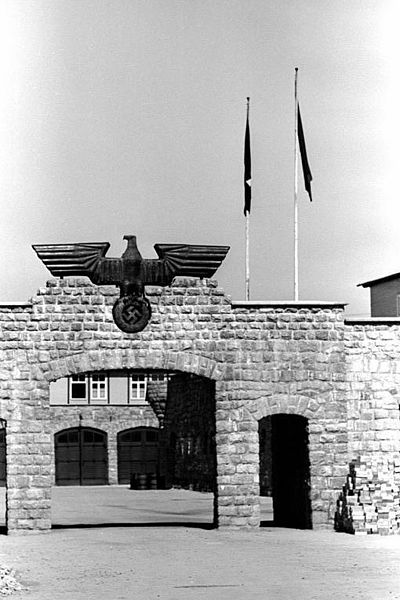
Mauthausen                     Attribution: Bundesarchiv, Bild 192-334 / CC-BY-SA

Thanks for joining me on the veranda. If you don’t know what I’m talking about, this post flows from a book review I did on Elie Wiesel’s Night, which can be seen here. But don’t wander off just yet.

I married into a family of holocaust survivors.

Being sufficiently narcissistic, I haven’t been able to avoid thinking of the profound impact this had on my life.  I am married to the most extraordinary woman in the universe [my apologies to all other women, I’m sure you’re someone else’s most extraordinary woman] by virtue of the strength of a man who wrestled his way to the top of a pile of corpses, bleeding profusely from multiple shrapnel wounds, clawing his way out of a pit, and cleaning the gashes with his urine. That man was married to a woman, tiny of body but colossal of mind, who was in the group force marched from Budapest to Mauthausen. After the war, they had a child–my mother-in-law. Yada-yada-yada. I have marital bliss.

Not being completely narcissistic, I’m reminded that every one of our lives have been shaped by strong people who lived through close calls. Each of us comes hither as a gift from men and women who passed through a hail of bullets that bore no name. Some, like my wife’s grandfather, were riddled by bullets bearing their name, and still refused to heed their deadly whisper.  Every holocaust survivor survived by a thin margin. Every battlefield veteran’s life is an execution order rescinded. Every prisoner of war was one germ away from an unmarked grave.

No pressure or anything, but that sounds like a heavy debt we  all bear.

Telling this story in greater detail is one of my bucket list tasks. It’s a project I’ve had on the back burner for far too long. There are several reasons for this. The most feeble of which is a hope to find the right timing. Sadly, there are so many such stories that I fear it will be lost amid a sea of sorrow.  Then there is my need to develop grace with language sufficient to do the story justice. In a way the two novels I have drafted, and whose mess I am now painstakingly trying to dance into shape, are practice exercises.  Wish me luck.

On the plus side, my wife’s uncle had the foresight to have her grandfather speak his story onto about 20 tapes before he died. With today’s technology, there’s no excuse for anyone’s life-altering story to go untold.  So I guess if there is a moral to my rambling post it’s this: don’t let anyone in your life with a spectacular story pass from this world without it being heard.

5 Minefields of Armageddon for 2013

National Land Image Information, Ministry of Land, Infrastructure, Transportation & Tourism, Japan

National Land Image Information, Ministry of Land, Infrastructure, Transportation & Tourism, Japan

1.) Ever heard of the Senkakus? What about Diaoyus? If not, you should look them up. When you’ve been wearing a gas mask for the 33rd day straight, you may want to know about the chunks of rock in the East China Sea that we tripped into nuclear winter over. Simmering tensions between Japan and China have been flaring up over these islands of late. So you’re probably wondering who lives there who’s so important that it’s worth wandering through a minefield that could trigger World War III. If you answered, “absolutely no one,” give yourself a prize.  They’re uninhabited. It’s not the islands themselves that anyone gives a rat’s as about, it’s the ramification they have for underwater drilling rights.

The reader may accuse me of hyperbole. (Shh! Dont tell anyone, but– of course– that’s what I do.) After all, China has a boldly stated “No First Use” policy. That is, they claim they will not use nukes in a first strike. Given that Japan isn’t a nuclear weapons state (NWS), there doesn’t seem to be much risk. Except that a.) Japan lives under the U.S. nuclear umbrella;  b.) Japan is the non-NWS that could develop nuclear weapons in the shortest time imaginable — they have the material, infrastructure, and technical know-how (okay, Germany is in the same bag); and c.) see #2

KimJongUn3

2.) North Korea conducted its third nuclear test. This presents a risk because: a.) it provides an incentive for Japan to build its own nukes (particularly if faith in the US umbrella wanes.) b.) [and more importantly] Kim Jong Un has too many yes-men, and no one to slap him in his chubby face and say, “are you smoking powdered unicorn horn?” In other words, he doesn’t have a good idea of what he can get away with before the world unleashes a crate of whoop-ass on his sad country. So he wanders in the minefield.

3.) Europe is getting depressed. Fat and happy Europeans are productive and polite. Downtrodden Europeans have been known to swallow some pretty despicable narratives, and– in doing so– drag the world into war. At the moment this seems really far-fetched. These political movements are at best in the political fringe of countries on Europe’s fringe, right? Maybe so. Time will tell.

4.) If America’s economy is crash-landed, everyone is going to be hit by the debris. This will be depressing, see #3 and then multiply globally. Times like these  echo Churchill’s comment, “Democracy is the worst form of government, except for all those other forms that have been tried from time to time.” Any person, company, or government that sees the train coming in the distance but can’t find its way off the tracks can’t be expected to thrive for long.

5.) India and Pakistan, enough said…

TODAY’S RANT: Hyper-relativistic Mathematical Zones: or, When Will my Car be Done?

Albert Einstein theorized that distance and time are relative depending upon one’s speed. In everyday life we rarely notice this because of a little-known tenet of General Relativity that says, “Whenever one attempts to approach the speed  of light, there will be an octogenarian in the left-hand lane.”

Since the early 20th century, physicists have thought they were this close (author holds up hand with thumb and index fingers about 3/4 of a centimeter apart) to being able to explain the whole shebang. Figure out why very small things behave differently from very big things, and, Bob’s your uncle, we’ve got your Eureka moment.

I, however, think physicists will find that they have yet another hurdle to solve (mixed metaphor intended, smartypants.) This has to do with certain zones in which conventional measurements of space and time break down even when one is only moving at the speed the planet is revolving (24 hours/day, I think, no that sounds wrong somehow.)

I don’t think physics is quite prepared to explain why an hour in a mechanic’s shop is equal to about 4.33 hours on the outside. We’ve all experienced the inverted time-dilation effect of the Department of Motor Vehicles. According to Einsteinian relativity, time slows as one approaches the speed of light. However, time slows even more when one is in the slowest state of movement possible, the DMV line.

I won’t go into the distance contraction effects localized to the crotch region of men who wear wife-beaters and gold hood ornaments around their necks.

Are these just zones in which bistromathics trump mathematics (Sorry only readers of Douglas Adams’s Life, the Universe, and Everything will get that reference.)

Any Unified Field Theory must explain these phenomenon before I can accept it.

TODAY’S RANT: Pronunciation Police

Pronunciation is tricky.

Pronunciation is tricky.

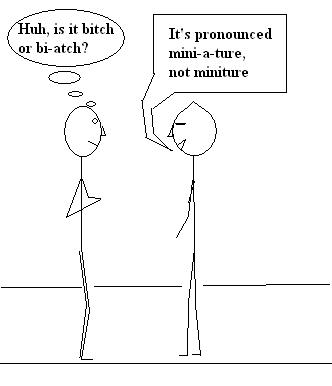
If you’ve ever had someone tell you that any water can be put in a pot (for pronouncing drinking water pot-table rather that po-table), then you may be with me here. If you frequently exercise your perogative, rather than your prerogative, you may agree. Have you had sherbert, or only sherbet? Do both your eggs and oxen have yokes?

If you’re not with me, you –my friend– might be the person on the right in my little stick cartoon.

I’m as anal about language as the next writer, but let’s try to dial down the pretentiousness. The big question I have for pronunciation police is this: What in your experience with the English language has led you to believe it is a phonetic language?

For those who think English is phonetic because they learned it via “Phonics,” let me expose you to a poem that says it more eloquently than I ever could. (I would attribute the poem, but it is to my knowledge owed to that most prolific “Anonymous” chap.)

Hints on Pronunciation for Foreigners

I take it you already know
of tough and bough and cough and dough.
Others may stumble, but not you,
On hiccough, thorough, laugh and through.
Well done! And now you wish, perhaps,
To learn of less familiar traps.

Beware of heard, a dreadful word
That looks like beard and sounds like bird.
And dead-it’s said like bed, not bead.
For goodness sake, don’t call it deed!
Watch out for meat and great and threat.
They rhyme with suite and straight and debt.

A moth is not a moth in mother,
Nor both in bother, broth in brother,
And here is not a match for there,
Nor dear and fear for pear and bear.
And then there’s dose and rose and lose
Just look them up–and goose and choose.
And cork and work and card and ward.
And font and front and word and sword.
And do and go, then thwart and cart.
Come, come I’ve hardly made a start.

A dreadful language? Man alive,
I’d mastered it when I was five!

If you still don’t believe that the language can handle multiple pronunciations, check out what the experts say.