Five Wise Lines [April 2024]

Diogenes Sitting in His Tub by Jean-Leon Gerome (1860)

Of what use for us is a man who, although he has long practiced philosophy, has never upset anyone?

Diogenes of sinope on Plato, according to themistius

The superstition that we must drive from the Earth is that which, making a tyrant of God, invites men to become tyrants.

Voltaire in On Superstition

The progress of an artist is a continual self-sacrifice, a continual extinction of personality.

T.S. Eliot in Tradition and the Individual talent

What’s the difference between a king and a poor man if they would both end the same bundle of white bones.

Zhuangzi

The absence of evidence is not the evidence of absence.

Carl sagan (Note: There are variations on this quote that long predate Sagan’s)

HONORABLE MENTIONS:

You live off the crumbs that fall from the festive table of my genius.

Kurban Said in Ali and Nino [Not so much wisdom as a wicked burn]

To roam Giddily and be everywhere, but at home, Such freedom doth a banishment become.

John donne in a Poetic letter to rowland woodward

Lions are not the slaves of those who feed them, it is the feeders, rather, who are the lion’s slaves. For fear is the mark of a slave, and wild beasts make men fearful.

Diogenes the cynic

BOOKS: “The Dangerous Life and Ideas of Diogenes the Cynic” by Jean-Manuel Roubineau

The Dangerous Life and Ideas of Diogenes the CynicThe Dangerous Life and Ideas of Diogenes the Cynic by Jean-Manuel Roubineau
My rating: 5 of 5 stars

Amazon.in Page

This is a translation of a French book about the life and philosophy of Diogenes the Cynic. It’s a thin volume, as there is much that’s unknown about the life of Diogenes, and the dearth of surviving texts means that some of what is believed about Diogenes and Cynic philosophy maybe corrupted by the reports of detractors. I learned a great deal from reading this book, but not because I learned much new about Diogenes, himself. The colorful anecdotes from his life have been extensively discussed.

With respect to what I did learn, it largely fell into three categories. First, I gained insight into the context and environment in which Diogenes lived. Second, I discovered that many of the stories of Diogenes’ life are far less certain than we have been led to believe through the presentations of them in so many books. For example, we know Diogenes was exiled from his native Sinope in relation to a scheme involving currency debasement. This is often straightforwardly stated as “Diogenes was a counterfeiter,” but Roubineau shows that we don’t know much (if anything) about the degree to which Diogenes was involved (i.e. whether he was mastermind, accomplice, or an unwitting pawn.) Third, I benefited from the comparing and contrasting of Cynic philosophy with that of predecessors (e.g. Socratics) and successors (e.g. Stoics,) and – in a few cases – comparisons between Diogenes and other Cynics.

The book consists of four chapters. The first is a discussion of what is known about Diogenes as a historical figure. The second focuses on the Cynics views on economy, wealth, and related ideas. The third explores the Cynic view of the human body and related topics like sex, pleasure, and pursuit of health and well-being. The last chapter considers Diogenes as a teacher and the Cynic approach to practicing philosophy.

I’d highly recommend this book for readers interested in philosophy.


View all my reviews

ESSAY: “Tradition and the Individual Talent” by T.S. Eliot

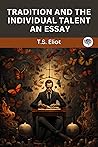
Tradition and the Individual Talent: An EssayTradition and the Individual Talent: An Essay by T.S. Eliot
My rating: 5 of 5 stars

Read for free at the Poetry Foundation

Amazon.in Page

While this is a controversial essay and I don’t accept it wholesale, myself, I would wholeheartedly recommend it as required reading for poets (and other artists.) What is Eliot’s controversial thesis? It’s that poetry should be less about the poet. That broad and imprecise statement can be clarified by considering two ways in which Eliot would make poetry less about the poet. First, Eliot proposes that poets should be in tune to the historic evolution of their art and — importantly — should not be so eager to break the chain with the past masters. He’s not saying a poet needs to be a literary historian, but rather that one be well-read in the poetry of the past. Second, Eliot advocates that a poet avoid packing one’s poetry with one’s personality, and – instead – let one’s personality dissolve away through the act of creation.

A quote from the essay may help to clarify — Eliot says, “Poetry is not a turning loose of emotion, but an escape from emotion; it is not an expression of personality, but an escape from personality.”

One can imagine the accusations of pretension and dogmatism that Eliot received in 1919 from the mass of poets who were moving full speed ahead into poetry that was suffused with autobiography, was avant-garde, and which was free of meter, rhyme and other compositional elements that had once been seen as the defining characteristics of poetry.

I don’t see this essay as being the map to our new home, but rather as the catalyst of a conversation that could move us to a more preferable intermediary location. I have, too often, picked up a collection by a young poet that was entirely autobiographical and (also, too often) of the “everybody hates me, nobody loves me, I think I’ll go eat worms” variety of wallowing in personal feelings. And I always think, when I want to read something depressing, I’ll read something from someone who has lived tragedy — e.g. a Rwandan refugee, not something from a twenty-four-year-old MFA student at some Ivy League school.

So, yeah, maybe we could use more connection to the past and a bit less autobiographical poetry from people who haven’t lived a novel-shaped life.

View all my reviews

“Darest Thou Now O Soul” by Walt Whitman [w/ Audio]

Darest thou now O soul,
Walk out with me toward the unknown region,
Where neither ground is for the feet nor any path to follow?

No map there, nor guide,
Nor voice sounding, nor touch of human hand,
Nor face with blooming flesh, nor lips, nor eyes, are in that land.

I know it not O soul,
Nor dost thou, all is a blank before us,
All waits undream'd of in that region, that inaccessible land.

Till when the ties loosen,
All but the ties eternal, Time and Space,
Nor darkness, gravitation, sense, nor any bounds bounding us.

Then we burst forth, we float,
In Time and Space O soul, prepared for them,
Equal, equipt at last, (O joy! O fruit of all!) them to fulfill O soul.

BOOKS: “Inner Space Philosophy” by James Tartaglia

Inner Space Philosophy: Why the Next Stage of Human Development Should Be Philosophical, Explained Radically (Suitable for Wolves)Inner Space Philosophy: Why the Next Stage of Human Development Should Be Philosophical, Explained Radically by James Tartaglia
My rating: 5 of 5 stars

Amazon.in Page

Release Date: July 1, 2024

This is a strange book, and I suspect it will be mostly loved or loathed, with relatively few people in that usually broad spectrum of indifference. It’s not strange in its message (which is an argument for philosophical Idealism and a metaphysics consistent, therewith,) but rather it’s odd in its delivery. It mixes fact and fiction, often in an ill-defined way, and it’s loaded with fourth wall breaking self-introspection. I enjoyed reading the book, found it amusing at times, and received a lot of food-for-thought from it (but not without some frustration, particularly around not knowing which were true stories. I suspect this was intentional. Philosophical Idealism being a notion that what matters is our internal [i.e. mental / emotional] experience and that that experience may not have much to do with any external “reality” [and, to the degree it does, that we have limited capacity to know how.] Therefore, it makes sense that a book taking such a stance would eschew the importance of external world “truths” in favor of building mental models that have pedagogic value regardless of whether the reflect external world happenings. The book boldly puts its money where its mouth is in that regard.)

It should also be said that part of the reason for the book’s unusual approach was to make a hard break from the usual mode of philosophical writing, which is often pedantic, pretentious, and elitist. That’s because, beyond the metaphysics it’s prescribing, the book is also proposing a need for philosophy to be a broadly human endeavor – approachable by all, rather than the domain of an elite who communicate in their own special jargon-laden language and argue over minutiae irrelevant to everyday living. Like a number of books of recent years, it’s proposing that we need a philosophy of life that helps us live better lives, rather than a philosophy of semantics and elaborate logic that helps “professional philosophers” score points in a game of philosophy.

A few things I liked about this book, include: a.) it didn’t treat the Western Philosophical tradition as the sum total of philosophy (as many books have.) For example, it explored Akan and Buddhist philosophy alongside the ancient and modern philosophy of the West. b.) it gives special emphasis to Cynicism, a school of philosophy that is usually disregarded as the domain of a few madmen of ancient Greece. There is a chapter imagining Trinidad’s Gambo Lai Lai as a Cynic of the modern world. c.) I liked that it used the last chapter as a way to review in a way that was fun and echoed the approach of the Socratic dialogue. It pitted a scholar in favor of the ideas of the book against what might best be thought of as a mainstream academic philosopher (though he was also an opponent of the book.) This allowed the author to review the book’s ideas in a way that can only be experienced through a clash of ideas. (And it offered some levity, as well.)

I got a lot out of reading this book. If you can cope with your belief in the importance of factual happenings being challenged, you too will probably enjoy it.

View all my reviews

PROMPT: Teacher

Daily writing prompt
Who was your most influential teacher? Why?

By the measure of having taught still useful lessons about HOW to think (those who taught me WHAT to think are largely forgotten along with their lessons,) that would be a tie between my 11th grade Psychology teacher and an undergrad Religious Studies professor. The former, among other ideas, first exposed me to what I would come to believe is the most important lesson of human existence under his label of the “gestalt of expectations.” [I’ve never heard anyone else refer to it as such, but the lesson was sound and I would latter find it in philosophies from Buddhism to Stoicism.] The latter teacher, among other ideas, exposed me to two common opposing modes of fallacious thinking, what he called “the outhouse fallacy” and “the first-est is best-est fallacy” (he was a folksy, if erudite, professor.)

In terms of personal growth and development, generally speaking, there are numerous teachers of martial arts, yoga, and other mind-body practices that are incomparable and thus unrankable. Not to mention, a sound argument can made for the repugnantly unhumble statement that I am my most influential (and most important) teacher. (I state this claim not as though I am unique, but as one that could apply to anyone.)

Aesthete Levels [Free Verse]

       Anyone
can see beauty
in the flawless.

Artists
can see beauty
in the flawed.

Sages
can see beauty
in chaos.

“Placid” [Poetry Style #2] by Sikong Tu [w/ Audio]

It thrives in silence and with calm --
ephemeral and gossamer.
It's ever-flowing harmony,
gliding with a solitary crane,
wisping like the gentle breezes
that rustle and billow one's robe,
trilling softly like a bamboo flute.
How does one become one with it?
A chance meeting, lucked into, but
don't lunge forward, or it'll vanish.
When you think it's attainable,
it twists in your hand and is gone.

NOTE: The late Tang Dynasty poet, Sikong Tu (a.k.a. Ssŭ-k‘ung T‘u,) wrote an ars poetica entitled Twenty-Four Styles of Poetry. It presents twenty-four poems that are each in a different tone, reflecting varied concepts from Taoist philosophy and aesthetics. Above is a translation of the second of the twenty-four poems.

PROMPT: Negative Feelings

Daily writing prompt
What strategies do you use to cope with negative feelings?

A practice of feeling gratitude is extremely beneficial in that regard. Simple meditative practices help one become aware of thoughts and feelings more quickly, before they are fed through rumination, making the down-spiral cycle easier to disrupt.

And, sometimes, I rant. This usually veers quickly into comedic territory and I’m reminded of the ridiculousness of taking human life too seriously, given the absurdity of being primates in pants who love shiny things. (It would be unimaginable if human life weren’t absurd.)

PROMPT: Learned

Daily writing prompt
What is the last thing you learned?

Heavy Indian Club movement patterns and the core tenets of Perennial Philosophy.