BOOKS: “Chinese Grammar Wiki BOOK: Just the Basics” ed. by John Pasden

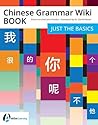
Chinese Grammar Wiki BOOK: Just the BasicsChinese Grammar Wiki BOOK: Just the Basics by John Pasden
My rating: 5 of 5 stars

Publisher Website

This is the first in a series of books that present the rules and structure of grammar for Mandarin Chinese along with examples. As the subtitle suggests, it covers only the rudiments of sentence structure as well as the most elementary ways of expressing existence, possession, location, number, and a few other basic grammatic functions, as well as teaching the reader how to count and express time and date.

The examples are all presented in characters, pinyin [w/ tone markers,] and the English translation. The explanations are straightforward, and the examples offer basic and useful sentences and phrases.

I found this book to be beneficial, and have obtained the next volume, which expands upon the basics. The book presents a simple and painless approach to Chinese grammar. I’d recommend this book for any fellow neophytes just learning Chinese.

View all my reviews

BOOKS: “Fluent Forever” by Gabriel Wyner

Fluent Forever: How to Learn Any Language Fast and Never Forget ItFluent Forever: How to Learn Any Language Fast and Never Forget It by Gabriel Wyner
My rating: 5 of 5 stars

Publisher’s Website

This is one of the most useful books I’ve read in some time. Wyner proposes a method to learn a new language that both removes some of the drudgery while improving retention. Anticipating the skepticism that I would have myself at this point: no, it is not one of those books that makes ridiculous and unfounded claims such as that you can learn a language entirely in your sleep or that you can develop native fluency in seven days. Instead, Wyner’s method is based on sound scientific ideas.

So, what does this method consist of? A few of the key points are: first, one doesn’t skip straight to basic conversational phrases as many books and courses do, but rather places great emphasis on learning how to hear and say the sounds of the target language. This phase is often given short shrift, presumably assuming that this skill will be picked up automatically in the process, but Wyner’s argument is that not being able to hear what’s correct or not great slows progress in the long run. Second, memorization tasks use the “spaced repetition system” (SRS) method whereby you increase the time between exposure to new knowledge as you learn it until it is firmly entrenched in one’s mind. Third, one seeks to build a more visceral connection to the new vocabulary and phrases, and this makes learning more fun while improving retention. This is principally done by making flash cards that tell a story relevant to one’s personal experience (and / or which uses subject matter such as sex [which tends to produce more indelibility of memories.])

Beyond the method presented by the book, one is also presented with a great number of resources that can be helpful. Some of these resources are a part of the author’s own website, but many are external resources (from Anki [an app that allows one to build flashcards and study them on a SRS schedule] to courses of the State Department’s Foreign Service Institute.)

I’ve started to learn Mandarin and have begun employing a number of ideas from this book. I would highly recommend the book for anyone who is interested in learning another language, no matter what said language might be. (This is a book of “how to” learn, not “what to” learn.)

View all my reviews

Five Wise Lines [June 2024]

The man who says to me, “Believe as I do, or God will damn thee,” will presently say, “Believe as I do, or I shall assassinate thee.”

Voltaire, in On superstition

The real voyage of discovery lies not in seeking new landscapes but in having new eyes.

Marcel proust

The translation of a poem having any depth ends by being one of two things: Either it is the expression of the translator, virtually a new poem, or it is as it were a photograph, as exact as possible, of one side of the statue.

Ezra pound

The people are of supreme importance to the ruler,
food is of supreme importance to the people.

Chinese adage

All translators face two choices: leave the reader in peace and drag the author closer, or leave the author in peace and drag the reader closer.

Friedrich schleiermacher (1768-1834)
[Referenced in Twenty-Nine GOODBYES, ed. by timothy billings]

BOOKS: “Chinese Folktales for Language Learners” by Vivian Ling and Peng Wang

Chinese Folktales for Language Learners: Famous Folk Stories in Chinese and English (Free online Audio Recordings)Chinese Folktales for Language Learners: Famous Folk Stories in Chinese and English by Vivian Ling
My rating: 5 of 5 stars

Publisher Website

As the title suggests, this is a collection of fifteen Chinese folktales presented bilingually in a manner optimized to language learners. To clarify the “optimized for language learners” comment, these stories are paced differently than they would be if the central objective was to entertain. That old writerly chestnut of “show don’t tell” is often violated and the stories are kept short and sweet in a way that can feel like they sprint through critical moments. This is not criticism. I think it is the best way to give individuals learning Mandarin (or presumably Mandarin speakers learning English) a user-friendly book that doesn’t feature dense blocks of text and overly complicated language. (Note: it’s also not bad for those who just want the quick and dirty version of these tales.)

Each of the stories includes a section with some background information on the history and cultural elements behind the stories (stories which display a range of realism and are from distant times,) a list of terms and phrases in English and Chinese, and a brief set of questions to help the reader develop deeper insight into the stories. These ancillary features are all quite useful to the student of language.

As stories, some of these folktales are more compelling than others. A number of them are dry, but what they lack in intrigue they make up for in insight into the history and culture of China. And some of the stories, e.g. “Judge Bao Takes on the Emperor’s Son-in-Law,” are fascinating.

I’d highly recommend this book for those who are trying to learn Mandarin, but it would also serve those who wish to learn some Chinese folklore in a condensed and readable format.

View all my reviews

Introduction to Spellcasting [Lyric Poem]

We cast our spells by way of words --
Each sound, sacred. Its magic blurred
By mundane ways and untrained ears --
Failure to feel one's way to tears.

So, we're lost upon silent seas
Even when one could hear with ease:
Because boundless is speech's spread,
And boundless, still, within one's head.

Some seek their way to the magic
By means that are truly tragic,
When all they really need to do
Is listen as it passes through.

PROMPT: Secret

What’s a secret skill or ability you have or wish you had?

This is a trick question that can only logically have one answer. It’s more of a logic / linguistic test than a prompt.

First of all, it can’t be a skill that one has, is secret, and that one blabs about on the internet.

So, the only “secret skill” that one could discuss wishing that one had on the worldwide web must be the ability to keep a secret.

Not really a problem area for me as, being a introvert, I’m pretty tight lipped by nature.

PROMPT: Ban

If you could permanently ban a word from general usage, which one would it be? Why?

I would ban the word ban because banning is not a thing that should exist. It is not an impulse one should have.

Five Wise Lines (Jan 2024)

Every so often I run into a sentence that blows my mind a little bit. Here are a few recent examples:

We may be in the universe as dogs and cats are in our libraries, seeing the books and hearing the conversation, but having no inkling of the meaning of it all.

William james

One must read ten thousand books and travel ten thousand miles to be an educated man.

Old chinese adage (As Translated by ha jin in The Banished Immortal)

Poetry is an echo asking a shadow to dance.

Carl Sandburg

Distrust of grammar is the first requisite of philosophizing.

Ludwig wittgenstein

He who knows only his own side of the case knows little of that.

John stuart mill

BOOKS: “36 Ways of Writing a Vietnamese Poem” by Nam Le

36 Ways of Writing a Vietnamese Poem36 Ways of Writing a Vietnamese Poem by Nam Le
My rating: 4 of 5 stars

Amazon.in Page

Release Date: March 5, 2024

This is a clever collection of poems, lighthearted in places but raw and incensed in others. (A pacing that I appreciate in poetry collections.) The collection draws heavily on the author’s experience being of Vietnamese ethnicity while growing up in the West. It touches upon the tragedies lived by his elders, but, more so, how his life (and perception of him) has been shaped by war and the diaspora it caused. The collection playfully engages with language and cultural concepts in a way that is interesting and – at times – scintillating.

My main gripe with this collection would be its occasional swerves into the domain of huge, rare, and super-specialized terminology. I enjoy being sent to the dictionary as much as the next person, but in a poetry collection – where evoking emotion is the name of the game – I find it takes me out of the experience.

I enjoyed reading this collection and would recommend it for poetry readers.

View all my reviews

BOOKS: Everyday Shakespeare by Ben & David Crystal

Everyday Shakespeare: Lines for LifeEveryday Shakespeare: Lines for Life by Ben Crystal
My rating: 4 of 5 stars

Amazon.in Page

This is like a word-a-day calendar, but with a quotation from Shakespeare for each day (rather than a vocabulary word.) Also, each quote has accompanying text that explains what the quote is from, what it means, why the language says what it does, and the context in which an individual might use Shakespeare’s words today. [Note: while that last bit (i.e. how to employ the Bard’s words today) is a major theme of the book, I wouldn’t recommend it. It will make one look more like a pretentious nincompoop than like a clever wordsmith.] That said, the book still has great value for anyone interested in Shakespeare’s work, specifically, or the evolution of the English language, more generally. In dealing with many phrases that describe workaday activities that were common then as now, the book builds a niche different from books that deal in the grandiose phraseology of war and aristocratic life.

Many people struggle with Shakespeare, and this book helps make clear why some of the statements that were about mundane matters had the meaning they did. I would put people’s difficulties with Shakespeare into three buckets. First, poetic and non-colloquial language in which the reader knows all the words and their meanings, but the poetic / stylistic language and grammar throws them for a loop. This book shouldn’t really need to deal with this one, but it does a little bit. Second, evolutionary language drift, in this case the reader knows the words but is thrown off because they don’t mean what they once did. The book is quite helpful in clarifying these changes. Third, the revolutionary shifts, these involve words and phrases wholly unfamiliar to the reader because they deal in activities and perspectives not present in our daily lives. The book explains these changes, as well, but there aren’t a great deal of them because the selections are supposed to be applicable today.

The book draws from the entire Shakespeare canon, but more heavily from the plays than from the sonnets or long form poems. (Also, not surprisingly, it draws more heavily from the popular plays — i.e. many of the tragedies and the popular comedies — than it does from the more obscure plays (i.e. most histories and a few of the others.) This only makes sense, and I was happy to see references to sonnets, histories, and other Shakespearean poems at all.

All in all, this is an informative book and is recommended for those who are interested in getting into Shakespeare, or who are intrigued by the ever-shifting landscape of the English language.

View all my reviews