BOOKS: “Robert Frost: Sixteen Poems to Learn by Heart” ed. by Jay Parini

Robert Frost: Sixteen Poems to Learn by HeartRobert Frost: Sixteen Poems to Learn by Heart by Robert Frost
My rating: 5 of 5 stars

Amazon.in Page

Release Date: March 12, 2024

This book presents sixteen of Frost’s poems, each with a commentary on the poem, how events in Frost’s life influenced said poem, and assorted background details. It includes the “greatest hits” (e.g. “Mending Wall,” “The Road Not Taken,” “Fire and Ice,” and “Stopping by Woods on a Snowy Evening,”) a few of Frost’s more obscure works, and a number that are in-between in status.

I found the commentaries to be interesting and readable, which is important as Frost’s poems are now in the public domain, and so the value of this volume hinges on Parini’s work. Parini includes some stories that offer insight into Frost’s mindset, as with the story of the lady who approached him after a reading to ask the meaning of “Fire and Ice.” Reading Frost isn’t like reading, say, Allen Ginsberg, the latter being one who put it all out there – unabashedly, Frost’s poetry is more guarded and deals more in nuanced metaphor. This makes a volume like this useful if it can offer any insight into the poet’s mindset, which I think Parini does.

I considered reading this book to be an opportunity to learn more about the poems and poet, and – therefore – did not heavily weight the stated theme of presenting poems that should be rote memorized. I mention this because I suspect Parini had other criteria in mind as well. While the book does include poems that are easily memorized (e.g. “Fire and Ice” and “Stopping by Woods on a Snowy Evening”) as well as poems that have messages worth learning by heart (e.g. “Mending Wall” and “The Road Not Taken,”) it also includes poems that aren’t so memorable because they are long, not especially lyrical, or not particularly filled with stand-out ideas or vivid imagery (e.g. “Directive,” “The Wood Pile,” and “Birches.”) This also begs the question, why one wouldn’t include a poem like “Nothing Gold Can Stay,” which is short, lyrical, and has an easily grasped message (i.e. easily memorized.)

As for ancillary matter, there is an appendix that offers tips for memorizing poems as well as a short “recommended reading” bibliography.

That said, I enjoyed reading this book; I got a lot out of Parini’s commentary, and I would recommend the book for poetry readers.

View all my reviews

BOOKS: Kingdom of Fear by Hunter S. Thompson

Kingdom of Fear: Loathsome Secrets of a Star-crossed Child in the Final Days of the American CenturyKingdom of Fear: Loathsome Secrets of a Star-crossed Child in the Final Days of the American Century by Hunter S Thompson
My rating: 5 of 5 stars

Amazon.in Page

Kingdom of Fear is part memoir and part commentary on the state of America at the turn of the millennium. As a memoir, it explores Thompson’s bid for Sheriff, his arrest and judicial proceedings for drug and explosives charges that resulted from a “he said / she said” accusation that did not warrant charges in and of itself, a wild and wooly road-trip through Nevada, and Thompson’s position at the center of an investigation of a “threat” on the life of actor, Jack Nicholson.

As a commentary on the decline of America it discusses the battle for Grenada, a trip to Cuba, 9-11 and its aftermath, and the book revisits the ’68 Democratic Convention. It’s all written in Thompson’s drug-fueled Gonzo style, making it incredibly entertaining to read even as the hard walls between fact and fiction seem to dissolve. While the factualness might be at times in question, there is always a kind of truth that can only be received from those who’ve tossed off the shackles of societal convention and are willing to tell it as it is — even the embarrassing bits (especially the embarrassing bits.)

It’s not for those who take life and authority figures too seriously, but otherwise it’s a tremendously compelling and sometimes hilarious in its depiction of pre- and post-Y2K America.

View all my reviews

BOOK REVIEW: Singing and Dancing Are the Voice of the Law by Busshō Lahn

Singing and Dancing Are the Voice of the Law: A Commentary on Hakuin's “Song of Zazen”Singing and Dancing Are the Voice of the Law: A Commentary on Hakuin’s “Song of Zazen” by Bussho Lahn
My rating: 5 of 5 stars

Amazon.in Page

Release Date: December 20, 2022 [In India, may be out in your area.]

This book consists of a collection of essays inspired by the poem, “Song of Zazen,” written by the 18th century Zen master, Hakuin. Hakuin’s poem is brief (about forty lines,) and the essays composed by a present-day Zen priest (Lahn) offer commentary on a stanza-by-stanza basis. The book is divided into fourteen chapters, though the final chapter isn’t a stanza commentary.

I enjoyed reading this book and learned a great deal from it. The book benefits from the fact that the author is not rigidly sectarian. Therefore, the book is not doctrinaire, which warms the reader to the teachings. It’s also useful because it allowed the author to freely draw examples and quotes from a variety of sources, some of which may be more familiar or relatable to neophyte readers.

The last chapter offers a discussion of the fundamentals of zazen (seated meditation) as well as some other ancillary information that may be useful to readers new to Zen Buddhism, its practices, and its sutras. If you’re interested in Zen Buddhist meditation and philosophy, you may want to give it a look.


View all my reviews

The Internet [Verse in Tetrameter]

We've reached the place where screams aren't heard.
You'd think they'd build into a din,
but one can't grasp a single word.
It has become silent as sin.

The angry words are shot to black -
that inky void that's unpatrolled,
It's silent, yet all're struck by flak.
Still, no one admits being sold.

But each life 's a product consumed.
They wail away the night and day,
pretending they're not rightly doomed.
Some will say that it's here to stay...

True, but are we?

TODAY’S RANDOM THOUGHT: Hitler’s Final Victory

Source: German Federal Archives

Source: German Federal Archives

Hitler killed the short-stache (a.k.a. the “toothbrush mustache.”) Imagine that, almost 70 years after his death, he still holds power over people’s decisions about facial hair.

This is a misplaced take-away lesson. It’s the unbridled narcissism, the icy hatred, and the irrational exuberance in the power of evil of Hitler that should be abandoned (yet, somehow, those intangibles still quietly exist.) It’s not the superficial aspects of Hitler that should be shunned, but the ones at the bastard’s core.

I’m not saying the toothbrush-stache was a good look. On the contrary–as one who has had a mustache his entire adult life and has worn a beard now for several years–I’m a little offended by the lack of commitment to one’s choice of facial hair that the toothbrush-stache represents. (Incidentally, I feel the same about the sole patch and mutton chops.) In my mind, one should go full-stache or go home to shave.

Still, there being no accounting for taste, I think those individuals who would otherwise find the short-stache appealing (i.e. you know, indecisive types who wear culottes and eat with sporks) should revive the toothbrush mustache as a big fuck-you to Hitler–don’t let tyrants boss you around from the grave.

Toothbrush mustache admirers of world, unite!  (No, I won’t be joining you.)

First World Problems Are So Adorable


How deep is it? No one knows.

How deep is it? No one knows.

In the interest of enhancing global understanding and camaraderie, I’ve built a translator of common first world (FW) problems–putting them in terms of their Rest of the World (RoW) equivalents.

FW: This food needs salt.
RoW: This food needs food.

FW: My health insurance premiums went up $20 per month.
RoW: My right foot, which recently turned from purple to black, just fell off.

FW: My car is in the shop again.
RoW: My right foot, which recently turned from purple to black, just fell off.

FW: It’s raining again today.
RoW: My house was washed off its foundations and is currently floating down the Brahmaputra River.

FW: Looks like those devils from the other party got a majority in the legislature.
RoW: This coup was particularly bloody.

FW: Squirrels are getting into my bird feeder.
RoW: A tiger ate my family.

FW: A traffic jam made me late for Pilates class.
RoW: While limping through the Kyber Pass to get antibiotics for my right stump, I was socked in by an unanticipated blizzard.

FW: My GPS says this road cuts under the interstate, but now I’ve got to go around.
RoW: What’s GPS?

Rat’s Ass ≠ Flying Fuck

I get that nobody cares about the backside of a rodent. It’s clearly the toothy, gnawing front end that’s on people’s minds. So how is a “rat’s ass” synonymous with “flying fuck?” This isn’t a rhetorical question, people. I’d really like an answer.

So the fact that it’s preceded by “Who gives a…” makes me assume that a “flying fuck” isn’t anything that anyone much cares about. It’s like a rat’s ass, a goat’s gonads, or politician’s promise–no one cares. But wait. It seems to me that a flying fuck would be something that all parties concerned would take great interest in. Alright, I’m not  hip to all the maneuvers of the Kama Sutra, but I imagine  a flying fuck to be when a man with a woody gets a running start,  leaps up in the air in a horizontal configuration, and comes down so as to impale his partner’s lady bits. That’s like throwing a javelin to land a whole-in-one in the cup on the green of the 9th hole.

Is this a flying fuck?

Is this a flying fuck?

Even if I was a thrill-seeker, unconcerned about the threat of a sprained penis (it’s a real thing, look it up), I think my wife would care enough to be firmly opposed. If people weren’t scared of the flying fuck, it’d be all the rage.

Alright, let’s assume I’ve misinterpreted the term. Let’s say that a “flying fuck” really refers to being a member of the Mile High Club. Everybody cares about that. The man wants to celebrate it. The woman doesn’t want to be caught in a slutwalk of shame back to her seat. You can be damn sure the guy who’s locked out of the lavatory after having eaten a vending machine tuna salad sandwich from Concourse B cares greatly. Everybody cares about the flying fuck.

I can’t even imagine what else a flying fuck could be, but whatever it is I have trouble believing that nobody cares.

It can’t just be the alliteration.  Acrobat’s accountant, billionaire’s bunion, crooner’s cookie-jar, etc… are all alliterations that we care less about than a flying fuck.

So if you can shed some light, I’d be happy to hear an explanation. I do, truly, give a flying fuck.

The Deferential Calculus of Being an American in India

Every time I come home, the security man at the desk at our apartment building jumps to his feet and proceeds to stand at attention until I pass. This makes me uncomfortable, as do the many other ingrained acts of deference that occasionally border on obsequiousness. I’ve considered stopping to tell him he can be permanently “at ease” with me, but given the language barrier I’m afraid I’d just confuse the issue–plus have him standing at attention that much more longer. So, when in Rome…

If you’re an American, but not, say… General Pershing, you’d probably find this makes you uneasy as well. I think one of the reasons that Americans have historically excelled at technological development  is that we were in a hurry to have machines do our laundry, wash our dishes, or trim our nose hairs so that we wouldn’t have to have some other human apparently kowtowing to us. (This may be why the 19th century North was considerably more technologically advanced than its Southern counterpart, which had successfully rationalized a subclass of human being.)

There’s a guy who stands at the end of the lane and lifts a swing arm up and down every time a car (or, oddly, a pedestrian such as myself) comes down the lane. The first couple times I walked around the end in hopes of indicating to him that, “Hey, see you don’t really need to swing that thing up, I can just walk right around it, easy as pie.” I think I hurt his feelings, or–perhaps worse–undermined his reason for getting up in the morning. My point is that operating a swing-arm barrier is a perfect example of the type of job that has been completely mechanized in America.

I’m sure that cultural differences are the root of my discomfort. India is coming from the caste system, whereby who you were born to determined your status in a rigidly hierarchical structure. While Indians may have dropped the caste system, the underlying thought process dies hard. I, on the other hand, come from a culture which believes that on a fundamental level we are all equal. Americans are often stymied as to why we are viewed as being arrogant by other cultures. This may be a failure to see things in the same light. It’s not so much that we project that we are better than the average Joe, it’s that we don’t accept that the kings and holy men those cultures hold dear are above us. This is true. I don’t think I’m better than the door man, but I also don’t think the King of [Fill in the blank] is better than me. [OK, the perception of arrogance is also partly that we’re loud and expect a ubiquity of comfort that is simply not available in much of the world. There is that. And the fact that our leaders often think they can fix every problem everywhere, and–given this is not actually true–we have left a lot of chaos in the our wake since our rise to hegemony.]

So the whole culture thing is part of it. However, I also worry that the man who brings my food with a warm smile and a bow is spitting in it. I wonder if the lady who launders my clothes, and then goes the extra mile by ironing them (though they mostly consist of T-shirts and jeans), might be preparing an itching powder attack. I wonder if the security guy standing at attention is just waiting for me to lock myself out of my apartment so that he can exercise some passive aggressive payback. [I suspect this is why Indian bureaucracy is notoriously slow and prickly. It’s a desire to exercise the leg up on has while one is in other ways part of an underclass.] I heard a comedienne of Indian origin say that her mother always flew British Airways just for the delight of bossing a Brit around. All of this consternation is because I worry that they think that I think I’m superior to them, which I don’t.

Yesterday I was eating at an Indian fast food joint called Kaati Zone. It’s one of those places that you order at the counter, get your food at the counter, and take it to one’s table. (FYI- this set up is much less common here except for little holes in the wall where one stands to eat.) When I was done, I pitched my trash in the trash can and put my tray on top, just like one would at a Wendy’s. When I turned around there was a young woman with her jaw agape and eyes wide looking right at me. My first thought was that I had pitched my wallet or my journal in the trash. I did a pat down and found I was alright. As I left, it dawned on me that her surprise may have had something to do with my handling of my own garbage.

DAILY PHOTO: Mustache Machismo

Taken September 5, 2013

Taken September 5, 2013

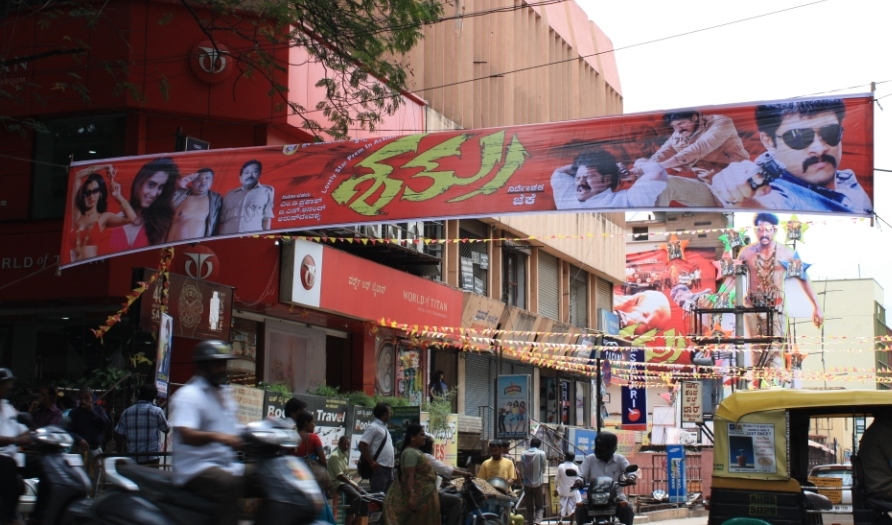
India is the last bastion of the luxuriant mustache as a font of machismo. While the thick, droopy stache may have fallen out of favor with male porn stars and deep South State Troopers, it remains emblematic in Bollywood.

One day, when the Freddie Mercury mustache returns to its former glory, Indian men will be able to hold their heads high, certain in the knowledge that they never abandoned the stache.

It should be noted that the power of the stache goes way back here. On the elaborately towering Hindu temples, one will see such figures. I have yet to learn which deity sports the stache (often along with a pot belly,) but it’s not Ron Jeremy–that much I know for certain.

Lies My Tuk-Tuk Driver Told Me

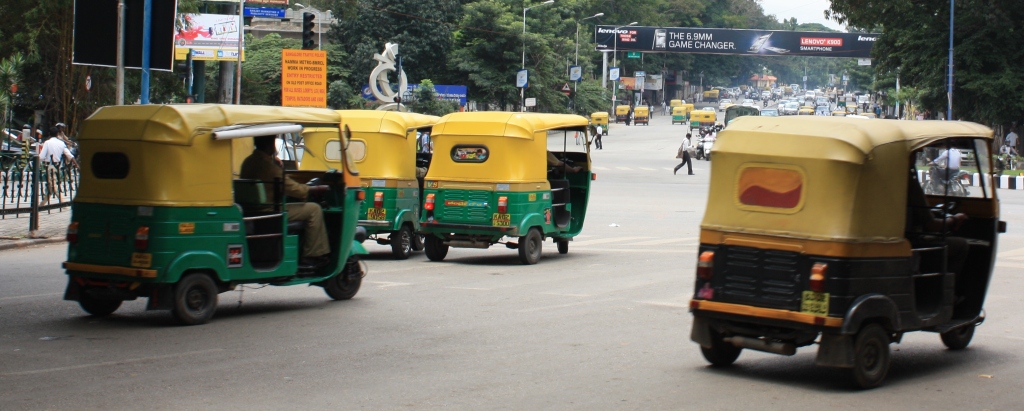
Taken Sept 5, 2013 in Bangalore, India

Taken Sept 5, 2013 in Bangalore, India

Tuk-tuks or Autorickshaws  are the ubiquitous three-wheeled vehicles-for-hire seen throughout South and Southeast Asia. (Note: Owing to their evolution from walking or pedal rickshaws, they’re sometimes just called “rickshaw” for short, or even “pedicab” or “petty cab”–the latter likely a corruption of the former.) They’re an essential way to get around in the big cities of Mega-Asia, but almost everyone has a bad experience with one at some point.

Let me point out that I’m not suggesting that most tuk-tuk drivers are amoral liars, but as a tourist (or someone who looks like one) the drivers that approach you probably will be. The vast majority of drivers are honest, hard-working men (and the elusive woman) just trying to put food on the table. That’s why my key advice to people on the subject is, “Pick your driver, and don’t ride with the ones who pick you. Then always negotiate your fare–or make sure they will use the meter– before you get in.” The drivers who pick you often have rationalized that it’s alright to treat foreigners like crap. And I’m not so much talking about charging you a little more money (which I personally don’t mind), but more that it’s alright to waste your time or take you places you didn’t ask to go [and potentially much worse.]

Well, without further ado, I’ll share some of my interactions with drivers. This is inspired by a whooper I was told yesterday.

1.) Driver: “The Temple is closed.”
Me: “But there’s a line of Caucasians and Japanese people with cameras going into the place right this moment. I can see them as we speak.”
Driver: “Uhh, monks and nuns.”

2.) Driver: “That road closed. Big protests. Throwing stones. Very dangerous!”
Me: “But I can see all the way to the corner where we need to turn, there’s nobody there.”
Driver: “They hide. [Pantomiming popping up over a wall] Throw rocks.”

3.) Driver: “Meter[ed fare is] 200 Rupee, but I’ll take– only 150 Rupee.”
Me: “I just took a trip yesterday that was 50% farther and took twice as long, and the metered fare was 50 Rupee.”

4.) Driver: “But traffic very bad, VERY BAD. Premium rate time.”
Me: “But it’s Sunday morning at 8:00am. I haven’t heard a horn for half an hour, and I happen to know that there’s no such thing as ‘premium rate time.'”
Driver: “It’s new.”

5.) Driver: “You can’t get from here to there, except go past travel office.”
Me: “Sure you can. It’s one block over and then a straight shot of five kilometers. The travel office is four kilometers out-of-the-way.”
Driver: See lie #2