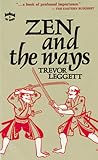
BOOKS: “Zen and the Ways” by Trevor Leggett

Zen and the WaysZen and the Ways by Trevor Leggett
My rating: 5 of 5 stars

Open Library Page

This book is the most densely populated with interesting insights that I’ve read in some time. It’s not new, being first published in 1978, but it takes a variety of approaches to give the reader a better understanding of Zen and the application of Zen mind to martial arts and other activities that found benefit in stillness and clarity. By “the Ways,” Leggett is referring to those arts and activities benefiting from Zen, which include: tea ceremony, flower arranging, painting, poetry writing, and all manner of martial arts. [Often represented by ending “do” in Japanese.] (The latter are dealt with most extensively, but not exclusively.)

The book is arranged in six parts, the first half of which focus mostly upon Zen Buddhism and, particularly, the Kamakura school that found a huge following among warriors and other artists. Those first three chapters take a big to small approach, examining Zen from ever finer levels of detail, starting with an introduction to Zen Buddhism broadly, moving on to the Kamakura developments, and then finally focusing on one particular practice — that of Koans (stories that present riddles which the student can only “solve” in a non-intellectual fashion.)

The second half of the book investigates the ways Zen has been applied to various arts. This is where one sees the varied approaches used to explore the confluence of Zen and artistry. Part Four consists of a series of essays explaining concepts such as ri (universal truth) and ji (formal technique,) ki (vital energy,) and isshin (single-heartedness) / zanshin (lingering awareness.) Part Five consists of historic martial arts scrolls and excerpts, including Yagyu Munenori’s Art of War and Chozan Shisai’s “Tengu’s Guide to the Martial Arts.” The final part consists of stories that illustrate crucial ideas in a readable and memorable fashion.

I was extremely pleased to stumble across a copy of this book in a second-hand bookshop. I’d long ago heard a fascinating story about murders in Edo era Japan of high-level martial artists, all killed in the same manner. They never found the killer, but they figured out how the murders were done easily enough. The killer exploited his knowledge of that school’s techniques to lay a fake that exploited their own technique to create an opening. It’s a cautionary tale that drilling muscle memory is not the end-all be-all of martial arts, and that it can create its own problems. At any rate, I’d never been able to find the source… until now. There is a detailed discussion of it in this book.

For readers interested in how state of mind influences artistic performance, I’d highly recommend this book.

View all my reviews

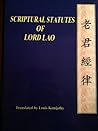
BOOKS: “Handbooks for Daoist Practice: Scriptural Statutes of Lord Lao” by Louis Komjathy [and Lord Lao]

Handbooks for Daoist Practice: Scriptural Statutes of Lord LaoHandbooks for Daoist Practice: Scriptural Statutes of Lord Lao by Louis Komjathy
My rating: 5 of 5 stars

Author Site

This paper presents exposition on, and translation of, an important Taoist work. Like many collections of sutras and other epigrams of wisdom, the “Scriptural Statutes of Lord Lao” are only a couple pages of sayings. To be more specific, they consist of nine practices (九行) and twenty-seven moral precepts. The bulk of the twenty-five-ish pages of this work are a scholarly background on the nine practices and twenty-seven precepts, plus back matter including references and the original (Chinese) “statutes.”

I read this because the nine practices seem like a concise statement of what it means to be Taoist (a topic that can be tremendously complicated given the varied sects, beliefs, and practices that all fall under the heading of “Taoist” — some religious, some philosophical, and some mystical.) Those nine practices are: non-action (which is much more complicated than just sitting on one’s bum,) softness, guarding the feminine, namelessness, stillness, adeptness, desirelessness, contentment, and knowing how and when to yield. The text offers some insight into where these practices come from (e.g. the points in the Dao De Jing that reverence them,) but the scope of the work is far to limited to gain a deep understanding of them (for that one will have to go elsewhere.)

I found reading this short work to be quite beneficial and insightful, despite its thin profile. I’m glad it includes the original text as well as provides citations, as therein much of its value lies.

View all my reviews

PROMPT: Athletes

Daily writing prompt
Name the professional athletes you respect the most and why.

I generally leave admiration for professional athletes to others, as I feel — like other entertainment celebrities — they get an unhealthy level of adoration as it is.

That said, I have been impressed by grappler Mikey Musumeci for the intensity of his training regime and for finding his own way.

PROMPT: Fears

Daily writing prompt
What fears have you overcome and how?

For example: being punched in the face and swimming in open waters.

As for how, to my knowledge there’s only one way to overcome any fear and that’s exposure to the fearful stimulus. e.g. One loses (at least greatly reduces) fear of being hit by sparring.

BOOKS: “Water Margin” by Shi Nai’an

Outlaws of the marsh (the Water Margin)Outlaws of the marsh by Shi Nai’an
My rating: 5 of 5 stars

Amazon.in Page

Water Margin is one of the four classic Chinese novels. The English language translations of the novel go by many names, but in Chinese it’s called Shui Hu Zhuan (i.e. 水滸傳.) The book tells a tale of war and brotherhood in a world in which a person’s virtue and his station in life are often topsy-turvy. It’s one of the most engaging pieces of fiction I’ve read in some time. While it’s a sprawling epic (close to a thousand pages in the unabridged translation,) it draws the reader in and keeps one reading by way of clever plotting and intense intrigues.

The story revolves around 108 individuals of varied checkered pasts who end up together as a band of outlaws in the Liangshan Marsh (hence, one of the most common translated titles is “Outlaws of the Marsh.”) Under the leadership of an exceptionally virtuous and beloved leader, Song Jiang, these outlaws are united into, first, a band of outlaws and, later, (having been pardoned by the emperor) as an incomparable military force that quells threats to the nation.

About the first half of the book consists of the individual stories of the most central of the 108 outlaw chieftains. The next quarter of the book describes their time together as outlaws and, particularly, how they repeatedly defeated government attempts to crush their band. The final quarter of the book is about the band’s Imperial service: first in defeating Tartar invaders from the North and then in crushing a kingdom that arose in the south by uprising of a self-declared king.

If the reader is thinking that 108 primary characters is too many to contend with, I would say that: a.) there are a small set of characters that are so substantially discussed and developed that you’ll be able to always keep them straight; b.) not all of the 108 are crucial to keep straight to follow the flow of the story, but c.) yes, it is not easy to keep them all straight — particularly for a non-Chinese reader who will find a number of the names quite similar (e.g. Wu Yong and Wu Song.)

I should note that the book can be extremely visceral, too much so for some readers. This intensity largely has to do with the stories involving one of the chieftains, Li Kui. Li Kui is the worst. He has a horrific temper, a blood lust, is completely out of control, and almost always turns anything he touches into a bloody mess. His only saving grace is that he recognizes in Song Jiang’s virtue something that must be followed, such that he does his level best to do anything Song Jiang tells him to and (often more importantly) not do whatever he is told not to do. Many readers will hate Li Kui, finding him completely despicable. However, there is a good chance that thinking about why Li Kui is kept around and tolerated after constantly fouling things up will be a productive thought exercise for those who can get through the gore. One may want to consider that question in relationship to the fascinating fact that Song Jiang, the undisputed leader who all the men insist take the position of head chieftain, is the only member of the band who has no kung fu. The other 107 chieftains are all martial arts masters-extraordinaire, most with specialties in particular weapons or tactics.

I won’t say there aren’t clunky plot devices and repetitive elements, but they didn’t bother me much for a few of reasons. Firstly, this novel is from the fourteenth century, and — given that — the readability and emotional resonance of the book is phenomenal. Secondly, I have no way of knowing how much the cheapening plot devices are a product of the original versus of the translation. Finally, those elements are more than made up for by skilled story crafting.

I’d highly recommend this book for all readers who can feasibly get through an 850-page novel with hundreds of characters. Martial artists and travelers may find it of particular value.


View all my reviews

PROMPT: Teacher

Daily writing prompt
Who was your most influential teacher? Why?

By the measure of having taught still useful lessons about HOW to think (those who taught me WHAT to think are largely forgotten along with their lessons,) that would be a tie between my 11th grade Psychology teacher and an undergrad Religious Studies professor. The former, among other ideas, first exposed me to what I would come to believe is the most important lesson of human existence under his label of the “gestalt of expectations.” [I’ve never heard anyone else refer to it as such, but the lesson was sound and I would latter find it in philosophies from Buddhism to Stoicism.] The latter teacher, among other ideas, exposed me to two common opposing modes of fallacious thinking, what he called “the outhouse fallacy” and “the first-est is best-est fallacy” (he was a folksy, if erudite, professor.)

In terms of personal growth and development, generally speaking, there are numerous teachers of martial arts, yoga, and other mind-body practices that are incomparable and thus unrankable. Not to mention, a sound argument can made for the repugnantly unhumble statement that I am my most influential (and most important) teacher. (I state this claim not as though I am unique, but as one that could apply to anyone.)

Five Wise Lines (March 2024)

We are pattern seekers, believers in a coherent world, in which regularities appear not by accident but as a result of mechanical causality or someone’s intention.

Daniel kahneman; Thinking, Fast and slow

If you win, do not boast of your victory; if you lose, do not be discouraged. When it is safe, do not become careless; when it is dangerous, do not fear. Simply continue down the path ahead.

Kanō Jigorō; Founder of Jūdō

A writer makes new life in the void, knocks on silence to make a sound, binds space and time on a sheet of silk and pours out a river from an inch-sized heart.

Lu Ji; Wen Fu (261 – 303)

The worst kind of Virtue never stops striving for Virtue, and so never achieves Virtue.

Laozi

Moonlight floods the whole sky from horizon to horizon. // How much it can fill your room depends on its windows.

Rumi

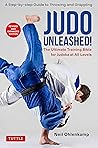
BOOKS: “Judo Unleashed!” by Neil Ohlenkamp

Judo Unleashed!: The Ultimate Training Bible for Judoka at All Levels (Revised and Expanded Edition)Judo Unleashed!: The Ultimate Training Bible for Judoka at All Levels by Neil Ohlenkamp
My rating: 5 of 5 stars

Amazon.in Page

Release Date: July 9, 2024

This is a new and revised edition of a book that has been on the market for many years. It provides an overview of the sport and martial art of judo, with particular emphasis on the competitive version of the art. It does discuss the self-defense philosophy and approach of judo in broad brushstrokes, but the techniques that are discussed (and shown) individually are the competition-legal ones. The book does take a no-nonsense approach and focuses on a straight-forward delivery of the most crucial information for a general reader.

The book’s organization is as one would expect of a martial arts guide: an introductory overview, a detailed breakdown of the techniques by type (i.e. throwing, grappling, groundwork,) and a brief closing (i.e. “where do we go from here”) section. Among the book’s useful features is that Ohlenkamp often tells the reader which judoka were particularly noted for their adeptness with a given technique as he presents said technique. This gives the reader wanting a little more insight the opportunity to do some internet research for video clips of that particular judoka doing the technique in question.

The book has a large number of color photos that are clear and present the gist of each technique in mid-action. It also has extensive appendices discussing rules and the formally accepted techniques of Kodokan Judo.

I found this book useful and would recommend it for those interested in judo, whether as a potential student or to compare and contrast it with other grappling sports / martial arts.

View all my reviews

True Balance [Senryū]

standing on one leg,
steadfast while squirrels mistake
 one for a tree.

Riverly Staff [Free Verse]

Simplicity.

It flows.
 It crashes.

It employs only
 as much effort as
  conditions dictate.

It does not rush
 in a panic.

While straight,
 its movements seem
  whip-like.

When possible,
 it moves straight,

But it rolls around or over
 any obstacle.

If follows the course,
 but also carves
  the course.

Its movement, inexorable.