BOOKS: The Shaolin Workout by Shi Yan Ming

The Shaolin Workout: 28 Days to Transforming Your Body and Soul the Warrior's WayThe Shaolin Workout: 28 Days to Transforming Your Body and Soul the Warrior’s Way by Yan Ming
My rating: 4 of 5 stars

Amazon.in Page

This book presents an exercise regimen based on Shaolin Kung fu as taught by a prominent New York City martial arts teacher. The book moves from gentle joint articulations suitable for anyone through to movements that require some degree of flexibility and athleticism. The sequence is presented in such a way as to build on itself, adding a bit more each time until one is doing the entire sequence.

Interspersed with the descriptions of the physical exercises are meditations, mostly of a contemplative nature. The illustrations are color pictures and provide the sequences of movement, though the textual descriptions will be necessary in many cases to clarify the transitional movements. There are a number of full-page color plates that are very well shot, though mostly for aesthetic (versus educational) purposes.

The book is probably the most pep-talk laden book I’ve ever read. That said, there’s not much discussion of modifications or capacity building for individuals who are incapable of doing the full expression of the techniques.

The practices often reminded me more of yoga than of martial arts. There are many deep stretches and low positions, e.g. similar to Warrior I (Virabhadra I.) It’s true that there are punch and kick movements, but they are done in more of a range-of-motion building way than as one would in combative arts.

It is an interesting set of movements, and I’d recommend it for those who like to work with unconventional workouts and movement systems.

View all my reviews

PROMPT: Physical Exercise

What is your favorite form of physical exercise?

I play no favorites. I love calisthenics, yogasana, running, swimming, functional movement, movement drills (e.g. martial arts,) etc.

I do have least favorites though, and – collectively – those are exercises where I have to go somewhere in particular to have access to some specialized equipment. So, for example, I don’t care for weight lifting or using ellipticals or climbers, etc. (I still enjoy the exercise well enough, but it’s more hassle than it needs to be.)

My whole equipment inventory consists of a yoga mat, a pull-up / dip apparatus, and a few resistance bands, and I can make do without those quite nicely — e.g. when traveling.

PROMPT: Well-Being

Daily writing prompt
What strategies do you use to maintain your health and well-being?

Diet: high fiber / low junk

Movement: frequent and varied (includes: yoga, calisthenics, running, swimming, and functional movement)

Mental: breathwork, yogic dispassionate witnessing, and gratitude awareness

Rest: Build in regular and redundant rest throughout the living process

PROMPT: Comfort

What strategies do you use to increase comfort in your daily life?

I don’t, but I have a lot of strategies for being more content in the face of various situations and environments — including uncomfortable ones. These include the yogic practice of dispassionate witnessing, minimalism, travel (and specifically minimalist travel to places – the less familiar the better,) and intense physical activity.

I think comfort as a major objective in life is overrated, and virtually insures a discontented life. A life in which one can be content, whatever may come along, is a happy life.
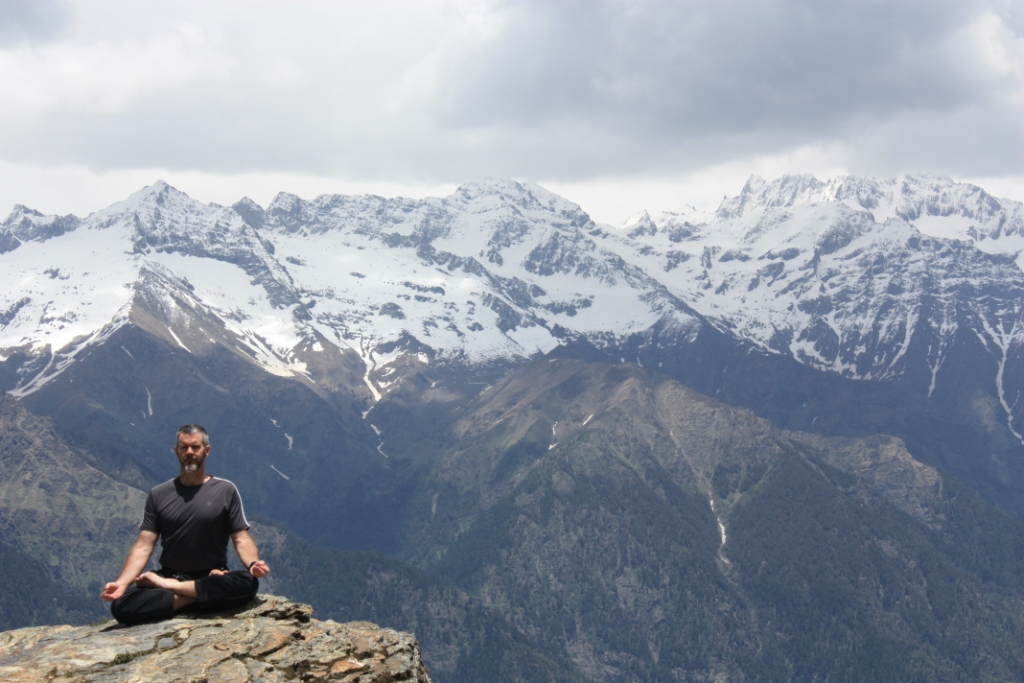
Kevala [Free Verse]

breath ceases
and the body is quiet
and the mind is calm

and there is nothing
no world
no throngs
no hordes
no disasters

breath returns
&
so does the world

BOOK REVIEW: The Stories Behind the Poses by Raj Balkaran

The Stories Behind the Poses: The Indian mythology that inspired 50 yoga posturesThe Stories Behind the Poses: The Indian mythology that inspired 50 yoga postures by Raj Balkaran
My rating: 4 of 5 stars

Amazon.in Page

Released: July 26, 2022

Yoga practitioners will be aware that — while some posture names are banal, straightforward descriptions (e.g. Utthita Hasta Padangusthasana, or “standing hand-to-big toe pose –”) many others invoke animals, sages, or deities for historical, mythological, or symbolic reasons. As this book’s title suggests, it presents the mythological backstories for fifty yoga postures. The vast majority of these fifty poses are common ones that will be readily familiar to most Hatha Yoga practitioners, though a few are advanced or obscure and aren’t likely to come up in your run-of-the-mill studio class. (And a couple may be familiar to some individuals by another name.)

The book is cleanly organized with five sections (Shiva poses, Vishnu poses, Devi / goddess poses, God story poses, and sage poses) each containing writeups for ten poses. Each pose is presented via colorful artwork in the Indian style (typically with the deity or sage in question performing the posture.)

I found the entries to be well-written and clear (Hindu Mythology can be extremely complicated and some authors get lost in the weeds by including too much minutiae or unnecessary details, but that wasn’t the case here.) The full-page artistic renderings of the poses are also clear and tidy, such that anyone familiar with the pose should readily recognize it.

The one thing I think could have been done better (though probably not without messing up the aforementioned clean organizational scheme) would be to cut some of the redundancy in the stories. In a few instances, the same story appeared in multiple chapters. To the author’s credit, these weren’t just copy / pasted, they were written uniquely, sometimes with additional information or a different focus. Still, it was a bit distracting to find myself in the middle of the same story and wondering whether I’d zoned out or lost my place. This might have been dealt with by putting multiple poses with one story and not repeating the tale one or more times. For example, the stories about Vasisthasana and Visvametrasana are inherently coupled, and the poses might be as well. (Perhaps even referencing the fact that the story had already been told might have been helpful and less distracting.)

All-in-all, I thought this book did a fine job of presenting the myths and relating them to the postures. I learned a great deal from reading the book and would recommend it for yoga practitioners and those interested in Hindu Mythology.


View all my reviews

BOOK REVIEW: The Physiology of Yoga by Andrew McGonigle & Matthew Huy

The Physiology of YogaThe Physiology of Yoga by Andrew McGonigle
My rating: 5 of 5 stars

Amazon.in Page

This is a much-needed book for two reasons. First, while there are a number of fine books on anatomy as it applies to yoga, such books focus on the musculoskeletal system, occasionally venturing into the respiratory system – re: pranayama (breathwork.) However, yoga anatomy books rarely giving an overview of the workings of the body as a whole or describe how yoga influences and is influenced by other bodily systems. This book systematically reviews not only the muscles, bones, and lungs, but offers insight into the less familiar systems, such as the lymphatic, immune, and endocrine systems. Unless you want to know more about yoga and the integumentary system (skin, hair, and nails,) this book has got you covered. The book does an excellent job of avoiding muddling science with mythological beliefs about the body, a common sin among yoga books.

Second, there are many physiology misunderstandings and mistakes that are widespread and have come to be repeatedly parroted by new generations of teachers. These range from ideas that are unsupported by scientific evidence to those that are completely in conflict with well-understood science. This book has text boxes throughout that investigate widely taught physiology myths (e.g. twists detox the liver, shoulder stands stimulate the thyroid & pineal glands, kapalbhati (forced exhalation breathing) stops the aging process, heavy sweating detoxifies the body, and various claims about specific asana / practices curing specific ailments.) These boxes review what studies have been done on each claim, and (in the absence of scientific literature) it discusses whether claims make any sense in light of well-established physiological science.

The book is clear and easy to read, and has well-drawn anatomical drawings and diagrams to help communicate the workings of the body. It also has an extensive bibliography of works referenced.

The book wasn’t perfect. I thought the last chapter, which is a collection of yoga sequences, was out of place and unnecessary, given the objectives of this book. I suspect its inclusion was solely to remind readers flipping through the book that they were reading a book about yoga as well as physiology. (The graphics and headings don’t necessarily scream yoga.) However, I think this could have been more relevantly and effectively by including more graphics throughout that show individuals engaged in yogic practices / asana, or – alternatively – focusing on the physiological aspects of the practices and sequences in the last chapter. There was also a place or two where I wasn’t sure what the authors were saying, not because they didn’t write in a clear and readable style or because what they were saying wholly conflicted with what I understood to be true, but just because there was enough ambiguity that I was left puzzled.

Overall, I’d recommend this book for yoga teachers and practitioners looking to expand their understanding of the workings of the human body, and to liberate themselves from some misinformation that has gained a following.


View all my reviews

BOOK REVIEW: Sadhus by Patrick Levy

Sadhus: Going Beyond the DreadlocksSadhus: Going Beyond the Dreadlocks by Patrick Levy
My rating: 5 of 5 stars

Amazon.in Page

I got to the last couple chapters before I realized that this was a novel, and not a work of immersion journalism. I don’t mean to suggest that it wasn’t as compelling as I’d wish a work of fiction to be. On the contrary, it’s a fascinating look into a group of people (Sadhus / renunciants) who are little understood because they exist on the edges of society and can appear strange – if not a little scary – in their countercultural existence. The book reads like an authentic account of the Sadhu experience of a Frenchman who gives up his money and all but a few meager possessions to become a wandering ascetic under the tutelage a philosophically compatible Baba. (Until the fever dream ending instills a bit of surrealism and fourth-wall breaking.) The fact that the lead is demographically and a philosophically like the author, heightens the tendency to believe it’s nonfiction. [It’s quite possibly fictionalized autobiography to some degree, but I couldn’t say to what extent.]

Besides telling a story centered on a wandering Western ascetic in Northern India, the book does double duty in reflecting upon Hindu-Yogic-Tantric philosophy, particularly with respect to metaphysics. The lead character is neither religious nor a believer in the supernatural. Rather, he is (like many of us) in search of an almost defunct variety of a philosophy, the kind practiced by Socrates and some historic and present-day Buddhists, a variety that’s open to questioning and challenging all beliefs and assumptions as the means to better understand one’s world, a variety that recognizes the ubiquity of ignorance with respect to key questions of metaphysics. The story includes a number of Socratic method style conversations, as well as quotes from texts such as the “Avadhuta Gita” and “Ashtavakra Gita.”

I found this story to be compelling and informative, shining a light on a rarely-seen side of India.

View all my reviews

Stretch [Haiku]

stretching overhead,
something opens deep inside,
and i feel alive

Mother Monkey Yoga [Haiku]

momma langur
looks like she’s saying,
“lean into your hammy!”