Someone put a tiny, limp-gunned tank
on Danube west bank --
in Budapest, opposite Parliament.
Unsubtle symbolism, indeed,
but worth noting:
The might of violence
made feeble in the face of democracy,
and all that.
So true,
and yet so few
seem to believe it.
We seem to believe
that matching savagery
is the key to strategy
in opposing the extreme,
but then we've really just made more
extremism, haven't we?
Tag Archives: politics
BOOK REVIEW: Identity: A Very Short Introduction by Florian Coulmas
Identity: A Very Short Introduction by Florian CoulmasMy rating: 5 of 5 stars
Amazon.in Page
This book explores the slippery metaphysical concept of identity — not only as it’s presented in philosophy, but also in psychology, law, politics, anthropology, and literature. It begins with individual identity and expands outward to encompass gender, political, socio-economic, and linguistic identities. The aforementioned slipperiness of identity stems from the fact that we all have an intuitive grasp of identity that could be leading us astray. It tends to make us believe that aspects of identity are inherent features of the universe, when – in fact – they may be arbitrary designations – in which case, a given criterion or classification of identity may be chopped up in different ways than a given culture happened to glom onto.
I learned a great deal from this Introduction, and feel it was well organized and presented. How we see various dimensions of group identity (as well as how we weight them) has a lot to do with our social tensions and strife, and the issues around identity are worth dissecting — despite the fact that it might seem like a dry academic topic at first blush.
If you’re interested in learning more about identity, selfhood, and how various group identities feature in an individual’s overall identity, this book is worth investigating.
View all my reviews
Red in the Blues Blues
BOOK REVIEW: Why I’m Not a Hindu by Kancha Ilaiah Shepherd
Why I Am Not a Hindu: A Sudra Critique of Hindutva Philosophy, Culture and Political Economy by Kancha Ilaiah ShepherdMy rating: 4 of 5 stars
Amazon.in Page
As a foreigner living in India for almost a decade, I’m always looking for books that offer insight into cultural and political realities that remain obscure even after many years in country. I stumbled upon this book and the diametrically titled book, “Why I Am a Hindu” by Shashi Tharoor. I figured the two books might cover the pro / con accounting of Hinduism through two personal accounts of how a couple of thoughtful individual’s perceptions of the religion differ.
Having read this book, chronologically the first, I discovered that the two books might not mirror each other as well as I’d thought. For one thing, this book is really more about: a.) why dalitbahujans shouldn’t be considered Hindu, and b.) why following the dalit cultural framework would be better for India than following Hinduism. That’s not to say that the book doesn’t count off many theological points that rub the author the wrong way, socio-politically speaking. It also displays no shortage of anger (which one could certainly be argued is righteous, but nonetheless detracts from the feeling of scholarly objectivity that one might hope for in such a book.) But, at the end of the day, this is a book about caste, and how the system is used by the few to oppress the many. [It also turns out that both books cast themselves in opposition to the Hindu nationalist movement.]
In short, the author argues that the “high castes” of Hinduism (i.e. Brahmins and Kshatriyas) are parasitic, misogynistic, violent, oppressive, corpulent, and demanding of “spiritual fascism.” On the other hand, the Dalitbahujans are painted as productive, egalitarian, democratic, creative, less materialistic, and capable of creating a sustainable path toward a healthy India of the future. I don’t know whether I came away with a much better insight into the truth of the situation, but as a social scientist I learned that what is true is often not so important as what is believed to be true – the latter can have huge impacts regardless of its objective truth. I say this because the author does make a lot of gratuitous assertions – unsupported statements — and these are particularly difficult to process when they address the motives of high caste people. He also sometimes whitewashes the “sins” of other religions to make the argument that Hindus are the worst / most unreasonable of all religions.
While it’s certainly true that the caste system has been oppressive and that the oppressed are within reason to be angry and to insist upon change, it’s hard for me to get a good read on what is true regarding the details because the author takes a preaching-to-the-choir route and doesn’t really provide the evidence an outsider would need to judge. That said, the book still offers a great deal of value because it tells one what the author (and presumably many others) feel to be the truth of the situation.
I found this book insightful and thought-provoking. There may be better books out there in terms of supporting arguments, but it’s a solid counter to the throngs of books by the Hindu intellectual elite. [FYI – The book will drive typo-haters insane, it’s loaded with missing letter typos, etc.]
View all my reviews
BOOK REVIEW: Gorgias by Plato
Gorgias by PlatoMy rating: 5 of 5 stars
Amazon.in Page
Project Gutenberg
This Socratic dialogue explores what rhetoric is, and whether rhetorician is a real job, like plumber or secretary, or whether it’s more like “bottled water sommelier” or “social media influencer” – i.e. an undertaking by which one can make loads of money without contributing society one iota. It starts out (as usual) with Socrates questioning someone, in this case the rhetorician Gorgias. This exchange can be summed up by the ideas that: 1.) rhetoric is persuasion; 2.) the ignorant are more persuasive to the ignorant than are those with knowledge. [Gorgias boasts that he has been able to convince patients to take actions that their physicians couldn’t. Because Gorgias had to admit he didn’t know as much about facilitating health as a physician, he was forced to agree to the sad absurdity that people will often comply with slick talkers who know nothing (a plight which may prove to be the downfall of our species.)] There’s a fine epistemological discussion of the difference between belief and knowledge that is used by Socrates to show that rhetoricians aren’t concerned with knowledge so much as beliefs.
Then Polus and Callicles (young rhetoricians) take up the questioning role, turning the tables and asking Socrates what is the art of rhetoric. [And we know they’re not going to like the answer.] Socrates denies rhetoric is an art, and calls it the counterfeit part of politics. Socrates compares rhetoric to cookery, where cooks pretend to be experts in what food should be eaten but, while people often love the cook’s meals, it’s the physician who actually knows what food is best. Socrates doesn’t consider rhetoric an art because it isn’t rooted in knowledge or virtue, but rather in momentary preferences. Much of the argument hinges on the fact that the young men believe it is worse to suffer injustice than to do injustice and that being able to exert control (be it for good or ill) equates to power and happiness. Socrates accepts neither premise, and systematically refutes both. Callicles’ tack is along lines of natural justice — the strongest do as they please and pursuit of pleasure is noble. [The truth is that while Socrates may have the more sound and supportable position, the rhetoricians describe the way the world operates more accurately.]
This is a sharp and insightful dialogue, and given its surprising relevance to the present day, I’d highly recommend reading it.
View all my reviews
Can India Compete With China?
There’s perennial hope in the West that India will succeed. Having won the Cold War, advocates of democracy and rule of law aren’t eager to replay it and have a Communist country win–not even one that yields to market forces in large part. Citizens of democratic nations want reaffirmation that democratic rule and rule by law, not men, is the superior paradigm. We acknowledge that such a system is rarely easy, but live with the words of Winston Churchill ringing in our ears:
Democracy is the worst form of government, except for all those other forms that have been tried from time to time.
When I found out that I was moving to India, I read all that I could find on India in magazines I subscribed to, such as Foreign Affairs, National Geographic, and Wilson Quarterly. Needless to say, there was a lot to read. Besides India’s nuclear programs, both energy and weapons, I hadn’t followed its role in the world. These articles took me on a roller coaster ride. If one went back many years, no one expected much of India. Then, a few years back, massive enthusiasm blossomed that India was going to rocket off and leave India in its dust. Then I got to the most recent articles, which did yet another turnabout–saying that India’s growth had been ephemeral and no one should expect much from the country in the near future.
India has a number of advantages. Almost everyone who is capable of publishing is fluent in the de facto international language of business and academic publication–namely English. India has as abundant a supply of cheap labor as anywhere. Indians have a culture that values education. They are building a first-class university system by, in part, having sent students to the very best of academic institutions globally. Their universities are attracting foreign students. This, in combination with such a big population, has given them the potential to build impressive student bodies.
So, why isn’t India competitive? The first thing that should be stated is that things are never as simple as they appear in aggregate. In some domains, India is competing quite nicely–and not just with China. Here in Bangalore, it’s apparent that large IT companies see big advantages in doing business in India.
I made a recent trip to Hampi and was amazed to see how successful India was in building up wind power generation in central Karnataka. India is 5th in installed wind capacity overall. Many democracies have difficulty getting traction with wind because the public views the turbines as an eyesore.
Still, India has its problems. Political and Economic Risk Consultancy (PERC) surveyed business leaders about Asian bureaucracies and found India to be the worst bureaucracy in Asia. On a 1 to 10 scale, where 10 is the worst possible, India rated a 9.21. This isn’t a surprise in the least. It seems to be common knowledge that business leaders who move to India do so in spite of India’s governance, not because of it. India’s bureaucracy hasn’t embraced the IT-revolution. It’s interesting being in Bangalore, where IT-companies are state-of-the-art, and being asked for the same copies of documents a half-dozen times because the information is only stored on non-networked PC hard-drives–and paper files are collected but don’t seem to be organized in any way.
An ethos of corruption is ubiquitous in India. Police officers have been known to sit in parks and solicit “admissions fees” from tourists. I’m pretty sure I saw a shakedown in progress this past week when our car went through a toll booth on a toll road we had already paid for and two guys standing outside in front of the toll-taker insisted that our driver pay for the toll that he had already paid not ten minutes before. Being from a country where corruption is punished severely, I’m ignorant of the process of bribes. (I suspect this is why I’ve had so little success in getting anything done that involves the Indian bureaucracy.) For a less anecdotal experience, one can turn to the “Corruption Perceptions Index,” which places India in the bottom half among all nations.
One may wonder how a democracy retains a culture of corruption. Usually, citizens of a democracy get fed up and start voting their disapproval. At the Bangalore Literature Festival, I heard an interesting policy panel featuring a politician, a retired general, and a policy pundit. It was said that there is a high degree of apathy among the Indian middle class. Indian voter turnout rates are generally below 60%. There’s a belief that those most capable of affecting change are relatively happy and, thus, unwilling to rock the boat. I don’t know how true this is, but it seems that India is having trouble defeating some of the problems that wither on the vine in the face of a politically active public.
It also seems that there is a segment of the population who are completely cowed. This is a legacy not only of colonial repression but also of caste repression. While castes have been done away with, there remains a large segment of the population who are accustomed to doing just as they’re told without questioning and without making moves to get ahead. Perhaps, because they believe they exist in a world in which there’s no getting ahead.
India’s abundance of cheap labor may be a curse as well as a blessing. While cheap labor has brought in foreign direct investment, it has also contributed to a business culture that doesn’t seem to value increased productivity. As an example, if one goes into a small shop in Chicago or Copenhagen or even Beijing, it’s likely that a single salesperson will show one merchandise, ring it up, and bag it. If it’s a big store, there may be a two person interaction–salesperson and cashier. In an Indian store, a salesperson will show one merchandise, a clerk will write up an invoice, one will take that invoice to a cashier, that cashier will take one’s money and hand one a carbon-copy of the “paid” stamped invoice and direct one to a pick up window, a bagger will bag your purchase, and a “checker” will check your receipt and hand you the bag. I love specialization as much as the next economist, but this is a Rube Goldbergesque approach to retail operations.
If India wants to be a first-rate power, it needs to take on corruption, bring its bureaucracy into the 21st century, and its population needs to realize they can have a more satisfying life than waiting around for someone to need them for a momentary job. The citizenry needs to value good governance, and businesses need to figure out how to increase productivity.
MASTER WORKS: Apology by Plato
My rating: 5 of 5 stars
Apology is Plato’s account of the trial of Socrates. This brief work presents Socrates’ defense of himself as well as his reaction to the death sentence verdict against him. Of course, it is all through the lens of Plato, as Socrates left us no written works.
Socrates was charged with impiety and corruption of the youth. He acknowledged both that he was eloquent and that he was a gadfly of Athens (the latter being a role for which Socrates believes he should be valued.) However, he denied both of the formal charges.
Socrates refuted the charge of corrupting the youth first by denying that he had taken money in exchange for teaching. Taking money was a component of this charge. Socrates’ claim is supported later when Socrates tells the court that he can only afford a very small fine, even in the face of the alternative–a death sentence.
Socrates says that he sees nothing wrong with taking money for teaching–if one has wisdom to share. Socrates says that he has no such wisdom, and suggests the philosopher/teachers that are taking money aren’t in error for taking money, but rather because they really don’t have wisdom themselves.
This is summed up nicely by this pair of sentences, “Well, although I do not suppose either of us knows anything really beautiful and good, I am better off than he is–for he knows nothing and thinks he knows. I neither know nor think I know.”
While Socrates raised the ire of the Athenian leaders with what they no doubt believed to be his arrogance, in fact it wasn’t that he thought himself wiser than they, but that he thought they were deluded in thinking themselves wise.
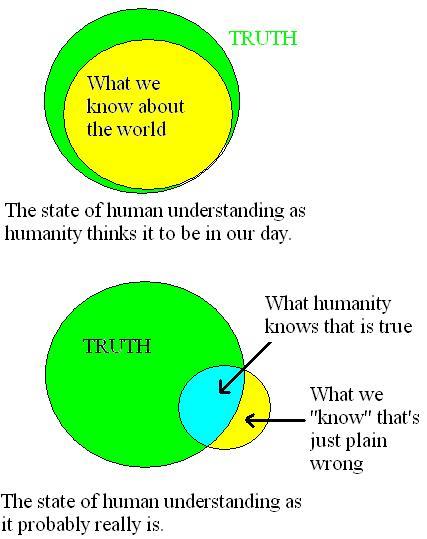
Socrates’ lesson remains valid today. It is the scourge of all ages to think that have finally attained true understanding of the world. Our posterity may know more, but we know all of the essentials and are rapidly converging on a complete picture of our world. We think our generation to be humanity’s sage elders, when, in fact, we are the impetuous teen whose growth spurt has made him cocky. I would propose to you that in all likelihood, even today, the sets of “that which is true” and “that which humanity ‘knows'” form a classic interlinking Venn Diagram. That is, some of the body of knowledge that we take to be proven true is, in fact, false. This occurs because we cannot accept that there are things we are not yet prepared to know, so we use sloppy methodology to “prove” or “disprove.” This one reason we have all these conflicting reports. E.g. coffee is good for you one week, and carcinogenic the next.
Socrates uses the method that today bears his name, i.e. the Socratic method, to challenge the arguments of Meletus, the prosecutor. The Socratic method uses questions as a device to lead the opposition to a conclusion based on premises they themselves state in the form of their answers. Socrates proposes that if it is he alone who is intentionally corrupting the youth, they would not come around–for no one prefers to be subjected to evil rather than good.
Socrates denies the suggestion that he does not believe in the gods, and in fact indicates that the very suggestion by virtue of the charges against him is a contradiction. What Socrates is guilty of is encouraging those who come around him to develop their own thoughts on god, and not to subordinate their thought to anyone–an idea the leaders found disconcerting.
Socrates goes on to say why he is unmoved by the death sentence. He wonders why it is thought he should beg and wail, when he doesn’t know for sure that an evil is being done against him.
The moral of the story is that those in power fear and will attempt to destroy advocates of free thinking.
This book should be read in conjunction with a couple other Platonic Dialogues, Crito and Phaedo.
My Humble Narcissistic Opinion on Organizations
Whenever an organization is built around an idea or set of values, that idea or set of values shrinks dwarf-like into the background. What looms large is the imperative to protect and expand the organization.
The organization is an organism, but one whose only growth governor is the attractiveness of its ideas. You think those ideas are the organization’s genes, but they aren’t. They aren’t the codes by which the organization lives. They aren’t its DNA. They are its skin. But even the loveliest beauty queen can be a gloppy, cancerous mess on the inside. No, the code that your organization lives by is the same viral code by which all organizations live.
Step 1: Preserve the organization.
Step 2: Grow the organization.
Step 3: Annihilate competitors.
Step 4: Repeat steps 1 through 3 until you’ve consumed the world.
You say that I’m not a loyal Party man. Guilty. I cannot be loyal to Party without being disloyal to my own mind. If one’s views mirror those of the Party, how likely is it that one didn’t twist one’s ledger into line? Not likely, I’d say. My thoughts are not static. They evolve. I learn. I will no more subordinate my belief s to a Party then I will chain my neck to a rock.
Your Company doesn’t make widgets, it makes Company.
You say I don’t believe in God. I see God in every leaf. I see him in the new fallen snow. I see him in the confident aerial leap of a nervous squirrel. I feel the pulse of him in my hand when it holds another hand. No, what I don’t believe in is religion. They say the problems of religion are the fault of flawed individuals. I say they have it exactly backwards. There wasn’t an evil cell in Hitler’s body, but together they formed an evil seed. Yet, one man cannot make a holocaust. Ever increasing numbers had to fall in love with a skin-deep mirage of an idea, and ignore the ugliness inside. A man can only be as evil as the world lets him, but a government? a church? Those, my friend, can consume worlds.
Our Most Beloved and Most Deadest of Presidents
Presidents live the ultimate catch-22, the only way to reliably boost their approval ratings is to shuffle off this mortal coil (i.e.become worm food.) The more decomposed a president, the more fond our remembrances of him. The worst thing that anyone ever says about a long dead president is nothing at all. When was the last time you heard a scathing character impeachment of Millard Fillmore? (I do realize that a person with the supreme narcissism needed to be president may find silence more insufferable than being called the son of a syphilitic donkey whore.)
(Quick, without looking, name a president from the 19th century other than Jefferson or Lincoln [or Fillmore]?) FYI- there were 23 or 24 of them. If you drank your entire cup of coffee before you could come up with one of the other twenty names, congratulations you are a typical American– or an exceptional non-American.
I first noticed this phenomena when watching the Reagan funeral. Everyone from all walks of life had great things to say about our 40th president on that day. However, while I was still a minor at the time, I distinctly remember half of the country loathing the man spectacularly and engaging in ad hominem attacks against him at any opportunity. Well there was one period during which no one was saying horrible things about Reagan’s character and that was during the brief period after the assassination attempt when his opponents thought he might die — at which point they went into dead presidents mode. Had Reagan passed away at the hands of John Hinckley, he would’ve achieved a level of freedom from being crapped upon usually reserved for a our first few (long decomposed) presidents.
Still, Reagan has achieved the broadly beloved status of being the Democrat’s “In-your-face President” just like Kennedy serves in that role for Republicans. An “In-your-face President” is one that political parties use to attempt to show that their current opposition is on the lunatic fringe by indicating that that iconic leader supported something vaguely, roughly approximal in a similar sort of way to what they are trying to do in the present day. These statements being followed by a silent, but understood, “IN YO’ FACE.”
I’m sure that when Carter dies, equally lovely things will be said about him — though never has a bigger train wreck of state been seen then the term of James Earl Carter. To be fair, some of the wheels that rolled off the RV-of-state were not his fault, but we give all the credit and all the blame to the president. Why do you think Clinton is always grinning like he just had sex? No, it’s not because he just had sex– though he did (the speaking circuit is like fishing with dynamite), it’s because he reigned over the big bubbly part of the bubble. When we were rich because we thought we had a lot of valuable stuff, before anyone bothered to look inside and see what we had was rotten at the core.
Admittedly, Nixon’s demise did challenge everybody’s ability to grin and say nice things. Comments were made such as, “That Checkers was a good boy, such a good boy, yes he WAS… YES he WAS. Oh yeah, and how about that China thing, that was a real work of diplomacy.” (Checkers was one of Nixon’s dogs, made famous by a Vice Presidential speech of the same name.) The word “China” was used at Nixon’s funeral more than it was used at the Chinese Conference on China in Beijing, China. Of course, there wasn’t much nice to say about Nixon. Democrats can’t even take advantage of the fact that the Environmental Protection Agency (EPA) was a Nixon Administration initiative. Nixon can’t be an “In-your-face President.” It’s too much like slapping your opponent with a bloated dead fish; you may hit them, but you’re going to get the stink on you never-the-less.
5 Minefields of Armageddon for 2013
1.) Ever heard of the Senkakus? What about Diaoyus? If not, you should look them up. When you’ve been wearing a gas mask for the 33rd day straight, you may want to know about the chunks of rock in the East China Sea that we tripped into nuclear winter over. Simmering tensions between Japan and China have been flaring up over these islands of late. So you’re probably wondering who lives there who’s so important that it’s worth wandering through a minefield that could trigger World War III. If you answered, “absolutely no one,” give yourself a prize. They’re uninhabited. It’s not the islands themselves that anyone gives a rat’s as about, it’s the ramification they have for underwater drilling rights.
The reader may accuse me of hyperbole. (Shh! Dont tell anyone, but– of course– that’s what I do.) After all, China has a boldly stated “No First Use” policy. That is, they claim they will not use nukes in a first strike. Given that Japan isn’t a nuclear weapons state (NWS), there doesn’t seem to be much risk. Except that a.) Japan lives under the U.S. nuclear umbrella; b.) Japan is the non-NWS that could develop nuclear weapons in the shortest time imaginable — they have the material, infrastructure, and technical know-how (okay, Germany is in the same bag); and c.) see #2
2.) North Korea conducted its third nuclear test. This presents a risk because: a.) it provides an incentive for Japan to build its own nukes (particularly if faith in the US umbrella wanes.) b.) [and more importantly] Kim Jong Un has too many yes-men, and no one to slap him in his chubby face and say, “are you smoking powdered unicorn horn?” In other words, he doesn’t have a good idea of what he can get away with before the world unleashes a crate of whoop-ass on his sad country. So he wanders in the minefield.
3.) Europe is getting depressed. Fat and happy Europeans are productive and polite. Downtrodden Europeans have been known to swallow some pretty despicable narratives, and– in doing so– drag the world into war. At the moment this seems really far-fetched. These political movements are at best in the political fringe of countries on Europe’s fringe, right? Maybe so. Time will tell.
4.) If America’s economy is crash-landed, everyone is going to be hit by the debris. This will be depressing, see #3 and then multiply globally. Times like these echo Churchill’s comment, “Democracy is the worst form of government, except for all those other forms that have been tried from time to time.” Any person, company, or government that sees the train coming in the distance but can’t find its way off the tracks can’t be expected to thrive for long.
5.) India and Pakistan, enough said…