BOOK REVIEW: The Romance of Reality by Bobby Azarian

The Romance of Reality: How the Universe Organizes Itself to Create Life, Consciousness, and Cosmic ComplexityThe Romance of Reality: How the Universe Organizes Itself to Create Life, Consciousness, and Cosmic Complexity by Bobby Azarian
My rating: 5 of 5 stars

Amazon.in Page

Out: June 28, 2022

This book presents a metaphysics based on the relatively new (but increasingly mainstream) sciences of complexity, chaos, and information. It boldly explores some of the major questions that consume both philosophers and scientists, such as: how life came to be, what life’s purpose is (to the degree it has one,) what consciousness is and does, and how come we live in a universe finely-tuned to generate and support life? (Particularly, if one doesn’t like explanations that are audacious and unprovable like “god did it” or “there are infinite parallel universes.”)

The book starts out in territory that is fairly uncontroversial among physicists, arguing that life comes about (and does so with striking speed – i.e. fast abiogenesis) by a process through which nature moves the ordered / useful energy that Earth has in abundance into disordered / useless energy (e.g. waste heat,) a process that runs on rules not unlike Darwinian evolution (molecules have an informational existence that allow something like hereditability [passing down of “blueprints”] and mutation [distortion in copies, some of which will make the molecule or organism more efficient at using energy.])

The book then ventures into territory that is quite controversial, arguing that life has a purpose (beyond the tedious one of moving low entropy energy into a high entropy state,) and that purpose is to be an observer – i.e. to be the first stage in a self-aware world. I should point out a couple things. First, when I say this part is controversial, I mean that it couldn’t be called the consensus view, but that’s not to say that these ideas don’t have a following among some high-level intellects. Second, I think we need people to consider ideas that might seem a bit “out there” because there is a danger of not progressing because we’re trapped in morass of assumptions. Science has quite a few self-appointed guardians who mock as pseudo-science any idea that strays from scientific consensus or from a rigidly reductionist / materialist / Copernican worldview. The author doesn’t abandon a scientific point of view, even though it might seem he does to some because he abandons the nihilistic view that’s taken as a given by many in the scientific community (i.e. that life is a happy accident without purpose, significance, or influence on the universe – and that life consists of automata, playing out programs — devoid of any kind of free will.)

I don’t know how much of Azarian’s metaphysics will prove true, but this book was superbly thought-provoking and opened up to me whole new vistas of possibility about the big questions of philosophy and science. I’d highly recommend it for readers interested in the meaning of life, the universe, and everything.

View all my reviews

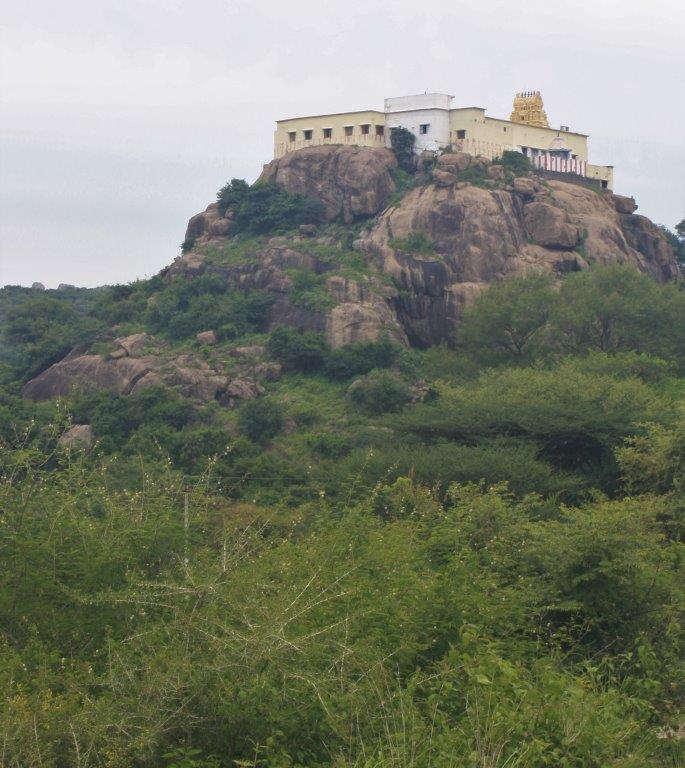
Temple on a Hill [Free Verse]

granite bubbled out of the jungle,
and - upon it - they built a temple

its walls were anchored into stone
until its walls were the hill,
and the hill was its walls

and no one could find one true point
at which one ended & the other began

was it built to be 
closer to the heavens,
or further from hell?

not by people for whom
heaven & hell
reside in the mind --
unattainable by velocity,
inescapable by distance --
constant traveling companions
only confronted head-on

maybe they wanted it to feel
permanent,
knowing even that granite
would crumble in due time

BOOK REVIEW: Awakening the Sleeping Buddha by The 12th Tai Situpa [Pema Donyo Nyinche]

Awakening the Sleeping BuddhaAwakening the Sleeping Buddha by Pema Donyo Nyinche
My rating: 5 of 5 stars

Amazon.in Page

This is a concise overview of Buddhism from the Kagyu Vajrayana [Tibetan] Buddhist perspective. It’s a straightforward, just-the-facts look at the fundamental teachings of Buddhism, and doesn’t plumb the depths of the subject, but rather offers a readable broad-brush view. And yet the author managed to state ideas in such a way as to provoke thought and offer insight.

The book is divided into eight chapters, each of which takes on a major concept from Mahayana Buddhism: Buddha nature, bodhichitta (compassion,) reincarnation / karma, emptiness, Tantric science, transformation, Enlightenment, and Mahamudra (the core meditation of the Kagyu lineage.) The organization is informed by what concepts one needs to learn to move through greater levels of refinement towards Enlightenment, with the final chapter examining Buddhist teachings as presented in the Kagyu line.

I value books on Buddhist philosophy and psychology that keep things simple and don’t overly religify the topic. This book does a good job of it, and that says something when considering the great complexity and esoteric nature of Tibetan schools of Buddhism. If you’re looking for an introductory text on Buddhism from the Vajrayana perspective, this is an excellent book to read.


View all my reviews

BOOK REVIEW: The Unreasonable Effectiveness of Mathematics in the Natural Sciences by Eugene Wigner

The Unreasonable Effectiveness of Mathematics in the Natural SciencesThe Unreasonable Effectiveness of Mathematics in the Natural Sciences by Eugene Paul Wigner
My rating: 4 of 5 stars

Available online here

This brief essay asks why math proves so effective for describing / codifying physical laws, and whether our physical theories — built on (phenomenally successful) mathematics — offer the truth, the whole truth, and nothing but the truth.

There’s a popular story in which a drunk man is found on his hands and knees under a lamppost at night when a police officer comes along. The cops says, “What-cha doin’?” To which the drunk replies, “I dropped my keys, and I’m looking for them?” So, the cop says, “Well, they’re clearly not where you’re looking, why not look elsewhere?” And the drunk says, “Cuz this is where the light is.” I think this story can help us understand what Wigner is getting on about, if only we replace the drunk’s “light” with the scientist’s “elegant mathematics.” Wigner reflects upon why it should be that so many laws of nature seem to be independent from all but a few variables (which is the only way scientists could have discovered them –historically, mathematically, and realistically speaking.) On the other hand, could it be that Physics has led itself into epistemological cul-de-sacs by chasing elegant mathematics?

There’s no doubt that (for whatever the reason turns out to be) mathematics has been tremendously successful in facilitating the construction of theories that make predictions that can be tested with high levels of accuracy. However, that doesn’t mean that some of those theories won’t prove to be mirages.

A few of the examples used in this paper are somewhat esoteric and won’t be readily understood by the average (non-expert) reader. That said, Wigner puts his basic arguments and questions in reasonably clear (if academic) language. The essay is definitely worth reading for its thought-provoking insights.


View all my reviews

BOOK REVIEW: Sadhus by Patrick Levy

Sadhus: Going Beyond the DreadlocksSadhus: Going Beyond the Dreadlocks by Patrick Levy
My rating: 5 of 5 stars

Amazon.in Page

I got to the last couple chapters before I realized that this was a novel, and not a work of immersion journalism. I don’t mean to suggest that it wasn’t as compelling as I’d wish a work of fiction to be. On the contrary, it’s a fascinating look into a group of people (Sadhus / renunciants) who are little understood because they exist on the edges of society and can appear strange – if not a little scary – in their countercultural existence. The book reads like an authentic account of the Sadhu experience of a Frenchman who gives up his money and all but a few meager possessions to become a wandering ascetic under the tutelage a philosophically compatible Baba. (Until the fever dream ending instills a bit of surrealism and fourth-wall breaking.) The fact that the lead is demographically and a philosophically like the author, heightens the tendency to believe it’s nonfiction. [It’s quite possibly fictionalized autobiography to some degree, but I couldn’t say to what extent.]

Besides telling a story centered on a wandering Western ascetic in Northern India, the book does double duty in reflecting upon Hindu-Yogic-Tantric philosophy, particularly with respect to metaphysics. The lead character is neither religious nor a believer in the supernatural. Rather, he is (like many of us) in search of an almost defunct variety of a philosophy, the kind practiced by Socrates and some historic and present-day Buddhists, a variety that’s open to questioning and challenging all beliefs and assumptions as the means to better understand one’s world, a variety that recognizes the ubiquity of ignorance with respect to key questions of metaphysics. The story includes a number of Socratic method style conversations, as well as quotes from texts such as the “Avadhuta Gita” and “Ashtavakra Gita.”

I found this story to be compelling and informative, shining a light on a rarely-seen side of India.

View all my reviews

Future Imperfect [Free Verse]

skyscrapers rise & fall
storms hit & wither
waves crash & recede

nature neither blesses nor curses,
despite the constant counting 
of its boons & banes; 
its bonanzas & broken bones

one who can feel grateful 
in the face 
of ignorance & imperfection
is free 

one who feels suffering 
in the absence of perfect comfort
will never know freedom 

such a one as that 
imprisons himself
in a cycle of imagining 
& coveting 
a perfection that has 
never existed  

Self-Aware World [Free Verse]

I am a witness 
for a self-aware world,

a world that's not just 
chunks of matter,
but an organism that dances
 matter into 
an entity that can know.

It can know truth
and fiction 
and the truth of fiction
and the fiction of truth.

It turns order into disorder,
but with knowledge salad
on the side.

I'm a compartmentalized agent
 of a super-organism that is 
beyond my capacity
to understand
or speculate the purpose of.

I am a lonely witness.

BOOK REVIEW: Ashtavakra Gita Trans. by Bart Marshall

Ashtavakra Gita: (bootleg version)Ashtavakra Gita: by Bart Marshall
My rating: 4 of 5 stars

Amazon.in Page

There are many translations of this Hindu classic of Advaita Vedanda, a non-dualist school that teaches the oneness of all things and the illusory nature of the universe that we think we know. “The Song of Ashtavakra” explores self-realization and the path to liberation (i.e. Moksha.) [Ashtavakra was a sage with birth defects from which the name “8 angles” derives. Yoga practitioners will know the name from an arm balance pose that involves balancing the kinked body on bent arms in a manner that was apparently reminiscent of the look of this sage’s body.]

The translation that I read, one by Bart Marshall, is clearly written in readily understandable language. It’s presented as a series of short-form poems arranged into twenty chapters that also form a dialogue between Ashtavakra and Janaka. This version doesn’t contain commentary and analysis as some translations do. Because it’s both highly readable and inexpensively acquired, I’d recommend one give it a chance. If you later decide you’d benefit from commentary, you’ll not be at a loss by having read this version first.

As is common enough in such tracts, the book can be repetitive as it reiterates ideas like the need to avoid desire and aversion and the nature of oneness. That said, there were some quite powerful statements that genuinely expanded on the ideas of the work. (e.g. 18.100: “One of tranquil mind // seeks neither crowds nor wilderness. // He is the same wherever he goes.” Or 3.12 “Why should a person of steady mind, who sees the nothingness of objects, prefer one thing over another?”)

If you’re a student of philosophy or of yoga as a philosophy, I think this is well worth a thoughtful read.


View all my reviews

Enlightenment in Four Bits of Shakespearean Wisdom

If you’re looking to attain Enlightenment, you may have turned to someone like the Buddha or Epictetus for inspiration. But I’m here to tell you, if you can put these four pieces of Shakespearean wisdom into practice, you’ll have all you need to uplift your mind.

There is nothing either good or bad, but thinking makes it so.

william Shakespeare, Hamlet

Through Yoga, practitioners learn to cultivate their inner “dispassionate witness.” In our daily lives, we’re constantly attaching value judgements and labels to everything with which we come into contact (not to mention the things that we merely imagine.) As a result, we tend to see the world not as it is, but in an illusory form.

The fault, dear Brutus, is not in our stars, but in ourselves.

William shakespeare, julius caesar

In Psychology class, you may remember learning about the self-serving bias, a warped way of seeing the world in which one attributes difficulties and failures to external factors, while attributing successes and other positive outcomes to one’s own winning characteristics. Like Brutus, we need to learn to stop thinking of our experience of life as the sum of external events foisted upon us, and to realize that our experience is rooted in our minds and how we perceive and react to events.

The fool doth think he is wise, but the wise man knows himself to be a fool.

william shakespeare, as you like it

A quote from Hamlet also conveys the idea, “There are more things in heaven and earth, Horatio, than are dreamt of in your philosophy.” If you grasp this idea, you may become both humbler and more readily capable of discarding bad ideas in favor of good. It’s common to want to think of yourself as a master, but this leads only to arrogance and to being overly attached to ineffective ideas. Be like Socrates.

Cowards die many times before their deaths; The valiant never taste of death but once.

william shakespeare, julius caesar

Fears and anxieties lead people into lopsided calculations in which a risky decision is rated all downside. Those who see the world this way may end up living a milquetoast existence that’s loaded with regrets. No one is saying one should ignore all risks and always throw caution to the wind, but our emotions make better servants than masters. One needs to realize that giving into one’s anxieties has a cost, and that that cost should be weighed against what one will get out of an experience.

There it is: Enlightenment in four bits of Shakespearean wisdom.

Slant [Free Verse]

They told it slant,
but not all the truth,
and it rolled into the ears
of the willing
and into the minds
of the faithful.

And in those minds
it was built into 
a swift machine,
one of great power -- 
if little reality.

But deaths never required
reality of motive,
only 
reality of matter.

So, the wild stories
became wild ideas
that were the bane
of us all.