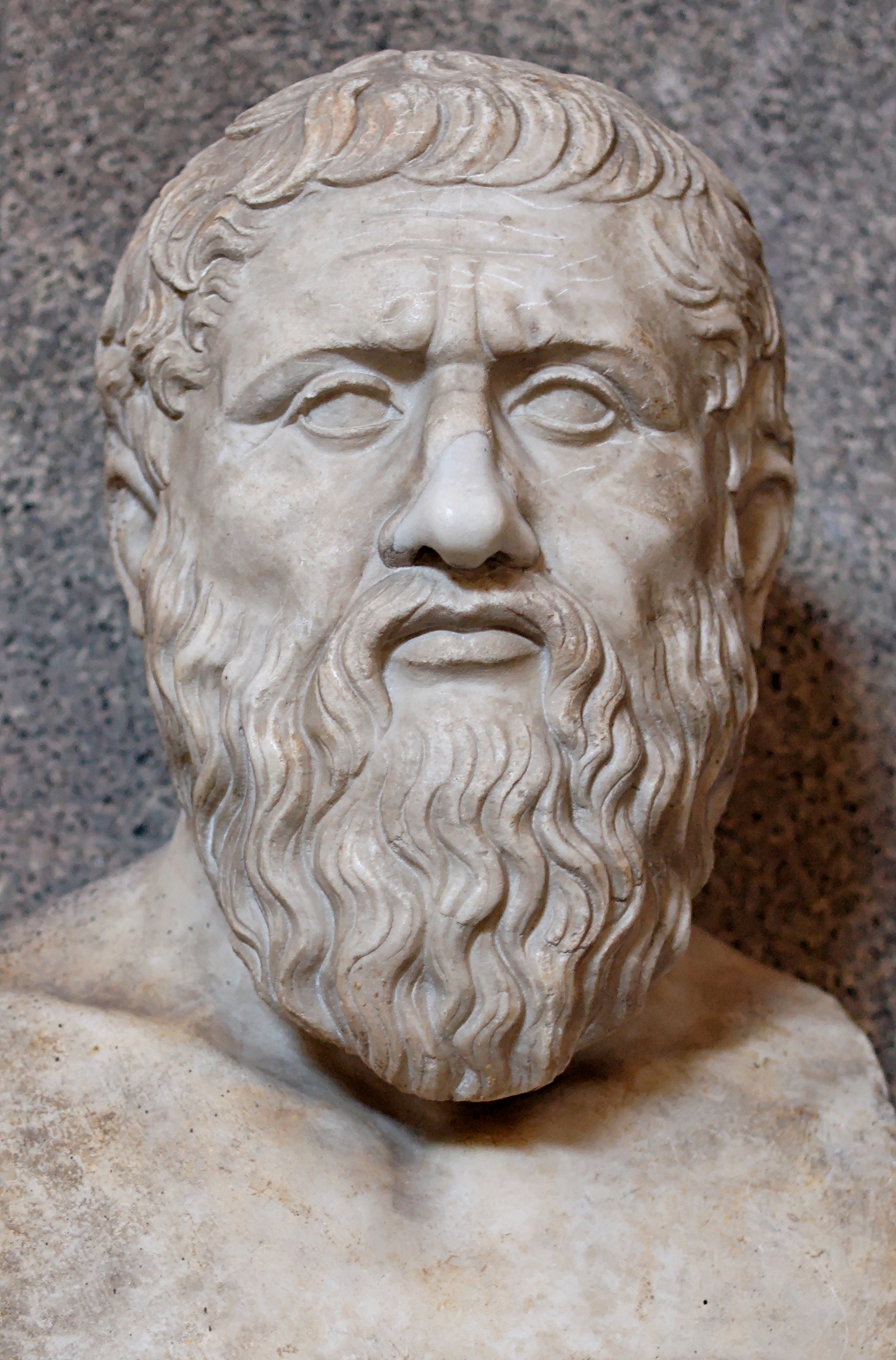
INTRODUCTION: The Republic is the most read and discussed of the Socratic dialogues written by Plato, and for good reason. It offers some intriguing ideas that have influenced philosophy, politics, religion, and even science fiction to this day. That said, the book isn’t without its stinkers, and many people have reasonably asked whether a state or nation employing all of Plato’s guidance wouldn’t be more dystopian than utopian. To avoid the error committed by many religious people regarding scriptures (and probably by a few scholars regarding Plato’s work,) we shouldn’t ignore the parts that are — let’s say…, complete lunacy, and also shouldn’t contort language and reason to make the questionable ideas palatable. With that in mind, we’ll start with a couple of The Republic‘s banana ideas before examining a few that have stood the test of time.
PLATO’S WAR AGAINST POETRY & THE ARTS: In The Republic, Plato goes on a tirade against the arts on the basis that they aren’t truthful and that they encourage readers and viewers to behave from the lesser elements of their “soul” – the emotional and desirous bits. Plato’s condemnation of art is informed by two of his major teachings. First, the “tripartite soul” in which reason is king and emotion and desire are lesser elements of humanity that should be checked by reason. Ergo, he doesn’t like that reading Homer makes people weepy or riled up. Second, in Plato’s conception of forms, for any given thing under the sun there’s an ideal form that was made once by god, then there are actual items made by craftspeople, and then there are the imitations made by artists. In Plato’s mind, this leads to a warped situation in which the craftsmen stray from the ideal by copying what artists presented, rather than seeking the divine ideal, and Plato is all about the pursuit of the ideal.
Plato would grant artists the opportunity to prove that their works are of service to the state, but barring their demonstration that the art advances reason and is truthful it would be outlawed. To me, it sounds a lot like the Soviet Union where art was mostly jingoistic pieces that encouraged a Stakhanovite effort. At any rate, I’ve got to give this one to Aristotle who saw the cathartic value of art and poetry. There is value in the existence of a wide variety of modes of expression and ways of thinking about the world. It allows us to break new ground. I was just reading a book by Yeats in which he wrote: “Everything exists, everything is true, and the earth is only a little dust under our feet.” This may not seem like sound thinking in our rational age, but I like that such a counterweight exists.
THE SHARING OF WIVES & CHILDREN BY THE RULING CLASS: Plato’s Republic would be ruled by a philosopher-king, and it requires the ruling class to be specially educated and controlled to avoid pursuit of wealth and comfort. One such control is that the aristocrats can only have kids (unaborted ones, at least) under certain conditions, but the children wouldn’t know who their biological parents were.
Plato is no fan of democracy. In fact, democracy is the stage right before tyranny in Plato’s model of political devolution. [It starts with Plato’s ideal, Aristocracy, which devolves into Timocracy with the declining character of leaders (because they’re not well-trained philosophers.) Timocracy devolves into Oligarchy as the lesser quality ruling class becomes obsessed with wealth. This leads to Democracy because people get fed up with the oligarchs having all the money and they revolt. But since anyone can become leader, a tyrannical type will eventually rise to the top and use an iron-hand to maintain power.]
There’s a reason why, to my knowledge, this approach has never been tried, despite the immense popularity of Plato and The Republic. It relates to a previously mentioned point as it pertains to Plato’s ineptitude with regards to human psychology. Plato [like several other philosophers of the ancient world] believes one can kill emotion and desire through the power of pure reason. Reason maybe our smartest mental activity, but it’s neither fastest nor particularly capable of steering the ship. At any rate, this joint parentage scheme makes me think of the Harry Harlow experiments in which baby monkeys were put either with a wire mesh or cloth-covered “mother surrogate.” We’ve learned a lot about how psychopaths are made since the days of Plato. I think Plato’s guardian class would be chock-full of lunatics.
THE SUPREME IMPORTANCE OF GEOMETRY: I love a triangle as much as the next fellow, but I think Plato may have gone a little overboard with his views about the transcendent value of geometry.
WHAT PLATO GOT RIGHT: There are definitely ideas in The Republic that continue to contribute to humanity’s understanding of itself and the world. Here are a few good reasons to read The Republic — despite all that junk mentioned above.
THE ALLEGORY OF THE CAVE: Because of sci-fi works such as The Matrix, this is probably the most widely cited bit of The Republic. However, it’s not just a fictional or hypothetical idea anymore. One will also see references to Plato’s cave in nonfiction works of neuroscience and physics that deal with how our perceived world doesn’t equate to the objectively real world. Plato offers a very clear thought experiment in Book VII.
PLATO’S GENDER PROGRESSIVISM: In The Republic, Plato argues that women can be guardians of the state as well as men, and that women must receive the same education in order to do so. Lest the feminist jump all-in on Plato, it should be noted that he maintained some pretty misogynist / patriarchal views (e.g. women being like children,) as well as some bizarre ones (e.g. the wandering womb hypothesis.) However, in at least that one regard, Plato was ahead of his time.
KNOWLEDGE ACQUIRED UNDER COMPULSION OBTAINS NO HOLD: Given that Plato’s Republic would feature some harsh limitations of individual freedom, from lack of artistic expression to inability to know one’s own mom, it’s nice to see that he held some freedom-loving views, as well.
COURAGE IS STAYING SPIRITED IN ONE’S DECISIONS IN THE FACE OF PLEASURE OR PAIN: Much of The Republic is an attempt to define and distinguish the cardinal virtue of justice. In fact, in many Socratic dialogues, the primary objective is to understand virtues, and they’re often discussed at length, not always resulting in a firm conclusion. I like the definition of courage provided in The Republic. One makes a decision based on the virtuous path, and sticks with it even when pleasure or pain might divert one.
THE TENDENCY TOWARD DIMINISHING EFFECTIVENESS IN POLITICS: While I share neither Plato’s enthusiasm for aristocracy nor his pessimism about democracy (there’s a reason the world has abandoned the former in preference for the latter,) I do think there’s a potential grain of truth in his model of political devolution that’s mentioned in Books VIII & IX. I think there can be a proclivity towards weaker and less effective leaders over time under certain systems of governance. One can see this in the Soviet Union, and arguably in North Korea. It seems possible that there are systemic causes for devolution of political effectiveness, at least under certain approaches to governance. (I’d argue this is one of the reasons that democracy is best, because it can fully overturn the apple cart of governance rather than struggling with whatever continuity issues contribute to declining effectiveness.)
READ THE REPUBLIC, both for its great and for its dystopian ideas, because even when it’s bad, it’s stimulating.
Share on Facebook, Twitter, Email, etc.