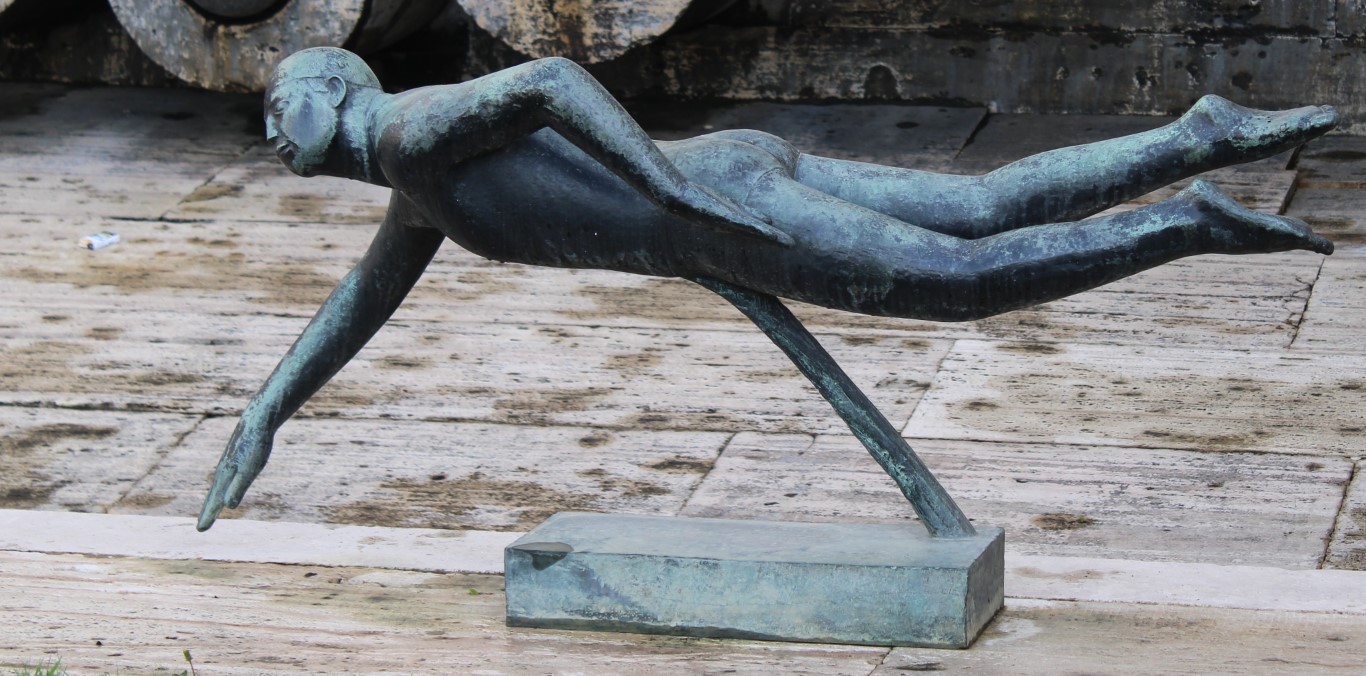
Swim through the world
- effortlessly -
Don't crave speed;
Maximize the glide.
With each stroke,
Sail as far as the limbs
will send one.
Don't thrash. Don't splash.
Don't gasp.
Feel the catch. Feel the pull.
Don't let short, wild motions
exhaust one.
Breathe!
Be wary of drag.
Put less effort
into propulsion,
And more into streamlining --
Shoot through the void,
without struggle.
Never lose sight of the value
of a good glide.
Tag Archives: Philosophy
PROMPT: Complain
People. They’re the worst. Or, possibly, technology. It’s a close runner up, at least. Of course, on some level, it’s all one shitstorm. Humans are the technological animal, and technology facilitates the making of comfort junkies who avoid deep thought at all costs. (Which is at the core of my beef.)
BOOKS: “Original Tao” by Harold D. Roth
Original Tao: Inward Training (Nei-yeh) and the Foundations of Taoist Mysticism by Harold D. RothMy rating: 5 of 5 stars
Publisher site – Columbia University Press
This book is built around a translation of an old Taoist manual called “Inward Training” (i.e. 内业,) and the book serves not only to elaborate the meaning of the twenty-six poems that make up the manual, but also to put this work in a context with respect to its place in early Taoist mysticism — which raises further questions as to what constitutes early Taoism and early Taoist mysticism. (Just as the earliest followers of Jesus didn’t think of themselves as “Christians” – at least not as we understand that term – it’s an open question as to when people started to think of themselves as Taoists and how that start relates to when people began holding a set of proto-beliefs that formed the basis of the school(s) of philosophy.)
“Inward Training” presents breathwork and meditational exercises that Roth calls “inner cultivation” — or what some have called “inner alchemy.” The book does contain the entire manual both in Traditional Chinese and an English translation, as well as a much more extensive elaboration of the teachings of the manual. The latter is necessary because, like many old manuals, sparse description, archaic language, and assumptions about common knowledge du jour make it difficult for the layman to get any depth of understanding from the manual, itself.
This is a scholarly work, which means that its readability isn’t the highest and it does dive into matters that will be arcana for non-expert readers. That said, particularly as works of academic philosophy go, its readability isn’t bad. The book is heavily annotated and offers and extensive bibliography.
If you are interested in Taoist practices of breath, meditation, and alignment, this book is well worth investigating.
View all my reviews
Evolution [Free Verse]
BOOKS: “Confucianism: A Very Short Introduction” by Daniel K. Gardner
Confucianism: A Very Short Introduction by Daniel K. GardnerMy rating: 5 of 5 stars
Publisher Site – OUP
This is a brief guide to Confucianism from the early life of Confucius (孔子 -Kǒngzǐ) to the ups and downs the philosophy experienced in the twentieth century. It has chapters exploring the system’s thinking with respect to personal development as well as with respect to governance and also discusses how later thinkers (most notably Mencius and Xunzi) expanded on Confucius’s ideas — but also created schisms. The book examines the laudable elements of the philosophy such as its sanction of benevolence among leaders, but also its less laudable elements such as its unenlightened views on women and what they are capable of [and, of course, the many ideas in between that could be seen in varied lights.)
As with other books in this series, it has a few graphics as well as a bibliography and further reading section.
I found this book to be readable, well-organized, and of a level appropriate for its intended purpose. I’d highly recommend it for individuals looking for a concise introduction to Confucianism.
View all my reviews
“Song of the Open Road” (15 of 15) by Walt Whitman [w/ Audio]
Allons! the road is before us!
It is safe -- I have tried it -- my own feet have
tried it well -- be not detain'd!
Let the paper remain on the desk unwritten,
and the book on the shelf unopen'd!
Let the tools remain in the workshop! let
the money remain unearn'd!
Let the school stand! mind not the cry of
the teacher!
Let the preacher preach in his pulpit! let the
lawyer plead in the court, and the judge
expound the law.
Camerado, I give you my hand!
I give you my love more precious than
money,
I give you myself before preaching or law;
Will you give me yourself? will you come
travel with me?
Shall we stick by each other as long as we
live?
PROMPT: Favorite Animal
I’m not sure whether the intention is to determine one’s favorite species of animal or one’s favorite particular individual animal. I’ll presume the former as the latter would turn it into a “Which of your pets (or children — for those who count humans among the animal kingdom) do you love best?” type of question — which is awkward to ask anyone with whom one is not on intimate terms.
At any rate, I’ve come to think of assigning favorites as a bad habit of lazy minds, intended to negate the need to actively observe and to see the beauty and brilliance of whatever stands before one at any given moment. [It’s part of a vast array of patterns people develop to be as cognitively disengaged as can be managed.] So, I don’t have a favorite species of animal, but aardvark does come first in the dictionary, if not in my heart.
[Incidentally, when I had multiple pets, I did have a favorite, and — perhaps tellingly — it was the one whose personality was least like my own.]
“Song of the Open Road” (14 of 15) by Walt Whitman [w/ Audio]
Allons! through struggles and wars!
The goal that was named cannot be
countermanded.
Have the past struggles succeeded?
What has succeeded? yourself? your nation?
Nature?
Now understand me well -- it is provided in
the essence of things that from any
fruition of success, no matter what, shall
come forth something to make a greater
struggle necessary.
My call is the call of battle, I nourish active
rebellion,
He going with me must go well arm'd,
He going with me goes often with spare
diet, poverty, angry enemies, desertions.
BOOKS: 三字经 by 王应麟 [“Three Character Classic” by Wang Yinglin]
三字经 by 章炳麟My rating: 5 of 5 stars
Available online — Project Gutenberg
This is a Confucian primer written in lines of three characters. It’s a children’s book in the sense that it’s aimed at children, but not necessarily with respect to being presented in a manner most conducive to childhood learning. (While it’s concise, the material isn’t presented in an interesting or memorable form. i.e. It’s intended for brute force rote memorization.)
The book consists of five sections, ranging between twenty-four and one hundred and six lines (72 to 318 characters per chapter.) The first introduces Confucian virtues. The second offers a broad overview of classics of Chinese philosophy. The third section lists the dynasties of China. The penultimate section describes ideal behavior from a Confucian perspective. The last, and briefest, section is largely a pep talk on studying hard.
As someone learning Mandarin Chinese, it’s interesting to see how sentences are formed in this sparse format, and this text offers insight into Chinese history and philosophy, in addition to providing a good early reader.
If you are interested in learning elementary Confucianism or you’re learning Chinese and looking for short and simple texts for reading, I’d recommend one look into the Three Character Classic.
View all my reviews
“Song of the Open Road” (13 of 15) by Walt Whitman [w/ Audio]
Allons! to that which is endless as it was
beginningless,
To undergo much, tramps for days, rests of
nights,
To merge all in the travel they tend to, and
the days and nights they tend to,
Again to merge them in the start of superior
journeys,
To see nothing anywhere but what you may
reach it and pass it,
To conceive no time, however distant, but
what you may reach it and pass it,
To look up or down no road but it stretches
and waits for you, however long but it
stretches and waits for you,
To see no being, not God's or any, but you
also go thither,
To see no possession but you may possess it,
enjoying all without labor or purchase,
abstracting the feast yet no abstracting
one particle of it,
To take the best of the farmer's farm and the
rich man's elegant villa, and the chaste
blessings of the well-married couple, and
the fruits of orchards and flowers of
gardens,
To take to your use out of the compact
cities as you pass through,
To carry buildings and streets with you
afterward wherever you go,
To gather the minds of men out of their
brains as you encounter them, to gather
the love out of their hearts,
To take your lovers on the road with you,
for all that you leave them behind you,
To know the universe itself as a road, as
many roads, as roads for traveling souls.
All parts away for the progress of souls,
All religion, all solid things, arts,
governments -- all that was or is apparent
upon this globe or any globe, falls into
niches and corners before the procession
of souls along the grand roads of the
universe.
Of the progress of the souls of men and
women along the grand roads of the
universe, all other progress is the needed
emblem and sustenance.
Forever alive, forever forward,
Stately, solemn, sad, withdrawn, baffled,
mad, turbulent, feeble, dissatisfied,
Desperate, proud, fond, sick, accepted by
men, rejected by men,
They go! they go! I know that they go, but I
know not where they go,
But I know that they go toward the best --
toward something great.
Whoever you are, come forth! or man or
woman come forth!
You must not stay sleeping and dallying
there in the house, though you built it, or
though it has been built for you.
Out of the dark confinement! out from
behind the screen!
It is useless to protest, I know all and expose
it.
Behold through you as bad as the rest,
Through the laughter, dancing, dining,
supping, of people,
Inside of dresses and ornaments, inside of
those wash'd and trimm'd faces,
Behold a secret silent loathing and despair.
No husband, no wife, no friend, trusted to
hear the confession,
Another self, a duplicate of every one,
skulking and hiding it goes,
Formless and wordless through the streets of
the cities, polite and bland in the parlors,
In the cars of railroads, in steamboats, in the
public assembly,
Home to the houses of men and women, at
the table, in the bedroom, everywhere,
Smartly attired, countenance smiling, form
upright, death under the breast-bones,
hell under the skull-bones,
Under the broadcloth and gloves, under the
ribbons and artificial flowers,
Keeping fair with the customs, speaking not
a syllable of itself,
Speaking of any thing else but never of
itself.