FIVE WISE LINES [December 2025]

William Blake painting of Urizen praying to the world he created, an illustration from "Song of Los."
William Blake:
Urizen prays to the world he created (1795)
Song of Los

I must create a system
or be enslaved by another man’s…

william blake; Jerusalem: The emanation of the great albion

Saying Yoga exists to make one more flexible
is like saying that it exists to wring farts out of one’s body,
both will happen — neither is the primary objective.

Me

He that is without sin among you,
let him first cast a stone at her…

JESUS; John 8:7

The best government is that which governs least.

Henry david thoreau, Civil Disobedience

Gods always behave like the people who make them…

zora neale hurston; Tell my horse

FIVE WISE LINES [November 2025]

Taken at Fo Guang Shan, near Kaohsiung in Southern Taiwan.

A thing is mighty big when time
and distance cannot shrink it.

Zora Neale hurston; Tell my horse

…if you want to be elected, it is better
to be Mean than to be Funny.

hunter s. thompson; Better than sex

And whosoever shall compel thee to go a mile,
go with him twain.

jesus; Matthew 5:38-40

The only gamblers who will talk openly
are the ones who don’t make money.
The successful ones keep their mouths shut.

Kit chellel; lucky devils

To live a creative life,
we must lose our fear of being wrong.

joseph chilton pearce

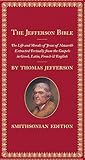
BOOK: “The Jefferson Bible” by Thomas Jefferson

The Jefferson Bible: The Life and Morals of Jesus of NazarethThe Jefferson Bible: The Life and Morals of Jesus of Nazareth by Thomas Jefferson
My rating: 5 of 5 stars

PDF available online [Public Domain]

Thomas Jefferson (yes, the same one who wrote the Declaration of Independence) produced this book by cutting and pasting excerpts from the Gospels so as to produce a distillation of who he believed Jesus was and what Jesus’s essential teachings were. It mixes parables and other New Testament teachings with biographical description.

There is an introduction which offers the reader more specific insight into Jefferson’s thinking than can be gleaned merely from what he includes and what he trims. The Introduction also discusses the similarities and differences between Christian philosophy and that of the Jews, the Greeks, and the Romans.

If you’re looking for a condensed version of the New Testament, I’d highly recommend this book. Jefferson was obviously a sharp guy who looked at the Bible from the perspective of Enlightenment-era thinking.

View all my reviews

“The Lamb” by William Blake [w/ Audio]

Little Lamb who made thee
Dost thou know who made thee
Gave thee life & bid thee feed.
By the stream & o'er the mead;
Gave thee clothing of delight,
Softest clothing wooly bright;
Gave thee such a tender voice,
Making all the vales rejoice!
Little Lamb who made thee
Dost thou know who made thee

Little Lamb I'll tell thee,
Little Lamb I'll tell thee!
He is called by thy name,
For he calls himself a Lamb:
He is meek & he is mild,
He became a little child:
I a child & thou a lamb,
We are called by his name.
Little Lamb God bless thee.

Self Portrait [Common Meter]

So many historic figures 
 whose look we think we know.
  Did Jesus of Nazareth sport
   hippie hair & a halo?

Perhaps, he did have quite long hair
 but not the tawny blonde
  of which so many "portraitists"
   seemed to be quite fond.

The Shakespeare that we recognize 
 is drawn from memory.
  Kings oft declared true depiction
   a form of treachery. 

Past commoners' appearances 
 are lost in bygone days.
  We know Van Gogh from a mad mind,
    and know him thirty ways. 

Do you know whose look we do know?
 Every teen now alive.
  There're pics from every angle
   stored on redundant drives. 

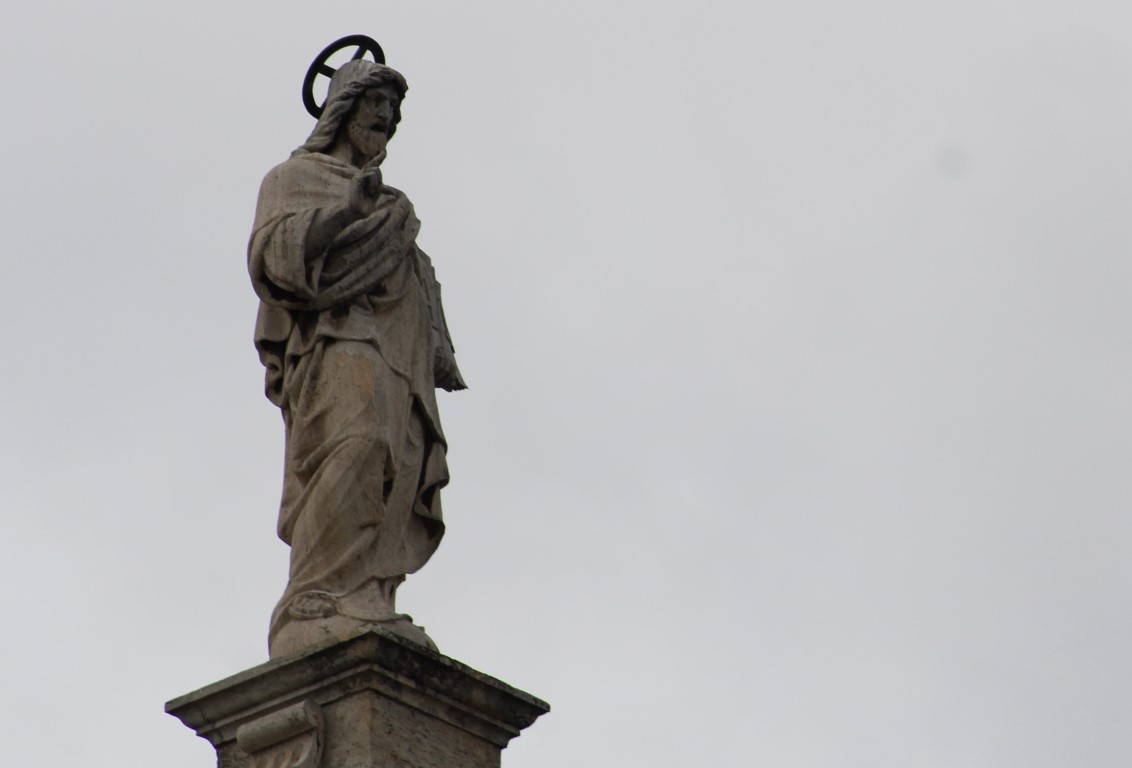
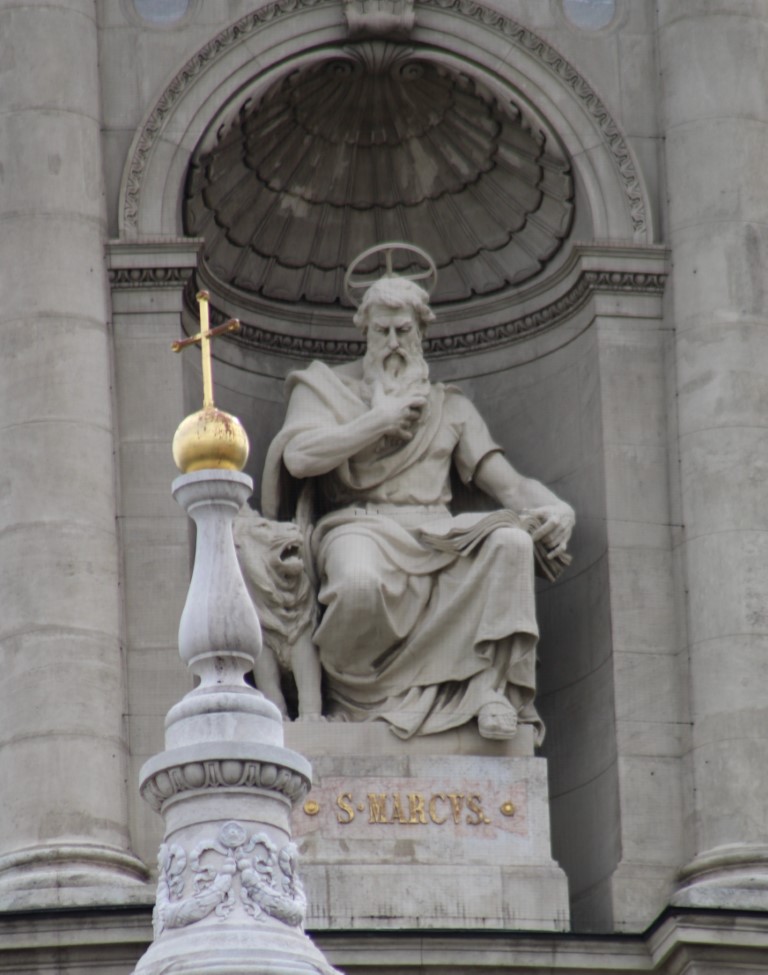
DAILY PHOTO: Statues of St. Stephen’s Basilica

BOOK REVIEW: Jesus: A Very Short Introduction by Richard Bauckham

Jesus: A Very Short IntroductionJesus: A Very Short Introduction by Richard Bauckham
My rating: 4 of 5 stars

Amazon.in Page

This book explores the life of Jesus, the historical context of that life, his approach to teaching, the nature of his identity, the story of his death, and concludes with the origins of Christianity. The book rests on a couple of controversial ideas, the most influential of which is that the four gospels of the New Testament are valid historical sources and that they’re more useful than competing sources (e.g. the Gnostic Gospels.) Rather than asking the reader to take this as a given, Bauckham does present his argument in the second chapter.

I found this book to be intriguing and worth reading – surprisingly, once I realized it was written by a theologian, and not a Religious Studies scholar or historian. (Theologians have skin in the game of religious teachings, whereas Religious Studies scholars and historians are expected to be more objective with regards to religious claims.) It’s telling that I didn’t realize Bauckham was a theologian right away; he does generally present the material with the dispassionate objectivity of a scholar. However, eventually, he slips into the proclivities of a theologian, such as the stance that in the absence of strong evidence either way one might as well accept the truth of religious teachings. Also, he gives Jesus a free ride on shady behavior (as when Jesus compares a Gentile to a dog – which Bauckham calls “almost rudely negative” before rationalizing away said negativity.)

For me, the discussion of Jesus’s teaching style (Ch.5) was the book’s strongpoint. That chapter shows the reader how Jesus became such a big deal. Believer or not, one will come away impressed with Jesus as a teacher.

If one is looking for a book that considers the gamut of views about Jesus, this isn’t the book you’re looking for – e.g. Chapter 6 on Jesus’s identity doesn’t give time to the view that he was just a smooth-talking preacher whose followers likely absconded with his body – let alone that he was a fiction. That said, there is a great deal of interest in the book, and I found it well worth reading.

View all my reviews

BOOK REVIEW: The Good Man Jesus and the Scoundrel Christ by Philip Pullman

The Good Man Jesus and the Scoundrel ChristThe Good Man Jesus and the Scoundrel Christ by Philip Pullman
My rating: 5 of 5 stars

Amazon.in Page

Pullman tells the story of Jesus’s life from manger birth to the birth of the religion that flowed from Jesus’s crucifixion, with two major deviations from the gospel accounts. First, in this book, Mary gave birth to twins: one healthy, disciplined, and charismatic [Jesus] and one stunted, bookish, and with grand designs [Christ.] Second, the book tells the story in a way which requires no miracles or magic.

The reason for complicating the story with twins is to be able to split apart two confounding entities. Jesus represents the traveling preacher that most people find appealing and admirable. He’s compassionate, non-judgmental, simple (in the sense of eschewing wealth and glory,) and is a great storyteller. Christ represents the path that Christianity would come follow — one of billionaire evangelists, manipulative missionaries, and the Spanish inquisition – as well as, less intentionally, the Crusades, witch hunts, and pedophilic priests. That said, “scoundrel” status is only realized at the story’s end when Christ plays the Biblical role of Judas. Even then, Christ is conflicted and thinks he’s acting in accord with the directions of an angel.

While most of the events described will be familiar (in some form) to those acquainted with the New Testament stories, there’s an ongoing sub-plot between Christ and “the stranger,” a mysterious character who has an interest in seeing Christianity blossom, if in its imperfect form.

This book is part of a series on mythology called the Canongate Myth Series that features numerous renowned authors.

I found this take on Jesus’s story to be compelling and thought-provoking. I’d highly recommend it, except for those who take their Bible stories very literally and get riled by such writings.

View all my reviews

BOOK REVIEW: Introducing Jesus: A Graphic Guide by Anthony O’Hear

Introducing Jesus: A Graphic Guide (Introducing...)Introducing Jesus: A Graphic Guide by Anthony O’Hear
My rating: 4 of 5 stars

Amazon.in Page

This book offers concise answers to some of the key questions that circle about the life of Jesus and the religion spawned by his existence. It tells the reader what is known about the life of Jesus, providing insight into what life events are well supported and which are only described in accounts written long after the fact (e.g. the gospels.) It describes which factions believed Jesus was a god and which didn’t. It describes opposing views of what Jesus was (i.e. if he wasn’t just a run-of-the-mill human being, was he wearing a human suit or was he some sort of divine hologram.) A lot of the book is more about Christianity than Jesus, proper, exploring how the religion came into existence, how it changed, why it became schismatic, and how it was influenced by other domains of human activity (e.g. governance and philosophy.)

As the subtitle suggest, the book uses graphics throughout – primarily drawings and monochrome artworks depicting Jesus, events from his life, and other characters in his story (e.g. apostles, disciples, and such.) Besides graphics, the only ancillary matter is a “Further Reading” section that discusses Bible versions and scholarly works on Christianity and the life of Jesus.

I found this book to be concise, interesting, and informative. If you’re looking for an outline of Jesus’s life that offers insight into the evolution of Christianity from a non-theological point of view (i.e. having no dog in the fight of whether Jesus was a god) you may want to give this guide a look.

View all my reviews